
Your friend hasn't texted back. Your brain says "they're mad at me." You feel sick, so you avoid them, and the worry grows. Cognitive behavioral therapy (CBT) is built to catch loops like that.

What CBT is
The NHS describes CBT as a talking therapy where a therapist helps you change how you think and act. The Beck Institute calls it structured and present-focused, based on psychiatrist Aaron T. Beck's idea that the way you see a situation shapes your reaction more than the situation itself.
If you want the theory behind it, see our page on cognitive behavioral theory. This page is about what the therapy is like.

What it helps with
According to the NHS, CBT is a recommended treatment for depression, anxiety (including social anxiety, phobias and OCD), PTSD, eating disorders and more. It can also help with insomnia, long-term pain and IBS.
What a session looks like
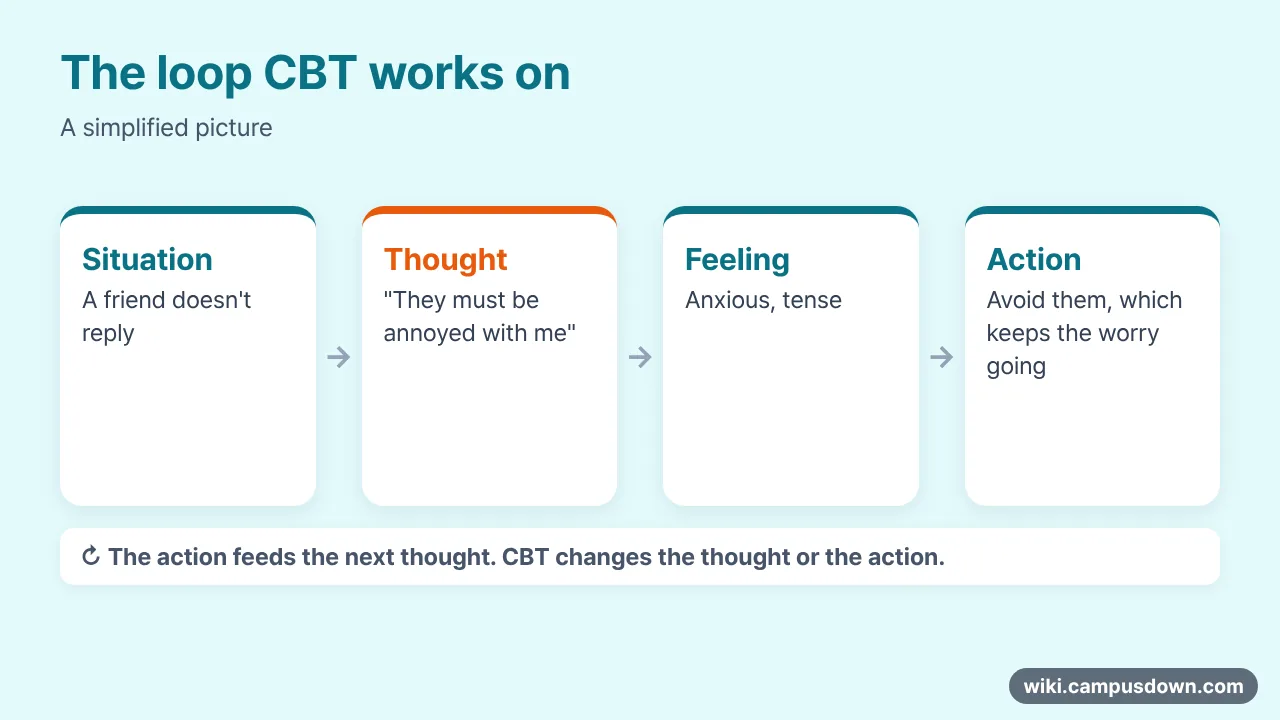
You talk about situations you find hard and how they make you think, feel and act. Then you work out different approaches with your therapist. That can mean questioning unhelpful thoughts, noticing feelings without reacting, or slowly doing things you've been avoiding.
You'll usually practise between sessions, sometimes with a worksheet or diary. The NHS says that practice matters for CBT to work. Most people have about 5 to 15 sessions, one to one, in a group, or as guided self-help, in person, online or by phone.
If you're in crisis, contact local emergency services or a crisis line right away. CBT is for ongoing support, not emergencies.
FAQ
- How long does CBT take?
- The NHS says usually about 5 to 15 sessions, depending on the problem.
- Is CBT only for depression?
- No. It's used for anxiety, PTSD, OCD, eating disorders, insomnia and more.
- Can CBT be done online?
- Yes. It can be in person, online or by phone, and as guided self-help.
Sources reviewed: 2026-11-20
References
- NHS. Cognitive behavioural therapy (CBT). What CBT treats, formats, usually 5 to 15 sessions, what sessions involve, practice between sessions.
- Beck Institute. Understanding CBT. Structured, present-oriented therapy based on Aaron T. Beck's cognitive model.