
You've probably heard "CRT" in the news, often in arguments that seem to be about very different things. So what is critical race theory, in the academic sense?

The basic idea
Britannica describes CRT as an intellectual movement and a loose framework of legal analysis. It starts from the premise that race is a social construction, not a biological category. It then argues that racism can be built into US laws and institutions in ways that keep inequality going, even when no individual means to discriminate.

Where it came from
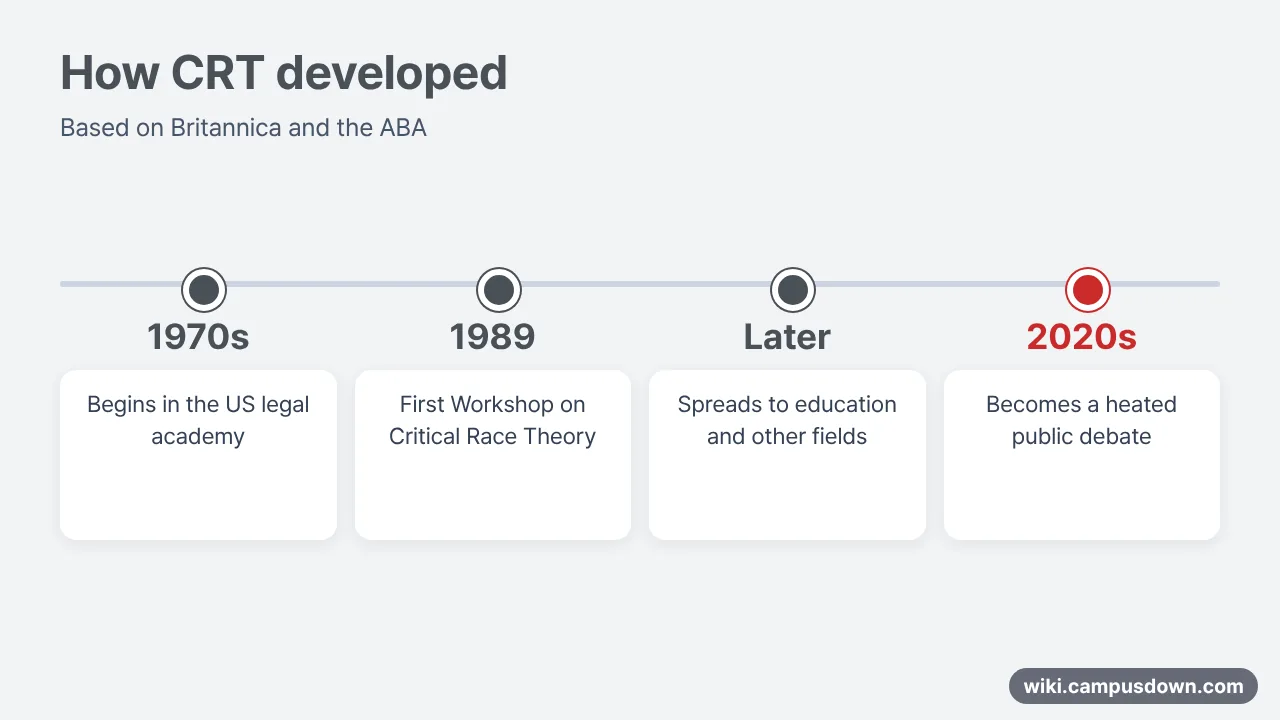
The American Bar Association's Human Rights magazine says CRT began in the legal academy in the 1970s and grew in the 1980s and 1990s. Britannica dates its official organization to a 1989 workshop. Its precursor was critical legal studies, which argued that law isn't purely neutral.
Scholars associated with it include Derrick Bell, Kimberlé Crenshaw (who coined the name), Richard Delgado, Cheryl Harris and Patricia Williams.
Key ideas
According to the ABA article, common tenets include: race is socially constructed; racism is a normal, structural part of society rather than just the work of a few "bad apples"; and people's lived experience matters to scholarship. Bell's idea of "interest convergence" argued that civil-rights gains like Brown v. Board of Education happened partly because they also served the interests of those in power.
The criticism
Britannica notes that critics fault CRT for undervaluing liberal ideals of neutrality and for treating racial inequality as proof of institutional racism. Since 2020, debates over whether and how it is taught in schools have become a major political issue in the US.
FAQ
- Who created critical race theory?
- Legal scholars including Derrick Bell and Kimberlé Crenshaw; Crenshaw coined the name.
- Is CRT taught in law schools?
- It began there and remains a field of legal scholarship; it also influenced education and sociology.
- Why is CRT controversial?
- Critics say it undervalues neutrality and reads inequality as proof of systemic racism; supporters say it explains persistent gaps.
Sources reviewed: 2026-11-20
References
- Duignan, B. Critical race theory. Encyclopaedia Britannica. Definition, 1989 workshop, roots in critical legal studies, influence, and criticism.
- George, J. A. (2021). A Lesson on Critical Race Theory. American Bar Association, Human Rights Magazine. Key tenets, originators, origins in the 1970s legal academy, Derrick Bell's interest convergence.