
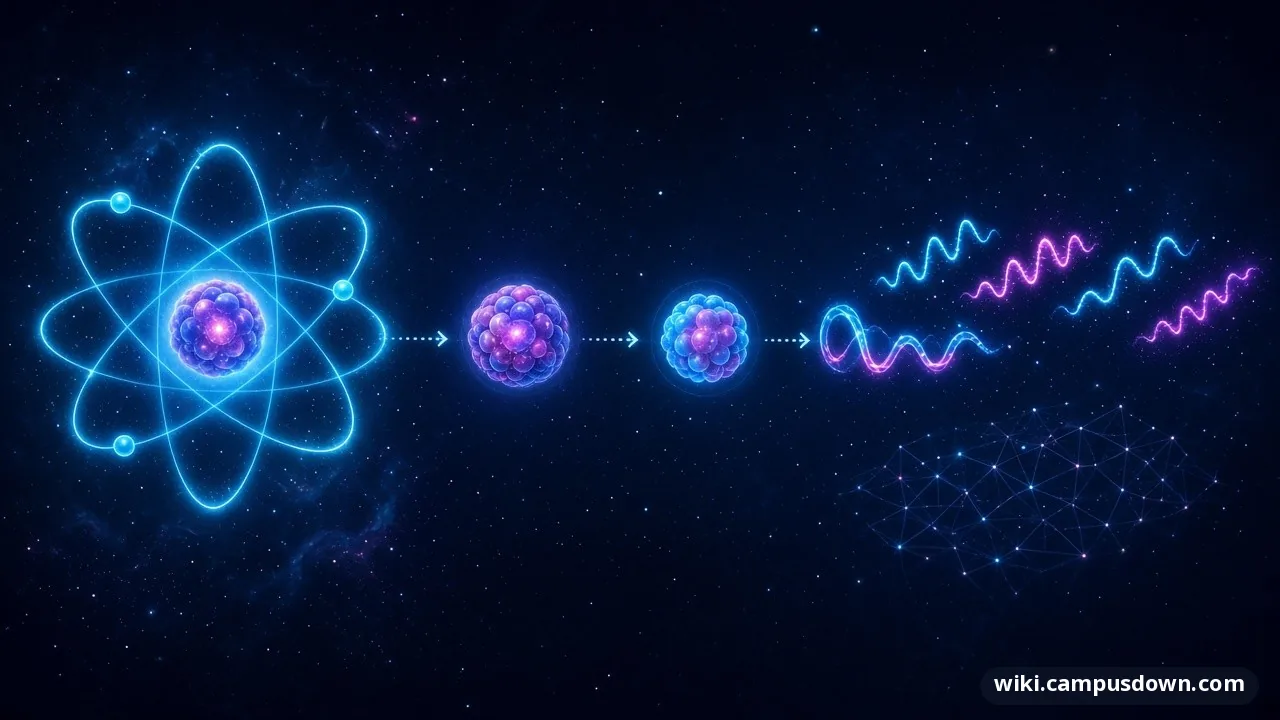
What if every particle in the universe were actually a tiny vibrating string, and the "note" it plays decided whether it is an electron or something else? That's the core picture of string theory.
From points to strings
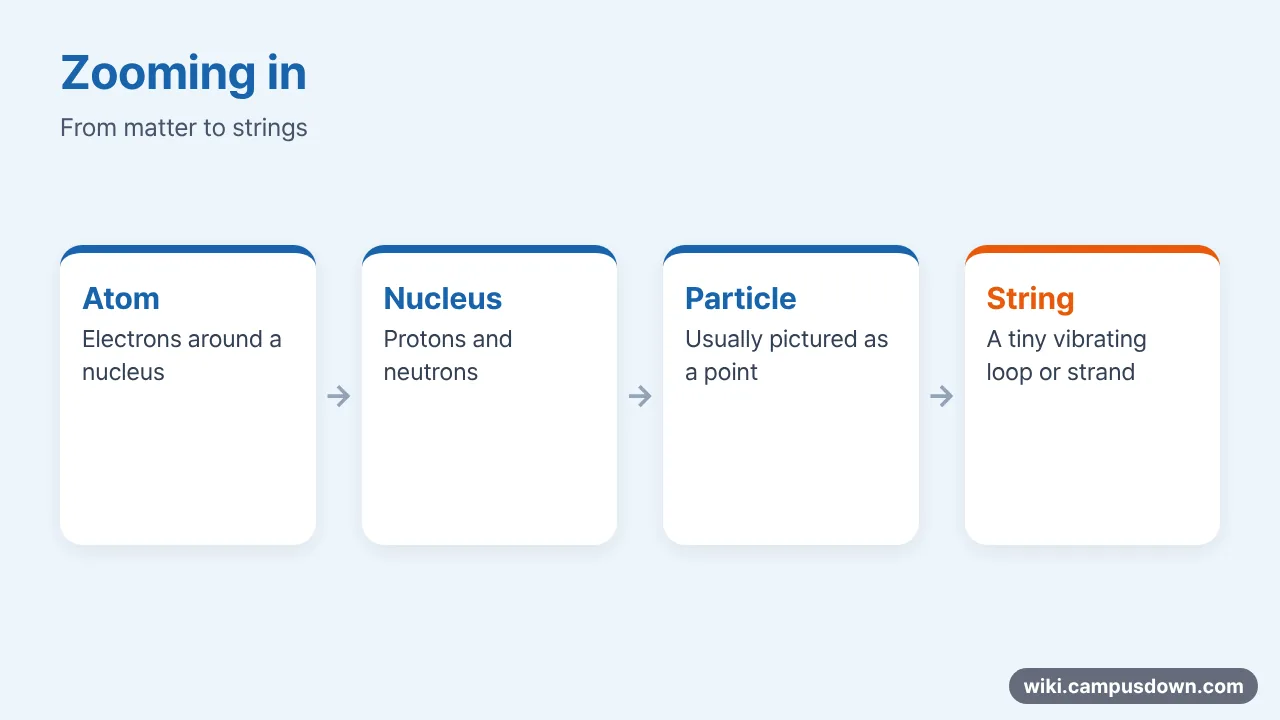
Physicists usually treat fundamental particles like electrons as points with no size. String theory swaps those points for one-dimensional strings. UC Santa Barbara's physics department describes them as having length but no thickness, typically around 10-33 cm. That's far too small to see directly.

Vibrations as particles
Strings can be open or closed loops, and each can vibrate in different modes. The basic idea is that each mode matches a different type of particle. UCSB compares it loosely to a violin string, where each particle is like one of its notes.
One closed-string mode looks just like the graviton, the particle thought to carry gravity. That's a big reason physicists find the theory attractive: gravity comes built in.
Why 10 dimensions?
The math of superstrings only works in a 10-dimensional spacetime. We see 4 (three of space plus time). The usual answer is that the other 6 are curled up so small that we can't detect them directly.
Is it true?
Nobody knows yet. String theory hasn't been confirmed by experiment, partly because strings would be so small. It remains one of the leading candidates for a theory of quantum gravity, and one of the most debated.
FAQ
- What is a string in string theory?
- A tiny one-dimensional object, about 10^-33 cm long, whose vibrations show up as particles.
- Why does string theory need extra dimensions?
- Superstring theory only works mathematically in 10 dimensions; the extra 6 are thought to be curled up very small.
- Has string theory been proven?
- No. It hasn't been confirmed by experiment.
Sources reviewed: 2026-11-20
References
- UC Santa Barbara Physics. Superstrings! String Basics. Strings as 1-dimensional objects about 10^-33 cm long, vibration modes as particles, the graviton.
- UC Santa Barbara Physics. Superstrings! Extra Dimensions. Why superstrings need 10-dimensional spacetime and how 6 dimensions are curled up.
- NASA Imagine the Universe! Superstrings. Plain-language overview: reconciling general relativity and quantum mechanics.