
Abraham Maslow (1908–1970) was an American psychologist known for the hierarchy of needs and self-actualization, and a leading figure in humanistic psychology.
You've seen his pyramid in a textbook, a business slide and probably a meme. But who was the guy behind it, and did he even draw a pyramid?

Who Abraham Maslow was
Abraham Maslow (1908–1970) was an American psychologist and philosopher. He is best known for the hierarchy of needs and the idea of self-actualization, becoming the fullest version of yourself.

His life in short
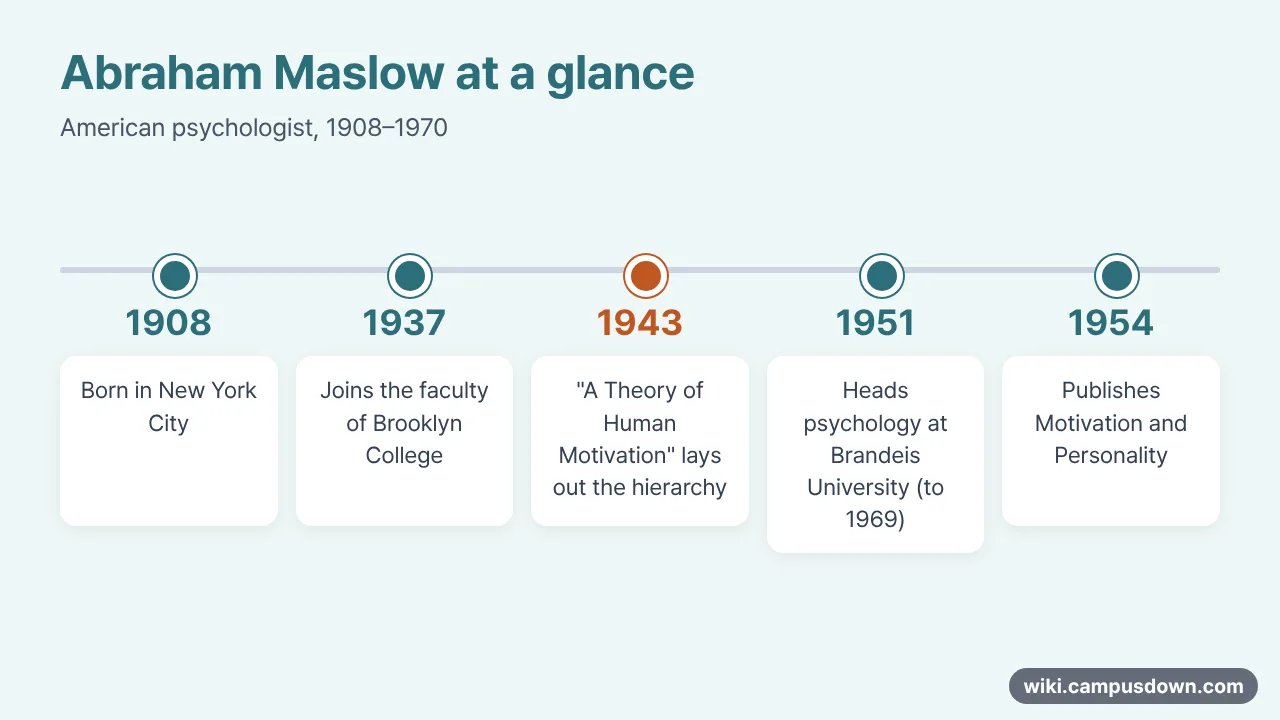
Maslow was born in New York City. He studied psychology at the University of Wisconsin, then joined Brooklyn College in 1937. In 1951 he became head of the psychology department at Brandeis University, where he stayed until 1969. He died in Menlo Park, California, in 1970.
The big idea
In his 1943 paper "A Theory of Human Motivation," Maslow argued that basic needs come first: food, then safety, then love and belonging, then esteem. Once those are met, people can chase self-actualization. He said this order wasn't rigid, and that fully self-actualized people were fairly rare.
Why he matters
Maslow was a major voice of humanistic psychology, often called the "third force" next to behaviorism and psychoanalysis. Instead of only studying problems, he wanted psychology to study healthy, thriving people too.
FAQ
- What is Abraham Maslow famous for?
- The hierarchy of needs and self-actualization.
- What were his main books?
- Motivation and Personality (1954) and Toward a Psychology of Being (1962).
- Where did he teach?
- Brooklyn College, then Brandeis University.
Sources reviewed: 2026-11-20
References
- Encyclopaedia Britannica. Abraham Maslow. Dates, career, books, humanistic psychology.
- Maslow, A. H. (1943). A Theory of Human Motivation. Psychological Review. Classics in the History of Psychology. The original paper.
- Bridgman, Cummings & Ballard. Who Created Maslow's Iconic Pyramid? Scientific American (2019). Maslow never drew the pyramid; McDermid 1960.