
Jean Piaget (1896–1980) was a Swiss psychologist who made the first systematic study of how children come to understand the world and proposed four stages of cognitive development.
Why does a four-year-old swear the tall glass has more juice, even after watching you pour it from the short one? One Swiss scientist built a whole theory out of answers like that.

Who Jean Piaget was
Jean Piaget (1896–1980) was a Swiss psychologist and the first to make a systematic study of how children come to understand the world. Britannica notes that many see him as the major figure in 20th-century developmental psychology.

From mollusks to minds
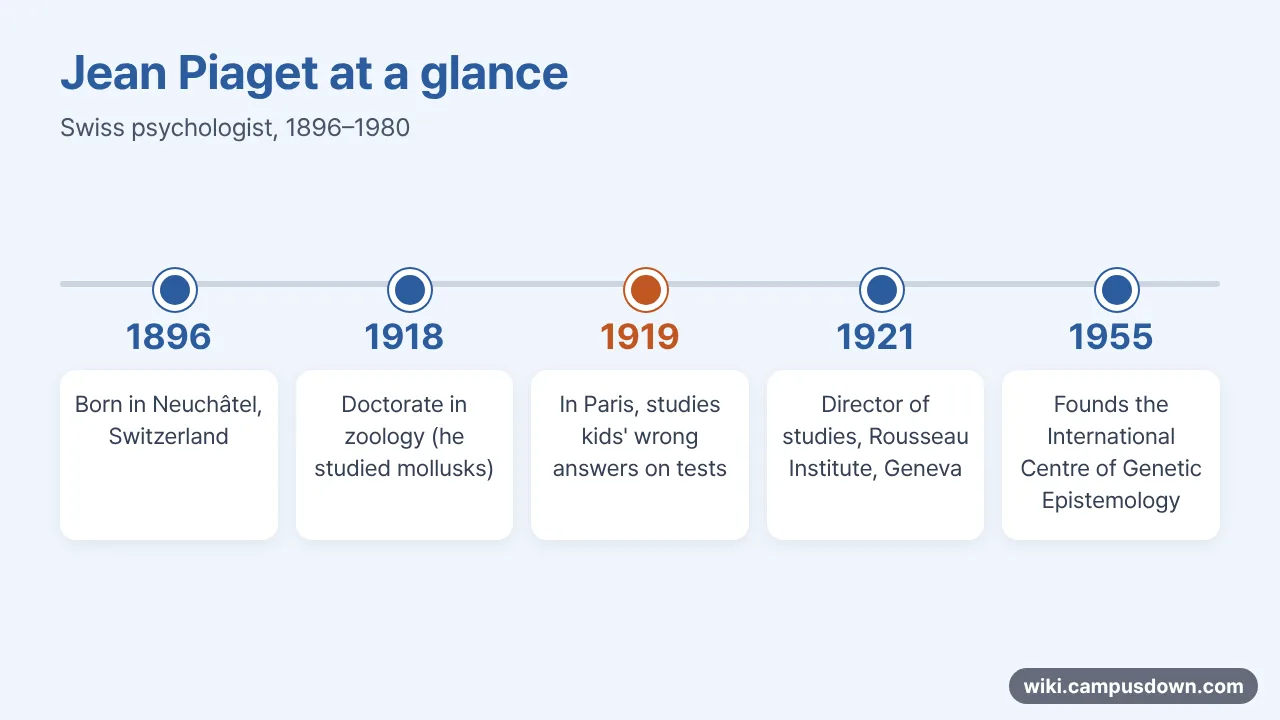
As a teen he was already publishing papers on mollusks, and he earned a doctorate in zoology in 1918. In Paris he gave reading tests to schoolchildren and got hooked on their wrong answers. The mistakes showed him that kids don't just know less than adults. They think differently.
He went on to lead the Rousseau Institute in Geneva, taught at the University of Geneva for decades, and in 1955 founded the International Centre of Genetic Epistemology.
The four stages
Piaget argued that thinking grows through four stages: sensorimotor (birth to about 2), preoperational (about 2 to 7), concrete operational (about 7 to 11 or 12) and formal operational (about 12 on). He watched and questioned children, including his own, to map them.
Why teachers still care
If kids can only grasp some ideas at the right stage, drilling isn't enough. Piaget's work pushed the view of the teacher as a guide to the child's own discovery.
FAQ
- What is Jean Piaget known for?
- His four-stage theory of cognitive development in children.
- Was Piaget a psychologist from the start?
- No. He trained in zoology first and moved into psychology after 1918.
- What is genetic epistemology?
- Piaget's name for studying how knowledge develops, from childhood up.
Sources reviewed: 2026-11-20
References
- Encyclopaedia Britannica. Jean Piaget. Dates, career, four stages, works.
- Fondation Jean Piaget (Geneva). Piaget's texts and biography.