
You want life to make sense. The universe doesn't explain itself. What now? Albert Camus called that gap the absurd, and his answer is called absurdism.

What "absurd" means here
For Camus, the absurd isn't in us or in the world alone. The Stanford Encyclopedia of Philosophy puts it as a divorce between human consciousness, with its "wild longing for clarity," and the "unreasonable silence of the world." We keep asking. The world doesn't answer.

The Myth of Sisyphus
Camus laid this out in The Myth of Sisyphus, published in October 1942, a few months after his novel The Stranger. In Greek myth, Sisyphus is condemned to push a boulder up a hill forever, only to watch it roll back each time.
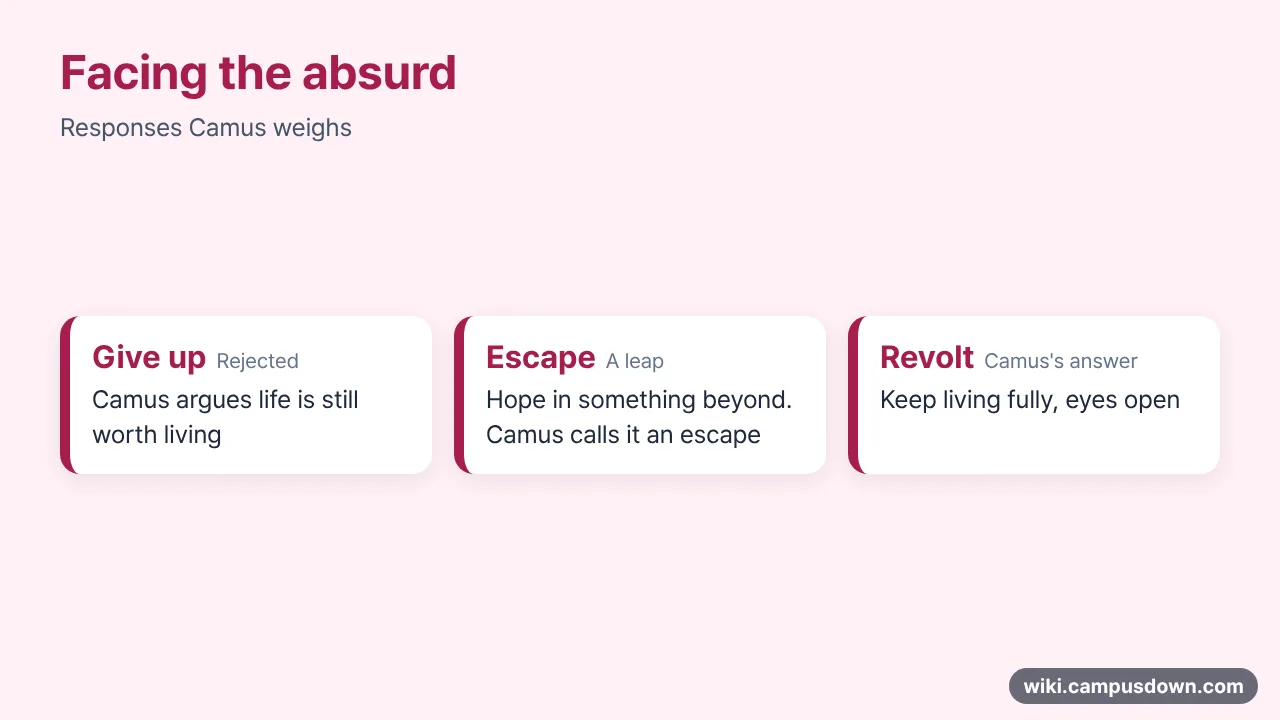
Camus asks how to respond to a life like that. He rejects giving up. He also criticizes thinkers who escape into a hope beyond this world. His answer is revolt: face the absurd honestly and live as fully as you can.
Is absurdism the same as existentialism?
They're close cousins, and Camus is often grouped with Sartre. Camus himself denied being an existentialist. He won the Nobel Prize in Literature in 1957 and died in a car accident in 1960, at 46.
So when your own routine feels like pushing a rock, absurdism doesn't promise the rock will stop rolling. It asks how you want to push it.
FAQ
- What is the absurd?
- The clash between our need for meaning and a world that offers none.
- Why imagine Sisyphus happy?
- Camus argued that the struggle itself, faced honestly, can fill a life.
- Is absurdism nihilism?
- No. Nihilism can stop at "nothing matters." Absurdism says keep living fully anyway.
Sources reviewed: 2026-11-20
References
- Aronson, R. Albert Camus. Stanford Encyclopedia of Philosophy (rev. 2021). Camus's life, The Myth of Sisyphus (1942), the absurd, revolt, Nobel 1957.
- Internet Encyclopedia of Philosophy. Albert Camus. Overview of Camus's philosophy of the absurd.