
Ever finished a long week and thought, "What's the point of any of this?" Philosophers have a name for taking that question all the way: nihilism.

Where the word comes from
"Nihilism" comes from the Latin nihil, meaning "nothing." The Internet Encyclopedia of Philosophy notes that Friedrich Jacobi used it early in the 1800s. It caught on after Ivan Turgenev's novel Fathers and Sons (1862), whose character Bazarov rejects every authority.
In Russia the label then stuck to a loose revolutionary movement that rejected the state, church, and family.

Three common types
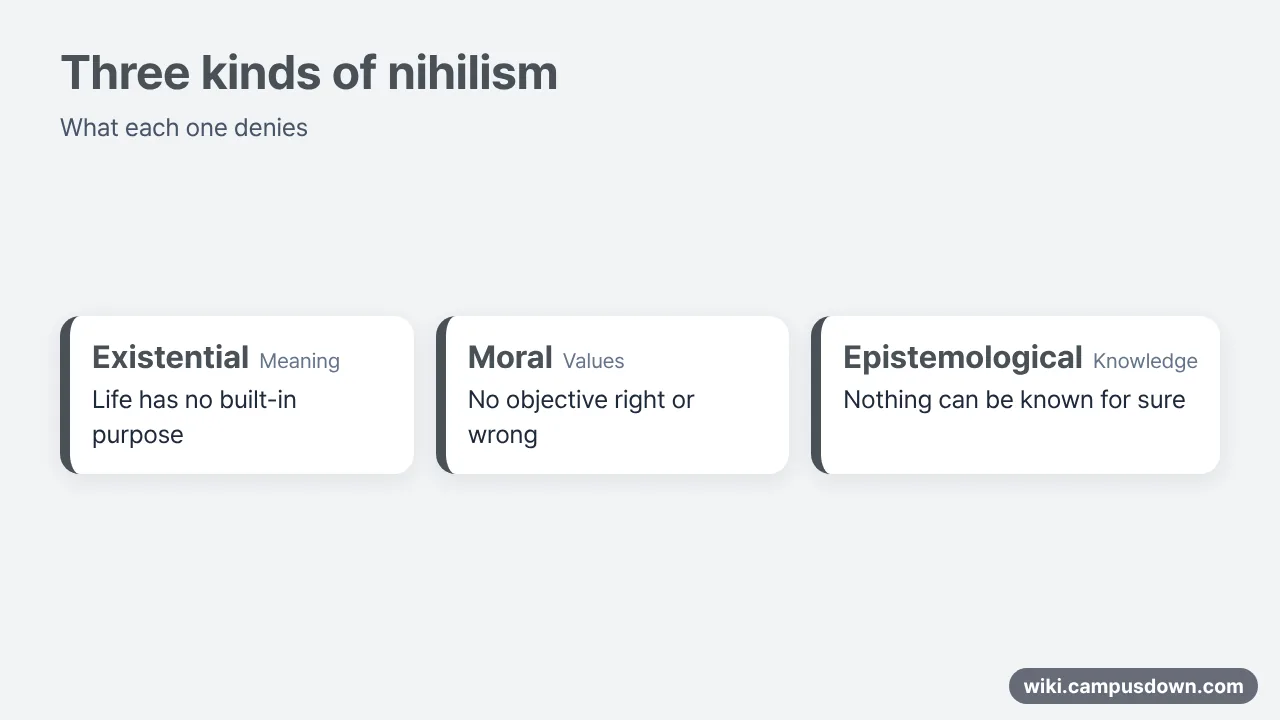
Existential nihilism says life has no built-in meaning. Moral nihilism says nothing is objectively right or wrong. Epistemological nihilism doubts that any knowledge is truly certain. You can hold one without the others.
Nietzsche: diagnosis, not cheerleading
Friedrich Nietzsche is the name most tied to nihilism, but he mostly treated it as a crisis to get through. When he wrote that "God is dead," he meant the old foundation for European values was collapsing. His worry was what people would build next.
How people answer it
The IEP points out that 20th-century existentialists took nihilism seriously and tried to blunt it. Sartre said we make our own meaning. Camus said to live fully anyway, without a promised answer. Others look to relationships, faith, or simple daily commitments.
So the real question nihilism leaves you with isn't "does anything matter?" It's "what will I choose to care about?"
FAQ
- Is nihilism the same as pessimism?
- No. Pessimism expects bad outcomes. Nihilism denies that meaning or value has a real foundation.
- Was Nietzsche a nihilist?
- He described and analyzed nihilism, but mostly wanted to overcome it by creating new values.
- Is nihilism dangerous?
- It can feel heavy. Many philosophers treat it as a starting point for choosing your own values, not an end point.
Sources reviewed: 2026-11-20
References
- Internet Encyclopedia of Philosophy. Nihilism. Origins (Jacobi, Turgenev 1862), types, Nietzsche, 20th-century reception.
- Stanford Encyclopedia of Philosophy. Friedrich Nietzsche. Nietzsche's life and his response to the loss of traditional values.