
If a computer answers every question perfectly, does it understand what it's saying? Philosopher John Searle said no, and he built a famous room to show why.
The setup
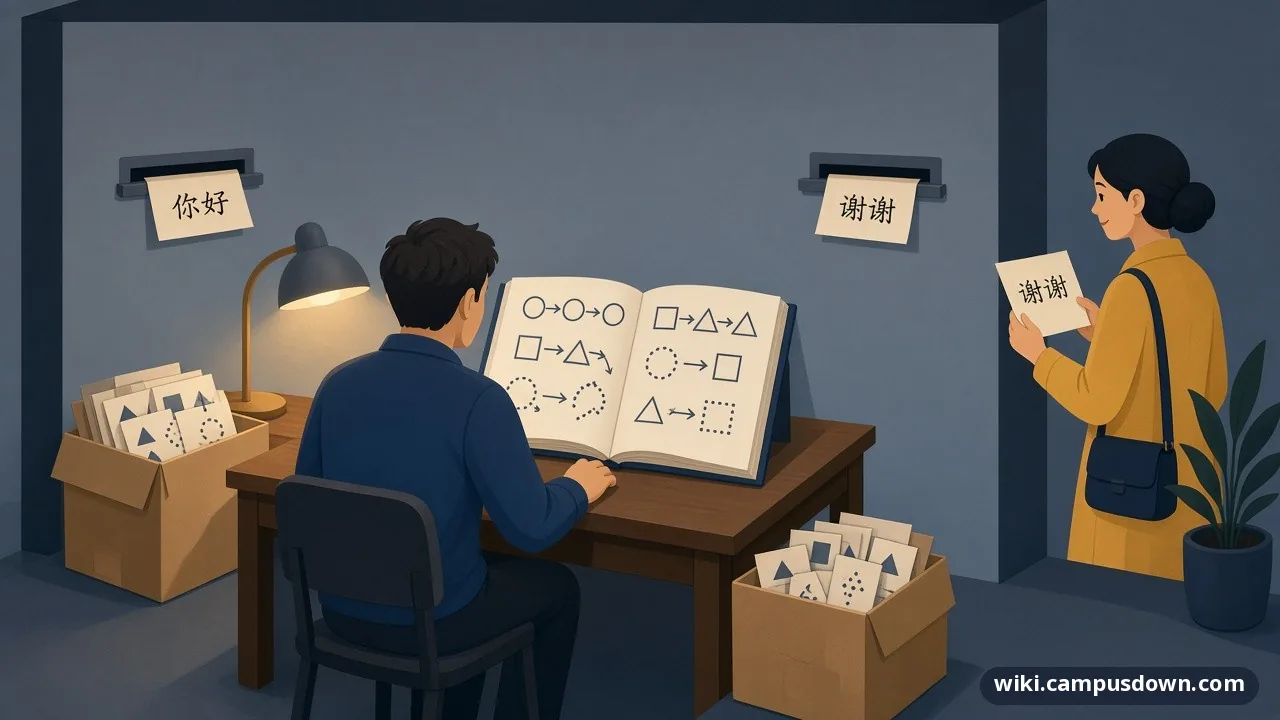
Searle imagines himself alone in a room. He knows no Chinese. People outside slide Chinese characters under the door. He looks them up in a rulebook written in English, which tells him which symbols to send back.
The rulebook is so good that his replies are indistinguishable from a native speaker's. To the people outside, the room understands Chinese. Inside, Searle understands nothing.

The point
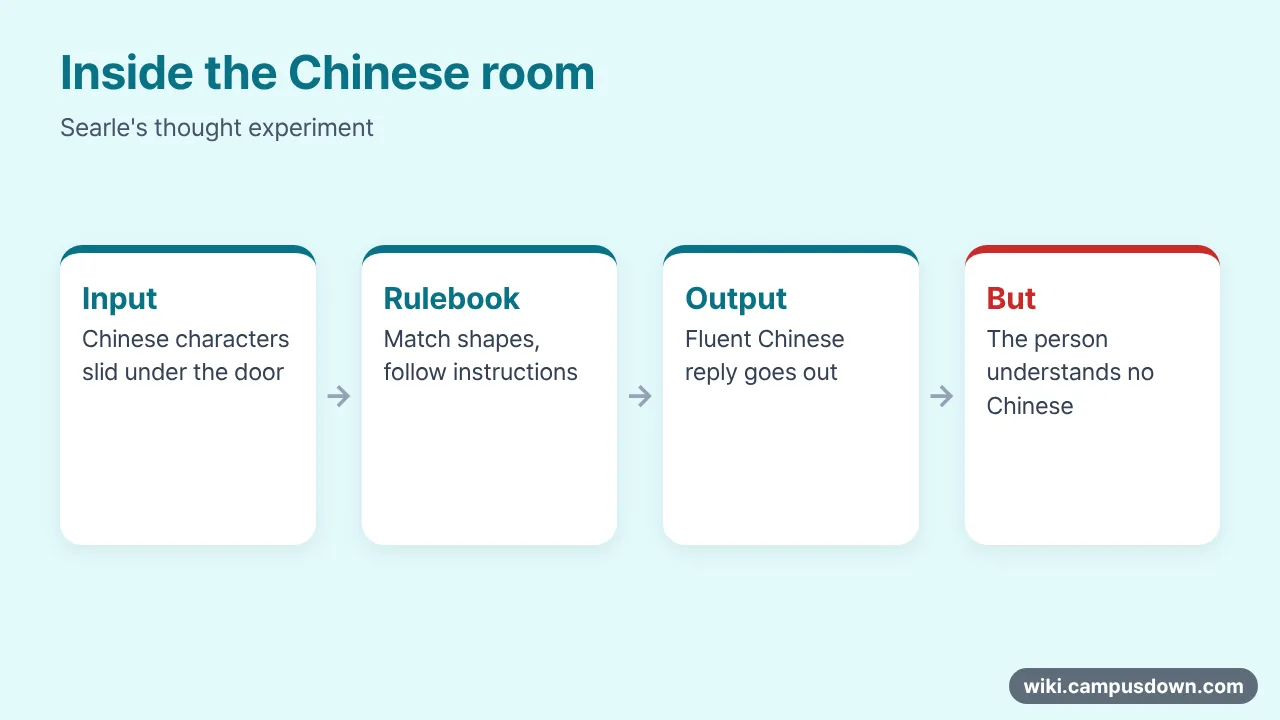
A computer running a program, Searle argued, is in the same position. It manipulates symbols by their shape (syntax) without grasping what they mean (semantics). So running the right program can't by itself produce understanding.
His target was "strong AI," the claim that an appropriately programmed computer literally has a mind. The argument appeared in his 1980 paper "Minds, Brains and Programs" in Behavioral and Brain Sciences, published alongside 27 responses from researchers.
The big replies
The systems reply says Searle is just one part. The whole system, room plus rulebook plus person, might understand. The robot reply says connect the computer to cameras and arms so its symbols are tied to the world. Searle answered both, and the debate has run for decades.
FAQ
- Who created the Chinese room?
- American philosopher John Searle, in a 1980 paper.
- Is it about the Chinese language?
- No. Any language the person doesn't know would work. The point is about symbols versus meaning.
- Does it prove AI can't think?
- It's an argument, not a proof. Many philosophers reject it, often through the systems reply.
Sources reviewed: 2026-11-20
References
- Cole, D. The Chinese Room Argument. Stanford Encyclopedia of Philosophy (rev. 2024). The thought experiment, Searle's 1980 paper, the main replies, and the debate since.
- Internet Encyclopedia of Philosophy. Chinese Room Argument. Overview of the argument and replies.