
Why does a cartoon robot feel adorable, but a nearly lifelike android can make your skin crawl? That drop has a name: the uncanny valley.

Where the idea came from
Japanese roboticist Masahiro Mori described it in a 1970 essay in a little-known Japanese journal called Energy. IEEE Spectrum, which published an authorized English translation, notes that the essay got almost no attention for years before taking off in robotics and pop culture.
Mori hypothesized that our response to a humanlike robot would shift abruptly from empathy to revulsion as it approached, but failed to reach, a lifelike look.

What the curve shows
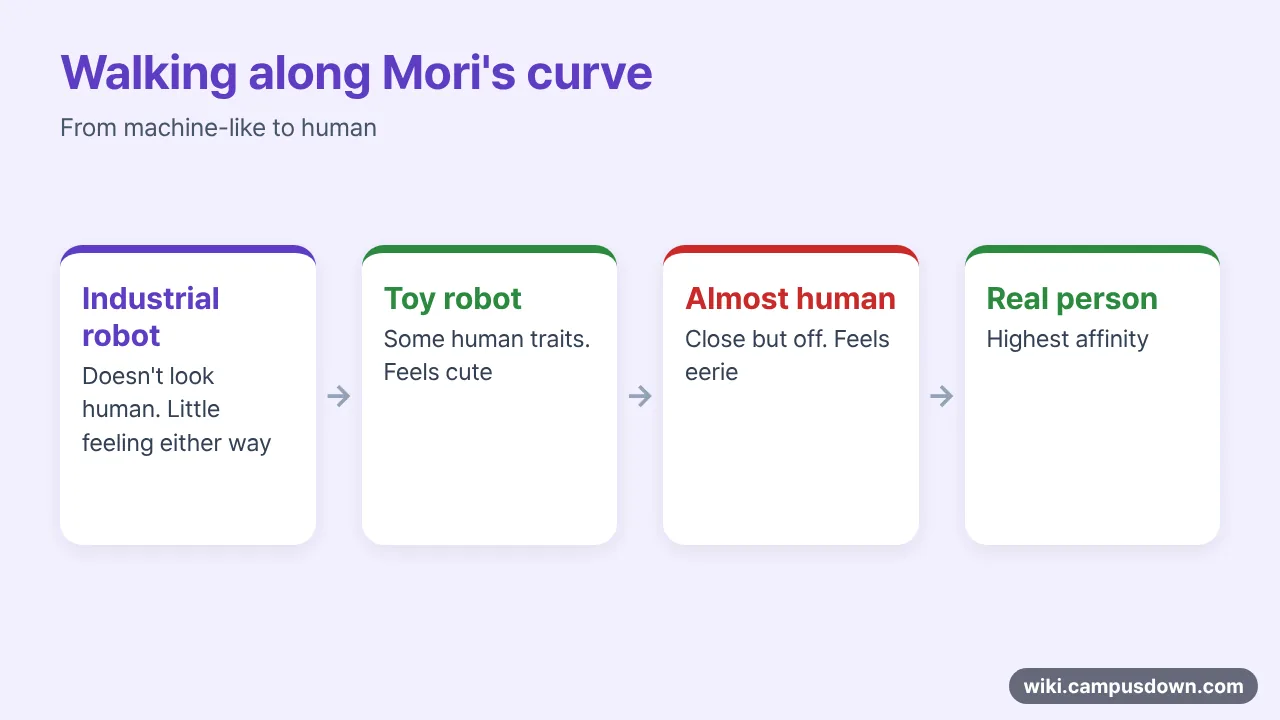
Picture a graph. Left to right, things look more human. Up and down is how much affinity you feel. An industrial robot arm sits low. A toy robot climbs higher. Then, just before "fully human," the line plunges. That plunge is the valley.
Mori's example was a realistic prosthetic hand. It looks real at a glance, but when you shake it and feel how cold and limp it is, the sense of familiarity flips into something strange.
Movement makes it deeper
Mori argued that movement amplifies the effect. He described a robot face built for the 1970 Osaka Expo with 29 pairs of artificial muscles. Slowing its smile down made it look unsettling instead of friendly.
Where you see it today
Animators, game studios, and AI avatar designers worry about it constantly. That's one reason many successful animated characters are stylized rather than photo-real.
FAQ
- Who came up with the uncanny valley?
- Japanese roboticist Masahiro Mori, in a 1970 essay.
- Is the uncanny valley proven?
- It's a widely studied hypothesis. Researchers still test when and why it appears.
- Why are some CGI characters creepy?
- Small mismatches in skin, eyes, or movement can push an almost-human face into the valley.
Sources reviewed: 2026-11-20
References
- Mori, M. (2012). The Uncanny Valley [authorized translation by K. F. MacDorman & N. Kageki]. IEEE Spectrum. Mori's original 1970 essay in English, with the affinity curve and examples.