
You chose this page. Or did you? If your brain, your past and the laws of physics made that click inevitable, in what sense was it a choice? That's the free will debate.

What free will means
The Stanford Encyclopedia of Philosophy describes free will as a significant kind of control over one's actions. Philosophers from Plato and Aristotle to Augustine, Descartes and Kant have argued about what that control requires, and whether we actually have it.

The challenge: determinism
Causal determinism is roughly the idea that given the past and the laws of nature, only one future is possible. The 19th-century scientist Pierre-Simon Laplace imagined an intelligence that knew every force and position in the universe. To it, he wrote, the future would be as clear as the past.
Three main answers
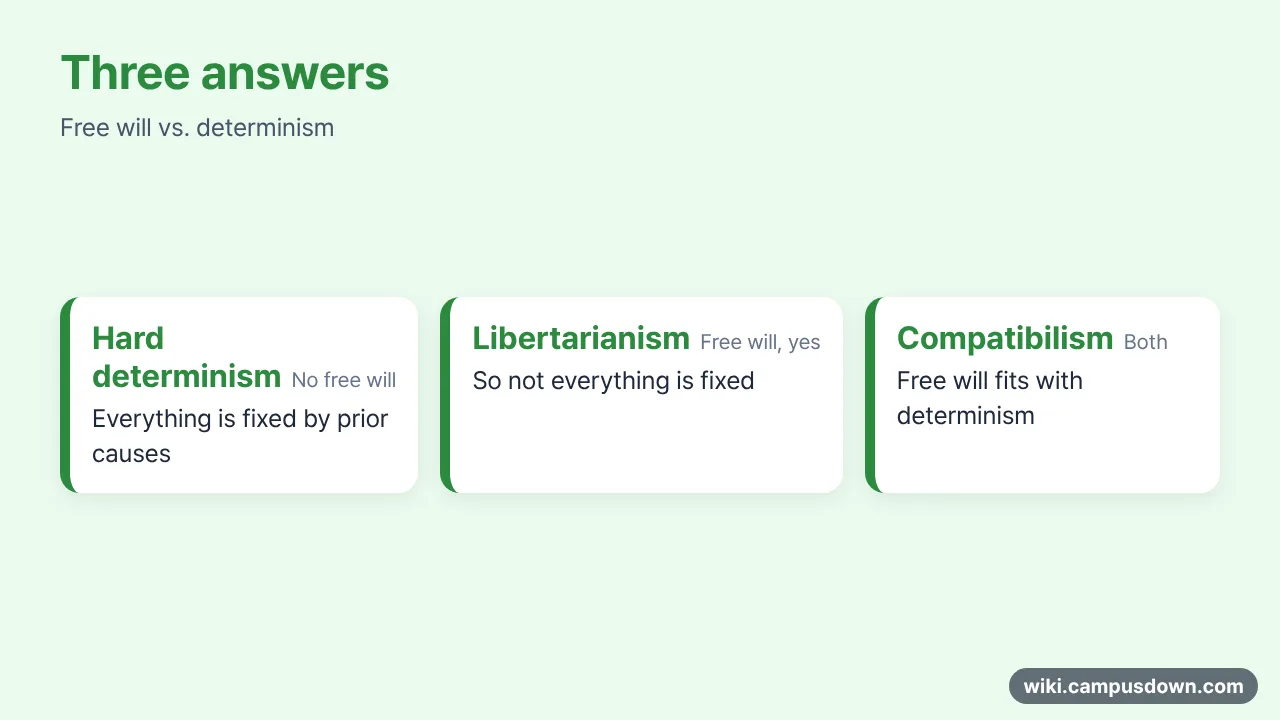
Hard determinists say determinism is true, so free will is an illusion. Libertarians (in the philosophical sense, not the political one) say we do have free will, so determinism must be false, at least for our choices. Compatibilists say the two can live together: you act freely when you act on your own reasons without being forced, even in a determined world.
Why it matters
It isn't just abstract. Praise, blame, punishment and pride all seem to assume people could control what they did. That's why the SEP ties free will so closely to moral responsibility.
FAQ
- Does determinism rule out free will?
- Incompatibilists say yes; compatibilists say no.
- What is compatibilism?
- The view that free will and determinism can both be true.
- Why does free will matter?
- Ideas of praise, blame and responsibility seem to depend on it.
Sources reviewed: 2026-11-20
References
- O'Connor, T. & Franklin, C. Free Will. Stanford Encyclopedia of Philosophy (rev. 2022). Free will as a significant kind of control over one's actions; compatibilist and incompatibilist views; moral responsibility.
- Hoefer, C. Causal Determinism. Stanford Encyclopedia of Philosophy. What determinism says, Laplace's famous "intelligence", and determinism vs. prediction.