
What if everything around you, the sky, your phone, your friends, were running on someone else's computer? It sounds like a movie plot. Philosopher Nick Bostrom turned it into an argument.

The argument in one breath
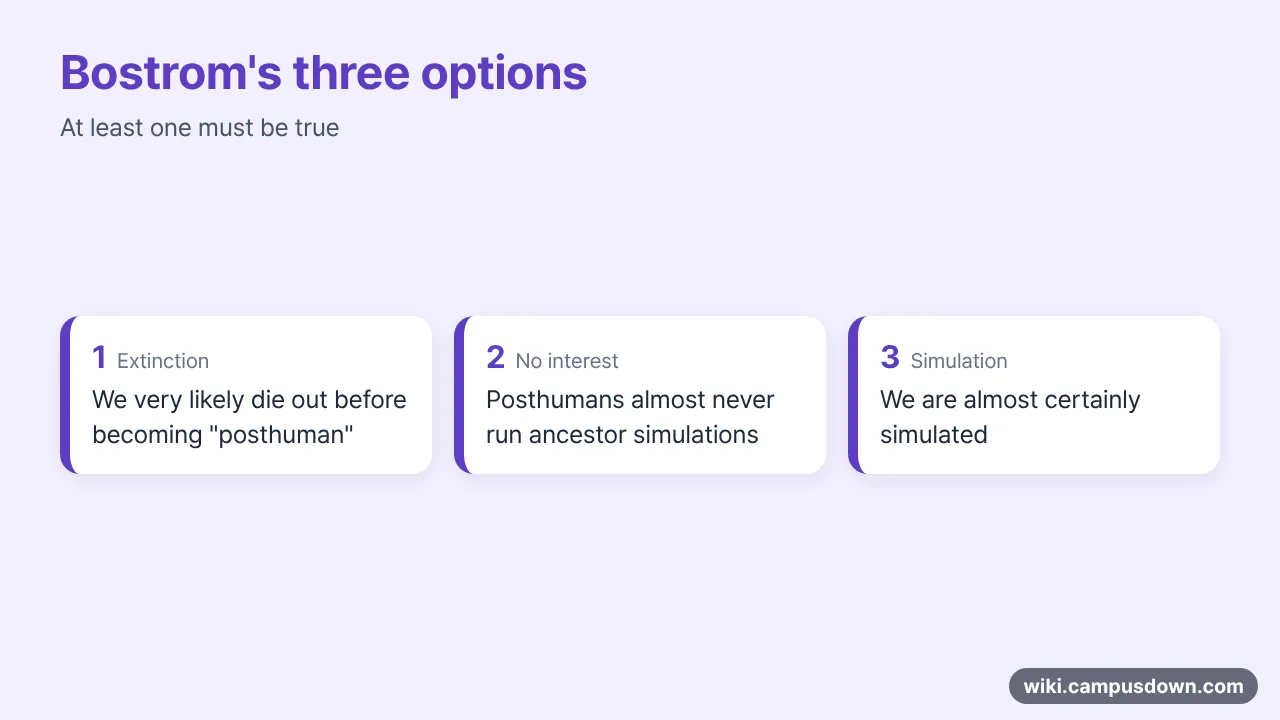
In a 2003 paper in Philosophical Quarterly, "Are You Living in a Computer Simulation?", Bostrom argued that at least one of three things is true:
1) Humanity is very likely to go extinct before reaching a "posthuman" stage. 2) Posthuman civilizations are extremely unlikely to run many simulations of their evolutionary history. 3) We are almost certainly living in a simulation.

Why it works that way
Suppose future civilizations have enormous computing power and run detailed "ancestor simulations." If simulated people can be conscious, there could be vastly more simulated minds than original ones. Then the odds that you are one of the originals would be tiny.
So unless option 1 or 2 holds, option 3 follows. Bostrom adds that believing we'll one day run ancestor simulations is false unless we're already in one.
Why people argue about it
Critics question its assumptions: that consciousness could run on a computer, and that we can reason about probabilities across simulated and real worlds. It's also hard to imagine a test that could settle it. That's why it stays a philosophy question rather than a physics one.
FAQ
- Who came up with the simulation argument?
- Philosopher Nick Bostrom, in a 2003 paper.
- Did Bostrom say we live in a simulation?
- No. He argued that at least one of three possibilities must be true.
- Can it be tested?
- No widely accepted test exists; it remains a philosophical argument.
Sources reviewed: 2026-11-20
References
- Bostrom, N. (2003). Are You Living in a Computer Simulation? Philosophical Quarterly, 53(211), 243–255. The original paper and its three-way conclusion.