
You know your own thoughts directly. Everyone else? You only see their faces, hear their words, and assume there's a mind behind them. How could you prove it? That itch is solipsism.

What solipsism says
The word combines Latin solus (alone) and ipse (self). It's often put as "I am the only mind that exists." The Internet Encyclopedia of Philosophy points out that's too loose: the last survivor of a disaster could believe that without being a solipsist. The real claim is about what can be known in principle. For me, "existence" just means my existence and my experiences.

Why it keeps coming up
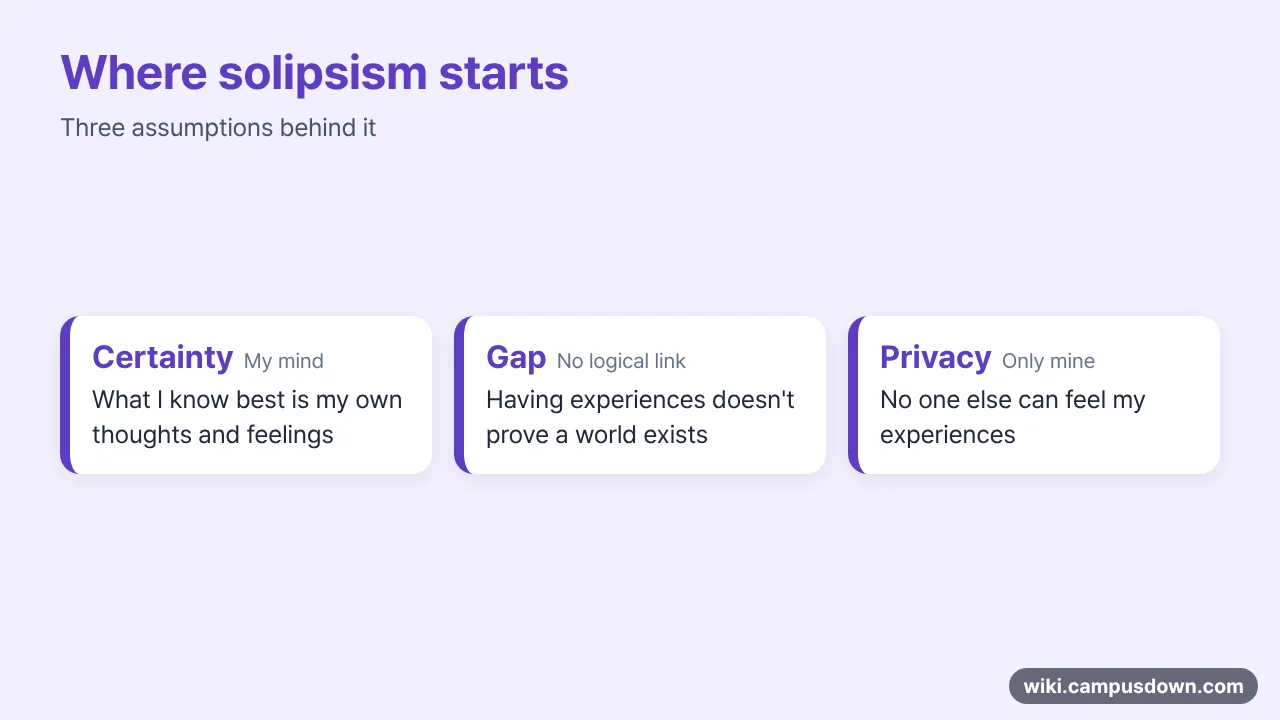
The IEP traces solipsism to a habit going back to Descartes: start the search for truth from your own mind, the one thing you can't doubt. Once you start there, it's surprisingly hard to climb back out to a world and other people you can be sure of.
It rests on three ideas many philosophers find natural: you know your own mind best, having experiences doesn't logically prove an outside world, and your experiences are private.
The problem of other minds
A close cousin is the problem of other minds. Even if you accept that the world exists, how do you know other people feel and think the way you do, and aren't just behaving as if they do?
FAQ
- Does anyone actually believe solipsism?
- Very few. It's mostly used as a challenge to test theories of knowledge.
- Is solipsism the same as the simulation hypothesis?
- No. The simulation idea allows other minds; solipsism questions whether any other minds can be known to exist.
- What is the problem of other minds?
- The question of how you can know that other people have thoughts and feelings like yours.
Sources reviewed: 2026-11-20
References
- Thornton, S. Solipsism and the Problem of Other Minds. Internet Encyclopedia of Philosophy. Definitions, the Cartesian starting point, three presuppositions, and the problem of other minds.
- Stanford Encyclopedia of Philosophy. Other Minds. How, if at all, we can know that others have minds.