
Your group-chat message got left on read. Your coworker took the last coffee. Was it on purpose? Hanlon's razor suggests a different first guess.

The saying
The usual wording is "Never attribute to malice that which is adequately explained by stupidity." It's called a razor because, like Occam's razor, it trims away unlikely explanations.
A gentler version works just as well: don't assume bad intent when an honest mistake, a rush, or a misunderstanding would explain it.

Where it really comes from
The line is often credited to Napoleon. Quote Investigator found no solid support for that. Science fiction writer Robert Heinlein wrote something similar in a 1941 story. The earliest close match QI found is in Murphy's Law Book Two (1980), edited by Arthur Bloch, which credits a computer programmer named Robert J. Hanlon.
How to use it
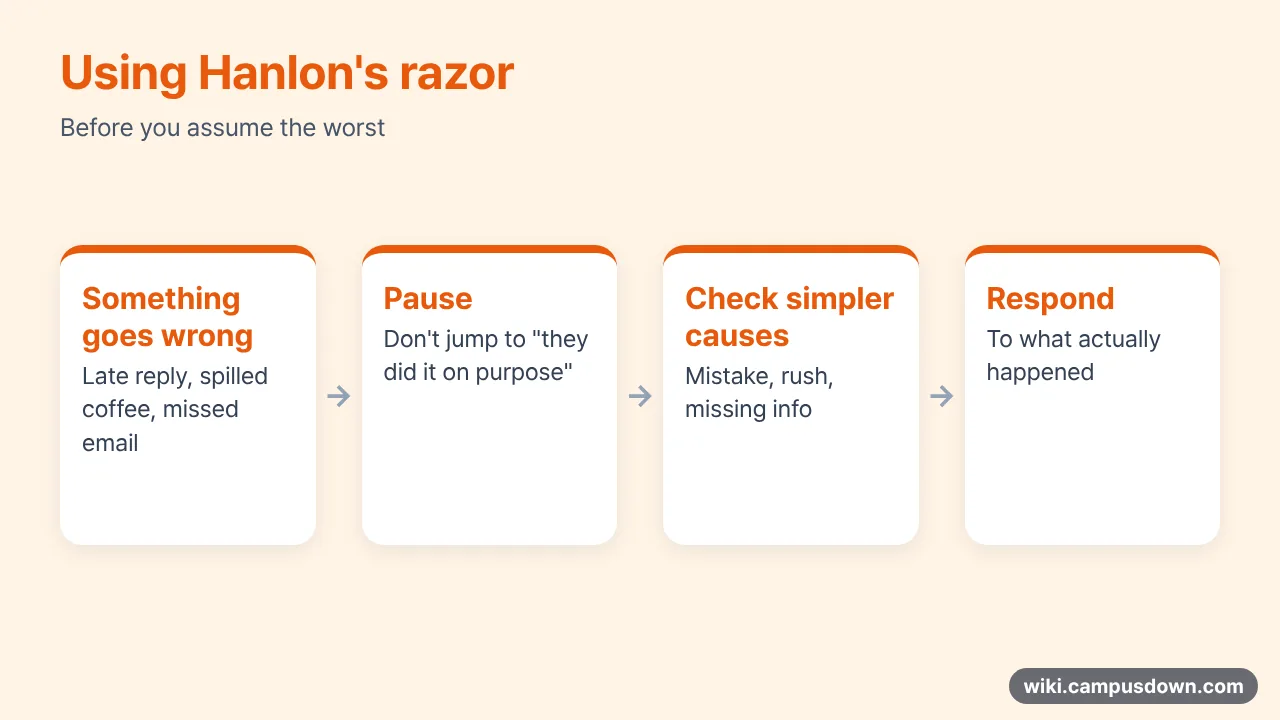
When something goes wrong, pause before deciding someone meant it. Ask what simpler cause might fit. Then respond to what actually happened. It keeps small problems from turning into feuds.
When not to lean on it
If the same "mistake" keeps happening, or someone gains a lot from it, the simple explanation may not hold. Use the razor as a first step, not a reason to ignore a pattern.
FAQ
- Who was Hanlon?
- Robert J. Hanlon, a computer programmer credited in Arthur Bloch's 1980 book.
- Did Napoleon say it?
- Quote Investigator found no solid evidence that he did.
- Is it the same as Occam's razor?
- They're cousins. Occam's razor favors simpler explanations in general; Hanlon's is about intent.
Sources reviewed: 2026-11-20
References
- Quote Investigator (2016). Never Attribute to Malice That Which Is Adequately Explained by Stupidity. Origin: Heinlein 1941 similar line, earliest close match in Arthur Bloch's 1980 Murphy's Law Book Two, credited to Robert J. Hanlon.