
Toast lands butter-side down. The bus leaves just as you get there. The printer jams the morning a paper is due. There's a name for that feeling: Murphy's law.

The rule
The usual version is short: "If anything can go wrong, it will." It isn't a scientific law. It's a joke that doubles as a warning.

The 1949 rocket sled
Wordorigins.org tells the famous story. In 1949, at Muroc Army Airfield (today Edwards Air Force Base), Capt. Edward A. Murphy was an engineer on experiments testing high-g deceleration on the human body, supervised by Col. John Stapp. Riders strapped into a rocket sled that stopped very fast.
Murphy was responsible for the sensors on the harness. On one run they recorded nothing. A technician had wired them wrong. As the story goes, Murphy grumbled that if there was a wrong way to do something, that technician would find it. At a press conference later, someone credited Murphy with the principle.
Much older than Murphy
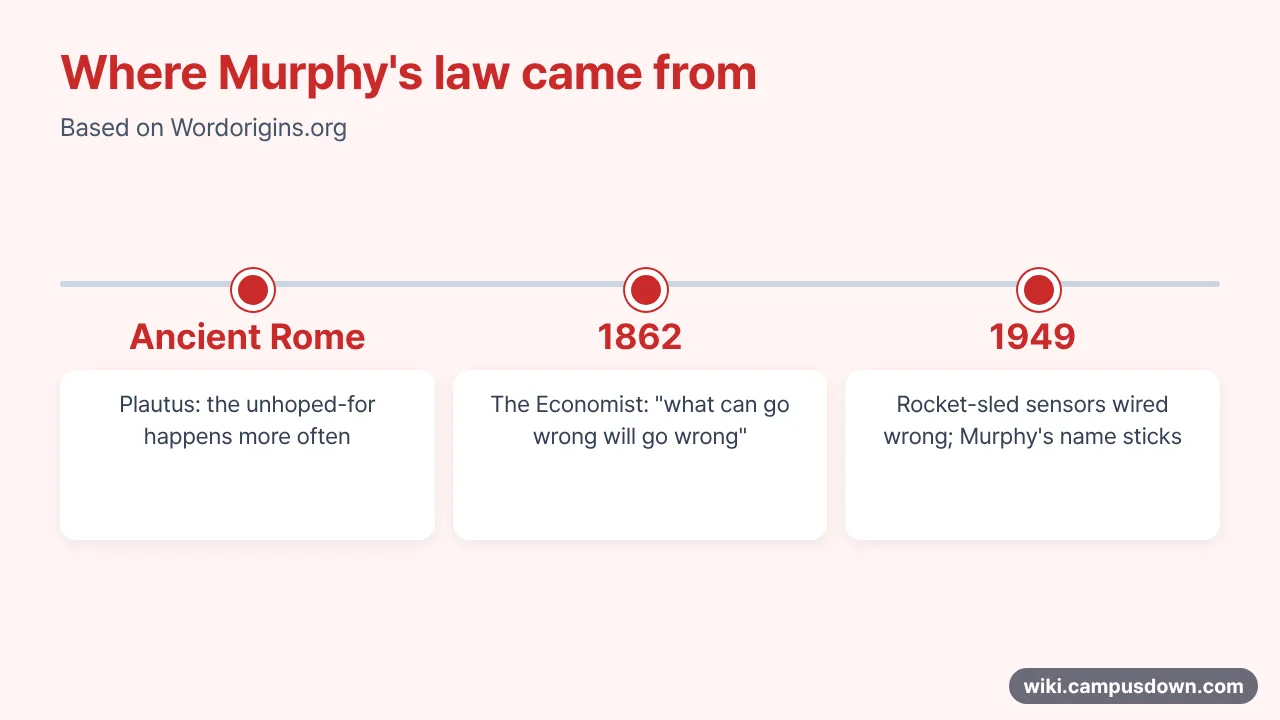
The idea goes back much further. Roman playwright Plautus wrote that things you don't hope for happen more often than things you do. In 1862, The Economist used the phrase "what can go wrong will go wrong" about how lawyers see business. Murphy may have lent his name. Even that part is debated.
FAQ
- Who was Murphy?
- Capt. Edward A. Murphy, a US Air Force engineer on John Stapp's 1949 rocket-sled tests.
- Did Murphy invent the saying?
- No. Similar lines go back to Plautus and appeared in The Economist in 1862.
- Is Murphy's law real?
- It's a joke, not a law of nature. It works as a reminder to plan for mistakes.
Sources reviewed: 2026-11-20
References
- Wilton, D. (2022). Murphy's Law. Wordorigins.org. Plautus, The Economist 1862, Capt. Edward A. Murphy and the 1949 rocket-sled sensors at Muroc.