
How can a clip on your finger tell how much oxygen is in your blood without a needle? It measures light, and the rule connecting light to what it passes through is the Beer–Lambert law. The same rule lets chemistry students find a solution's concentration and lets scientists track carbon dioxide in the air.
Definition
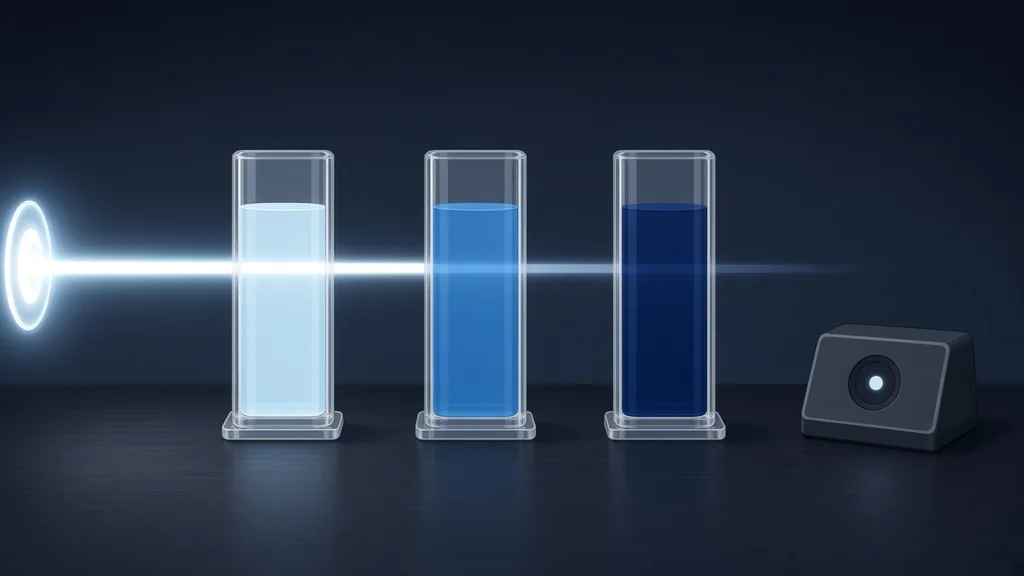
The Beer–Lambert law says that absorbance (A) equals a substance's molar absorptivity (ε) times the path length of the light (l) times the concentration (c): A = εlc. Absorbance is a logarithmic measure of how much light is lost, so doubling the concentration or doubling the distance doubles the absorbance. A spectrophotometer uses this to turn a light reading into a concentration.
Key idea
The law turns light into a measuring stick. If you know how strongly a substance absorbs a given wavelength and how far the light travels, you can work out how much of the substance is there.

History
The rule was built in steps. Pierre Bouguer found in work published in 1729 that light fades exponentially as it travels through the atmosphere. Johann Heinrich Lambert popularized and formalized this in his Photometria in 1760. In 1852 August Beer noticed that colored solutions show a similar relationship tied to concentration.
US cases
- When and where
- March 1958 onward, Mauna Loa Observatory, Hawaii
- What happened
- Charles David Keeling of the Scripps Institution of Oceanography used funding from the International Geophysical Year to install infrared gas analyzers. Carbon dioxide absorbs infrared light, and the measurements continue today with nondispersive infrared sensors.
- Why it matters
- The resulting Keeling Curve is one of the best-known records of rising atmospheric CO2, and it depends on light absorption measured the Beer–Lambert way.
- When and where
- December 2020, University of Michigan and a multicenter US cohort; published in the New England Journal of Medicine
- What happened
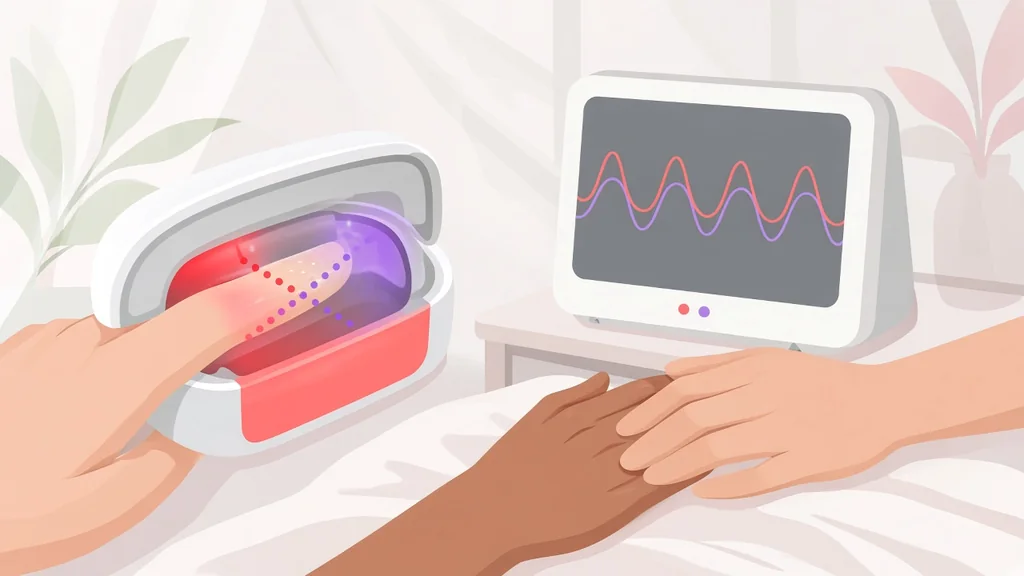
- Michael Sjoding and colleagues found that Black patients were about three times as likely as white patients to have low blood oxygen missed by pulse oximeters. Oximeters convert a ratio of red to infrared light into oxygen saturation using a calibration based on the Beer–Lambert law.
- Why it matters
- The study, published during the COVID-19 pandemic, was followed in February 2021 by a US Food and Drug Administration safety communication on oximeter limitations, and it became a widely cited example of bias in medical devices.
Limits
- High concentrations: at very high concentrations molecules interact and the straight-line relationship breaks down.
- Scattering: cloudy samples and living tissue scatter light, so real devices need calibration beyond the simple formula.
- Mixed absorbers: other substances absorbing the same wavelength, such as skin pigment, can distort readings.
Related concepts
The law describes how photons are absorbed by matter. Infrared absorption by carbon dioxide is the physics behind the greenhouse effect and the measurement of climate change. Like the ideal gas law, it is a simple model that works well within limits, and errors outside them are a matter of measurement error and uncertainty.
Study material (Korean): 「색채와 빛이, 파장 관련 핵심 내용 요약 정리」
Frequently asked questions
- What does the Beer–Lambert law say in simple terms?
- The more of a light-absorbing substance there is, and the farther light travels through it, the more light gets absorbed.
- What is the Beer–Lambert law used for?
- It is used in chemistry labs to find concentrations, in pulse oximeters to estimate blood oxygen, and in gas analyzers that measure carbon dioxide.
- Why can pulse oximeters be less accurate on darker skin?
- Melanin also absorbs and scatters light, and devices calibrated mostly on lighter-skinned people can overestimate oxygen levels in people with darker skin.