
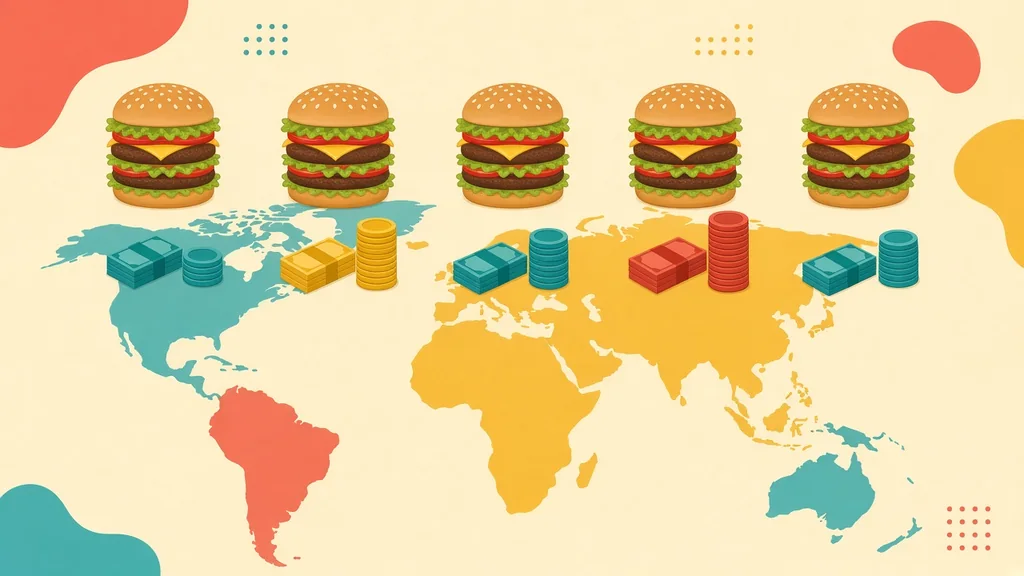
Is the dollar too strong or the yen too weak? Economists answer with complex models, but one of the best-known shortcuts uses a hamburger. The Big Mac Index compares what a McDonald's Big Mac costs around the world to judge whether currencies are overvalued or undervalued against the US dollar.
How it works
The index rests on purchasing power parity (PPP) and the "law of one price": in the long run, the same good should cost about the same everywhere once prices are converted into one currency. The Big Mac is useful because it is sold in many countries with a fairly standard recipe that combines local ingredients, labor, and rent.
The basic calculation:
- Implied exchange rate: local Big Mac price divided by the US Big Mac price.
- Compare with the market rate: if the implied rate is lower than the actual exchange rate, the local currency looks undervalued; if higher, overvalued.
For example, if a Big Mac costs 5 dollars in the US and 600 units of a foreign currency, the implied rate is 120 units per dollar. If the market rate is 150, that currency looks about 20% undervalued by burger logic.
Key idea
The Big Mac Index is a teaching tool and conversation starter, not a forecast. It shows where exchange rates seem out of line with prices, not where they will go next.

Origin
The Economist introduced the index in September 1986. The economics writer Pam Woodall created it as a light-hearted way to explain exchange rate theory. Because the burger is American and the dollar is the world's main reserve currency, the US price is normally used as the base. The index became so popular that it gave rise to the word "burgernomics." The Economist also publishes an "adjusted" version that takes into account differences in income per person.

US cases
- When and where
- 1967–1968, Pittsburgh area
- What happened
- The Big Mac was created by Jim Delligatti, a McDonald's franchisee who ran restaurants in the Pittsburgh area. It was introduced locally in 1967 and expanded nationwide in 1968, becoming McDonald's flagship product.
- Why it matters
- The index's yardstick is a US regional invention, and its US price is the base for every comparison.
- When and where
- January 2004, The Economist
- What happened
- The Economist ran a version that replaced the Big Mac with a tall latte from Starbucks, the Seattle-based coffee chain, to see whether a different American product told the same story about currencies.
- Why it matters
- It shows that the method depends on a widely sold, standardized US product, and that results can shift when the product changes.
Limits and criticisms
- Not a traded good: a burger cannot be shipped across borders to take advantage of price gaps, so prices need not equalize.
- Local costs differ: rent, wages, taxes, and competition vary by country. Poorer countries usually have cheaper non-traded services, so their currencies often look undervalued.
- Different demand: in some countries McDonald's is a cheap meal; in others it is a treat, which changes pricing.
- Price management: governments or companies can influence the price of a highly visible product.
Related concepts
The index is a simplified version of purchasing power parity, one of several exchange rate theories. Gaps between prices and exchange rates can also reflect inflation and short-term moves such as exchange rate overshooting. The global spread of fast food itself is studied as McDonaldization.
Study material (Korean): 「빅맥지수와 환율 예측, 구매력평가설로 본 환율 수준 평가」
Frequently asked questions
- Who publishes the Big Mac Index?
- The Economist, which has published it since 1986.
- Why is the US dollar the base?
- The Big Mac is an American product and the dollar is the main global reserve currency, so the US price is the natural benchmark.
- Does the Big Mac Index predict exchange rates?
- Not reliably in the short run. It suggests where currencies may be out of line but does not forecast their movement.