
Can a butterfly flapping its wings in Brazil set off a tornado in Texas? That question, from a 1972 talk, gave a name to one of the weirdest ideas in science.

A rounding "mistake"
MIT Technology Review tells the story. In 1961, MIT meteorologist Edward Lorenz was rerunning a computer weather simulation. This time he had rounded one value from .506127 to .506. That tiny change transformed the whole pattern over two months of simulated weather.
His insight: in some systems, small changes at the start can lead to big consequences later. Scientists call it sensitive dependence on initial conditions.

Where the butterfly came from
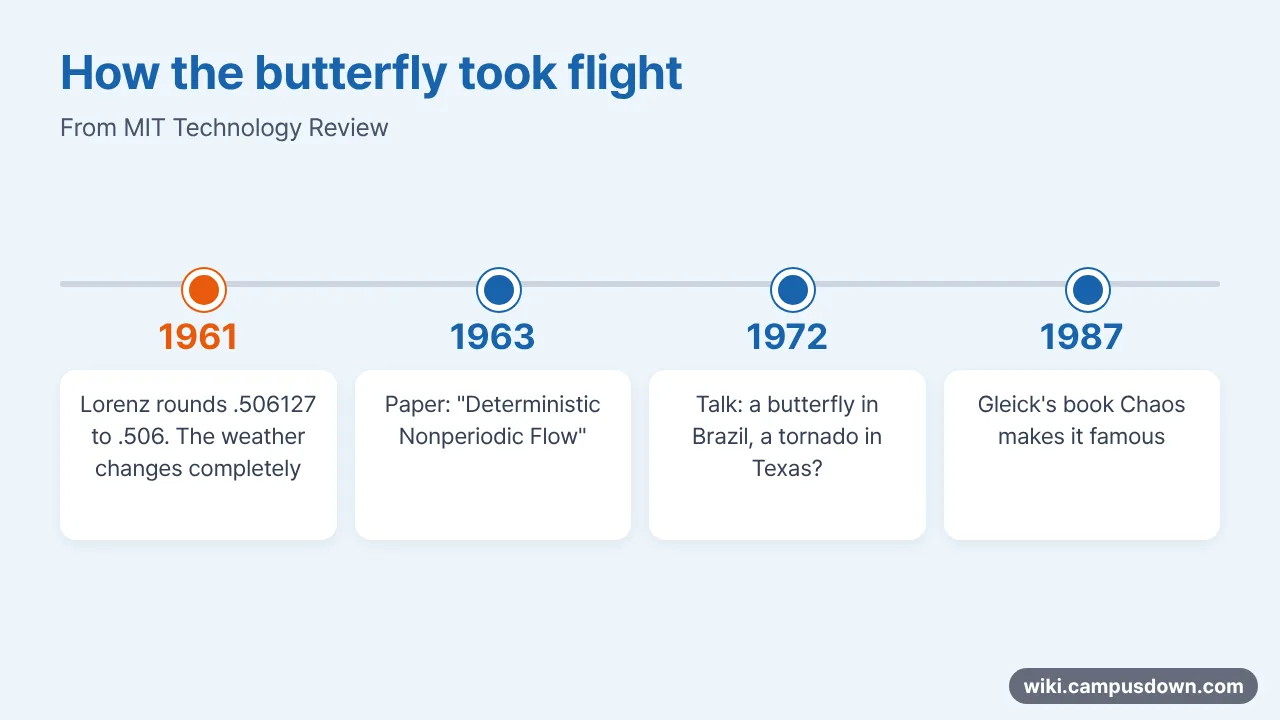
Lorenz wrote up his findings in a 1963 paper, "Deterministic Nonperiodic Flow." At first it was barely noticed outside meteorology. In 1972 he gave a talk at the American Association for the Advancement of Science titled "Predictability: Does the Flap of a Butterfly's Wings in Brazil Set Off a Tornado in Texas?" The title came from fellow meteorologist Philip Merilees. Lorenz's earlier example had been a seagull.
James Gleick's 1987 bestseller Chaos took the term to a mass audience.
Why it matters
Lorenz's work became a founding idea of chaos theory, which spread into geology, biology and beyond. It's also why weather forecasts get much less reliable the further ahead they look.
FAQ
- Who discovered the butterfly effect?
- Meteorologist Edward Lorenz at MIT, starting with a 1961 simulation.
- Where does the butterfly come from?
- His 1972 talk title, suggested by meteorologist Philip Merilees.
- Is the butterfly effect the same as chaos theory?
- It's a core idea of chaos theory: tiny changes in starting conditions can grow huge.
Sources reviewed: 2026-11-20
References
- MIT Technology Review (2011). When the Butterfly Effect Took Flight. Lorenz's 1961 rounding (.506127 to .506), the 1963 paper, the 1972 AAAS talk title, Gleick 1987.