
Why does a balloon stick to your hair after you rub it, and why does a sock cling to a shirt fresh from the dryer? The answer is the electric force between charges, and the rule that describes it is Coulomb's law, one of the foundations of physics and chemistry.

The law and the formula
In 1785 the French physicist Charles-Augustin de Coulomb used a sensitive torsion balance to measure the force between small charged spheres. He found that:
- the force is proportional to the product of the two charges;
- it is inversely proportional to the square of the distance between them;
- like charges repel and opposite charges attract.
In symbols, F = k × q1 × q2 / r², where q1 and q2 are the charges, r is the distance, and k is the Coulomb constant, about 8.99 × 10⁹ newton square meters per coulomb squared. The constant is tied to the vacuum electric permittivity, a value maintained in the CODATA set published by the US National Institute of Standards and Technology (NIST).
Key idea
Double the distance and the force drops to one quarter. That inverse-square pattern is the same shape as Newton's law of gravity, but the electric force is vastly stronger.

Why it matters
Coulomb's law explains why electrons stay bound to atomic nuclei, why atoms form chemical bonds, why static electricity builds up, and how many devices handle charged particles. It is also the starting point for the idea of an electric field and, with magnetism, for the full theory of electromagnetism.
US cases
- When and where
- October 22, 1938, Astoria, Queens, New York
- What happened
- Inventor Chester Carlson and his assistant Otto Kornei made the first xerographic copy in a rented room in Astoria. Their process charged a coated plate, exposed it to light so that charge remained only where the image was dark, and dusted it with powder that clung to the charged areas. The Haloid Company later developed the process and became Xerox.
- Why it matters
- Every office photocopier and laser printer relies on charged toner being pulled to charged areas, a direct everyday use of Coulomb's law.
- When and where
- 1933 to today, MIT's Round Hill site and Boston's Museum of Science
- What happened
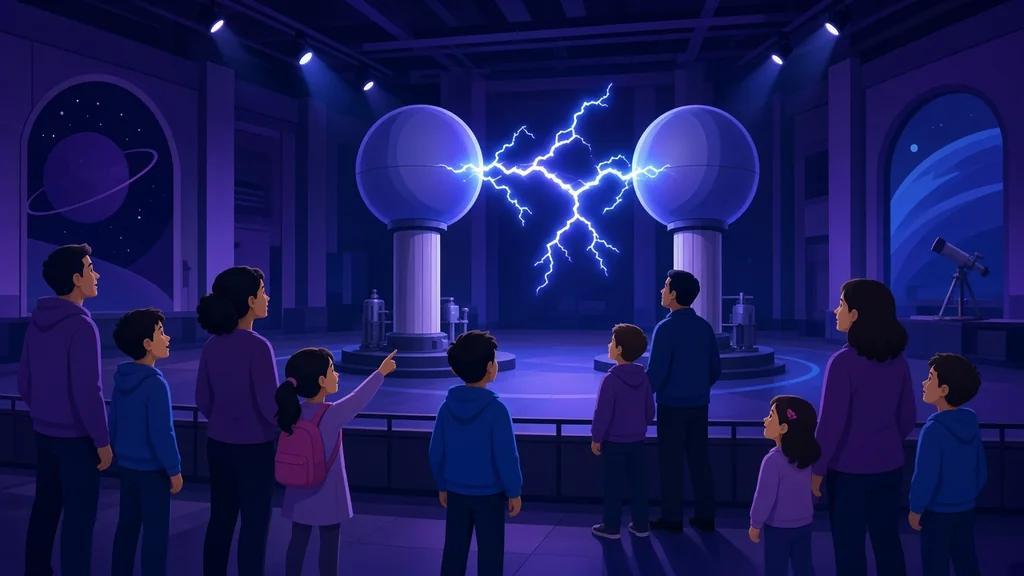
- Robert J. Van de Graaff built his first electrostatic generator at Princeton in 1929 and later completed the huge Round Hill machine for MIT in 1933. It is now permanently displayed at the Museum of Science in Boston, where demonstrations show huge sparks leaping between charged objects.
- Why it matters
- It makes the force between large accumulations of charge visible, and it was used for early nuclear physics research.
Limits
- Point charges: the simple formula applies to point charges or spherically symmetric charge distributions; other shapes require adding up many small pieces.
- Charges at rest: for moving charges, magnetic effects appear, and the full description needs Maxwell's equations.
- Very small scales: at atomic and subatomic scales, quantum electrodynamics refines the classical picture.
- Materials: inside a material, the force is reduced by the material's permittivity.
Related concepts
Coulomb's law parallels Newton's law of universal gravitation. Moving charges create a magnetic field, and changing fields produce electromagnetic waves. In circuits, the behavior of current is summarized by Ohm's law, and the structure of atoms depends on Coulomb attraction.
Frequently asked questions
- What is the formula for Coulomb's law?
- F = k q1 q2 / r², where k is about 8.99 × 10⁹ N·m²/C².
- How is Coulomb's law similar to gravity?
- Both forces follow an inverse-square law, but the electric force can attract or repel and is far stronger than gravity between particles.
- Where do we see Coulomb's law in daily life?
- Static cling, balloon tricks, lightning, photocopiers, laser printers, and electrostatic paint sprayers all rely on it.