
Why does calling your professor by their first name feel normal in one country and rude in another? Geert Hofstede spent his career mapping differences like that.

What the theory is
Hofstede was a Dutch social psychologist. His model describes national cultures with six dimensions, each a scale a country can sit higher or lower on. In his 2011 summary article he lists them as power distance, uncertainty avoidance, individualism/collectivism, masculinity/femininity, long/short-term orientation, and indulgence/restraint.

The six dimensions
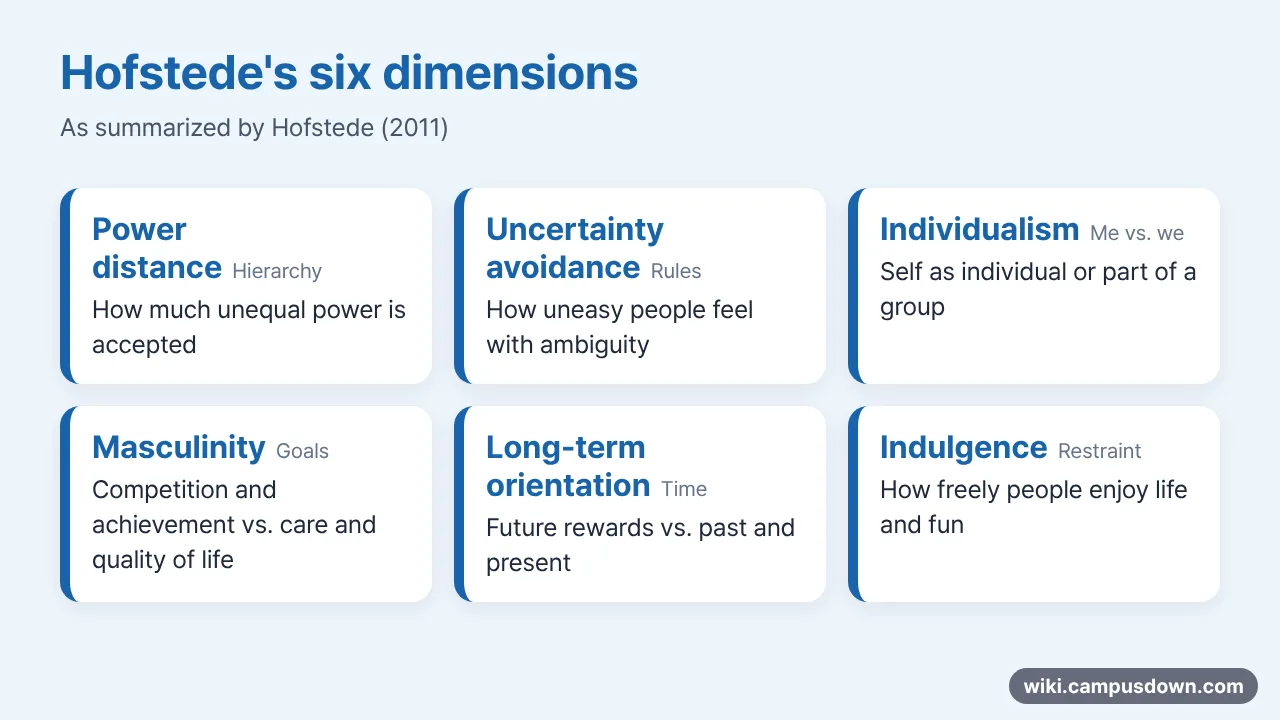
Power distance is how much people accept that power is unequally shared. Uncertainty avoidance is how uneasy people are with ambiguity. Individualism vs. collectivism is whether people see themselves mainly as individuals or as members of groups.
Masculinity vs. femininity contrasts competition and achievement with caring and quality of life. Long- vs. short-term orientation is about how much people focus on future rewards. Indulgence vs. restraint is how freely people allow themselves to enjoy life.
How people use it
Business schools, international companies and exchange programs use the model to prepare people for working across cultures. The Culture Factor Group offers an online tool for comparing countries' scores.
Limits to keep in mind
The dimensions describe averages for national cultures. Cultures also change over time, and countries contain many subcultures. Treat the model as a starting point for questions, not as a rulebook for people.
FAQ
- How many Hofstede dimensions are there?
- Six, in the model as Hofstede summarized it in 2011.
- Can I use Hofstede scores to judge a person?
- No. Hofstede warned the dimensions describe national cultures, not individuals.
- Where can I compare countries?
- The Culture Factor Group's country comparison tool.
Sources reviewed: 2026-11-20
References
- Hofstede, G. (2011). Dimensionalizing Cultures: The Hofstede Model in Context. Online Readings in Psychology and Culture, 2(1). Hofstede's own summary of the six dimensions, and his warning not to apply them to individuals.
- The Culture Factor Group. Country Comparison Tool. Interactive tool for comparing countries on the dimensions.