
Why would a lump of coal be a good-luck gift? In Scotland at New Year, it is, and it's part of a party called Hogmanay.

What Hogmanay is
Hogmanay is the Scottish word for the last day of the year and the celebrations around it. It first appears in written records in 1604, though many of its customs are older. Nobody is sure where the word comes from; Gaelic and Norman French are both suggested.

Why Scots partied at New Year, not Christmas
After the Reformation in Scotland, celebrating Christmas was discouraged. The gift-giving and partying moved to New Year. Christmas is widely celebrated in Scotland today, but Hogmanay is still the big night.
First-footing
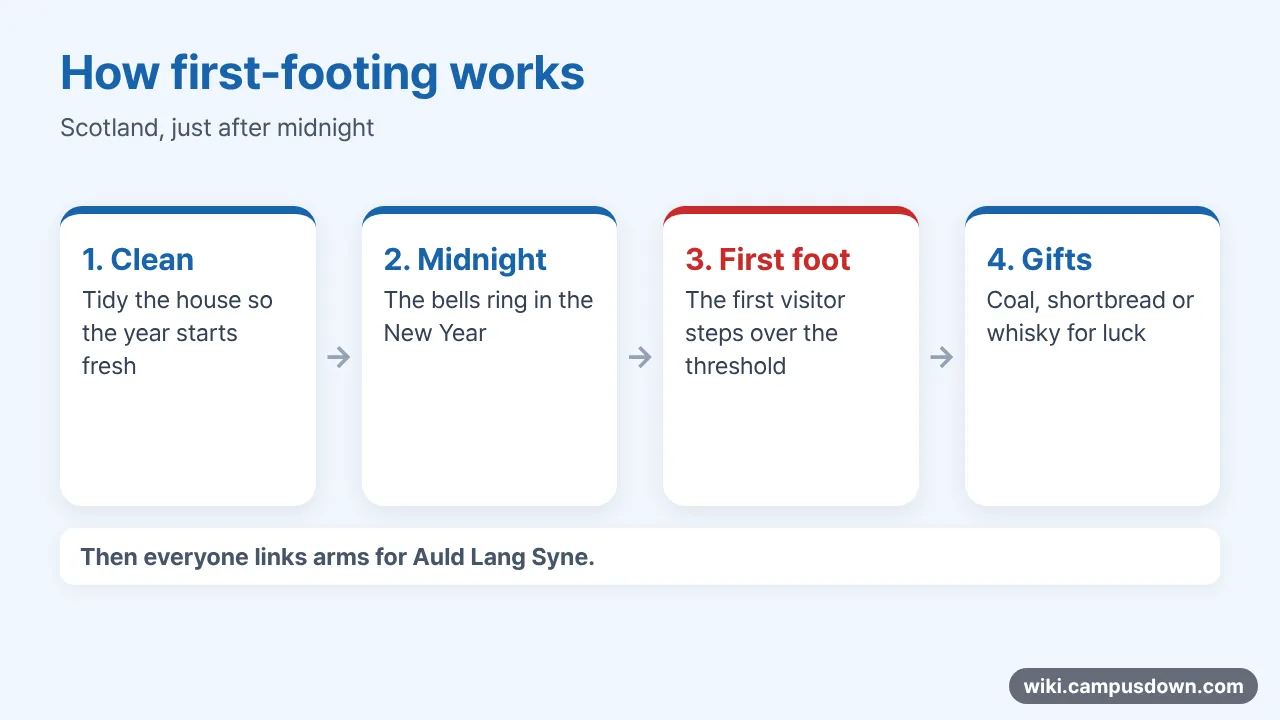
The best-known custom is first-footing: being the first person to enter a friend's or relative's home after midnight. Traditionally the luckiest first-footer is a tall, dark-haired man, and arriving empty-handed is a big no.
Fire, cleaning and song
- Clean house: some believe starting the year with a dirty house brings bad luck.
- Fire: torchlight processions, bonfires and fireworks. In Stonehaven, people swing giant fireballs on poles through the streets.
- Auld Lang Syne: Robert Burns's song, sung at midnight with arms crossed and hands linked.
FAQ
- When is Hogmanay?
- December 31, with celebrations running past midnight into New Year's Day.
- What do you bring when first-footing?
- Traditional gifts include coal, shortbread, black bun and whisky.
- How do you pronounce Hogmanay?
- Roughly "hog-muh-NAY," with the stress on the last syllable.
Sources reviewed: 2026-11-20
References
- Scotland.org. Hogmanay. History, first-footing, fire festivals.
- Scotland.org. Ten facts you might not know about Hogmanay. Gifts and Christmas history.
- Encyclopaedia Britannica. Hogmanay. Overview.