
Ever notice how December afternoons just… give up around 4:30? That's not your imagination, and it's not just the cold. The winter solstice is the single moment each year when the Sun hits the end of its southward road and, for a few days, seems to pause before heading back north.
So what exactly is the solstice?
It's a moment, not a whole day. Astronomers define the December solstice as the instant the Sun sits directly over the Tropic of Capricorn, about 23.4° south of the equator. In 2026 that happens on December 21 at 20:50 UTC, which is 3:50 p.m. in New York and already 5:50 a.m. on December 22 in Seoul.
The word comes from Latin sol (sun) and sistere (to stand still). Watch the sunrise point on your horizon through autumn and it creeps south every morning. Near the solstice the creeping almost stops. People noticed that pause thousands of years before anyone knew Earth was tilted.

Why it happens: the tilt, not the distance
Earth spins on an axis tipped about 23.4° relative to its orbit. In December the northern half leans away from the Sun. Sunlight arrives at a shallow angle, spreads over more ground, and the Sun's daily arc across the sky gets short and low.
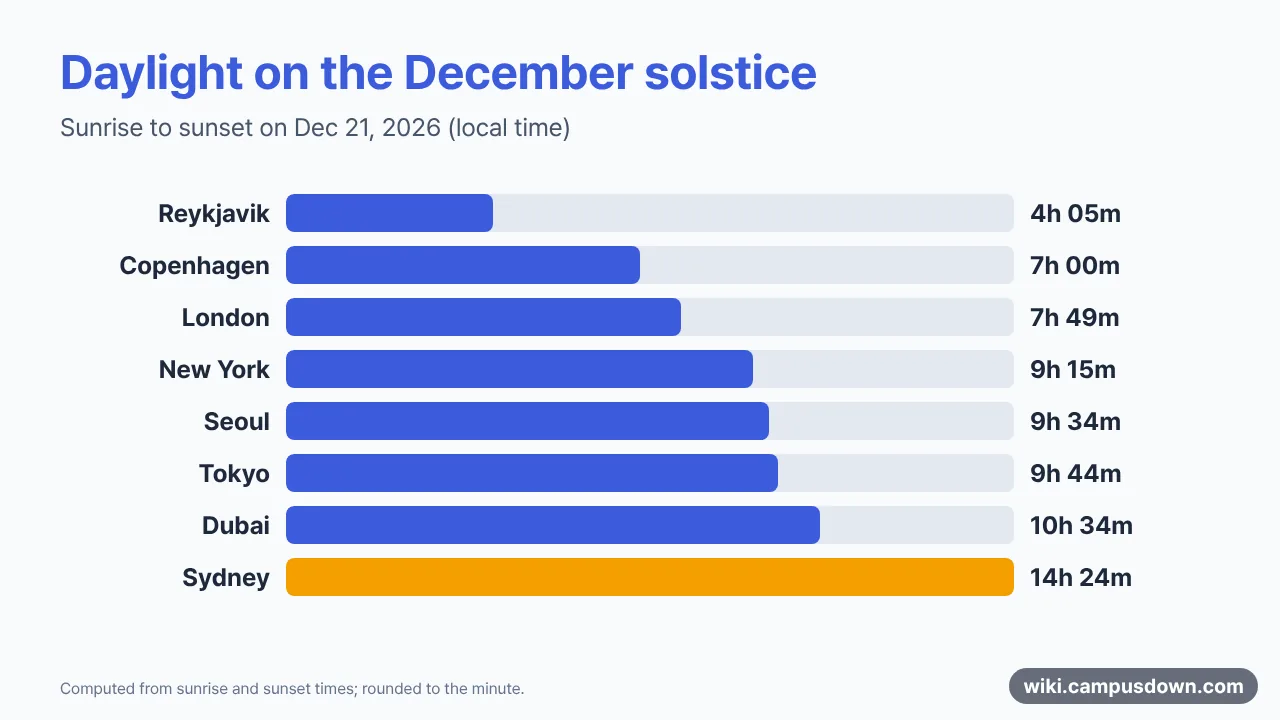
Fun twist: Earth is actually closest to the Sun in early January. Distance barely matters for seasons. Angle does. That's also why Sydney is having its longest day on the very same date.
At noon on the solstice the Sun climbs only about 29° above the horizon in Seoul, 26° in New York and 15° in London. Hold your fist at arm's length; one fist is roughly 10°. In London that's barely a fist and a half.
Shortest day, but not the earliest sunset
Here's the part that trips people up. In most mid-latitude cities the earliest sunset comes a week or two before the solstice, and the latest sunrise comes a week or two after. Earth's elliptical orbit and tilt shift solar noon a little later each day in December, so the whole daylight window slides later even while it shrinks. Total daylight still bottoms out on the solstice.
How people have marked it
- Stonehenge, England: the monument's main axis lines up with midwinter sunset in the southwest. English Heritage notes the setting Sun once dropped between the uprights of the tallest trilithon.
- Newgrange, Ireland: a passage tomb older than the pyramids, built so that sunrise light enters a roof-box and reaches the inner chamber around the solstice.
- Korea and East Asia: 동지 (Dongji) is one of the 24 solar terms. Families eat red-bean porridge, and older traditions treated the day as a "little New Year."
- Yule and other midwinter feasts in northern Europe gathered around the return of the light.
The common thread is simple. When the light runs out, humans throw a party for its comeback.
Does the solstice affect your mood or sleep?
Short days push sunrise later than many people's alarm clocks, and less morning light can nudge your circadian rhythm. For some people this season brings a real dip called seasonal affective disorder. A walk in the morning light is the cheapest experiment you can run.
FAQ
- Is the winter solstice always on December 21?
- No. In UTC it can fall on December 20, 21, 22 or 23, though the 21st and 22nd are most common. Your local date depends on your time zone.
- Does the day get longer right after the solstice?
- Yes, but only by seconds at first. The gain speeds up through January and February.
- Is it the coldest day of the year?
- Usually not. Land and oceans keep losing heat for weeks, so the coldest stretch often comes in January.
Sources reviewed: 2026-11-20
References
- timeanddate.com. (2026). December Solstice 2026: Longest & Shortest Day. Exact 2026 solstice moment, the word's Latin origin, and why sunrise and sunset times lag behind.
- English Heritage. (n.d.). Understanding Stonehenge. How the stones frame midwinter sunset and why midwinter may have mattered more to the builders.
- Newgrange.com. (n.d.). Newgrange, Brú na Bóinne. Background on the passage tomb and its winter solstice sunrise alignment.
- 한국천문연구원 천문우주지식정보. (n.d.). Korea Astronomy and Space Science Institute data on solar terms and sunrise times in Korea.