
The forecast says it's freezing. Then the wind hits and it feels way worse. That gap has a name: wind chill.
What wind chill means
The US National Weather Service defines wind chill as how cold people and animals feel when outside. It's based on how fast wind and cold pull heat from exposed skin. More wind, faster heat loss, colder feeling.
Their example: if it's 0°F (about −18°C) with a 15 mph wind, the wind chill is −19°F. At that level, exposed skin can freeze in about 30 minutes.

How it's calculated
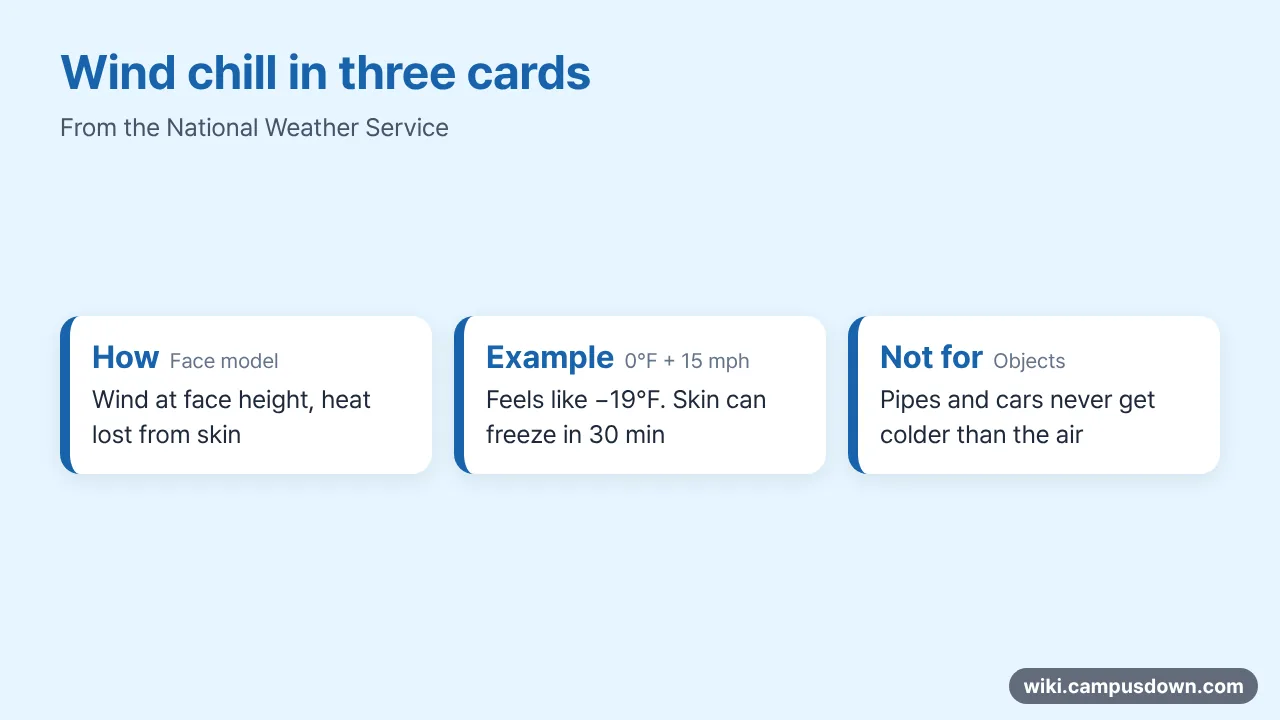
The NWS formula estimates wind at about 5 feet up, roughly face height, and is based on a model of a human face. It only applies at or below 50°F and with wind above 3 mph. Bright sunshine can make it feel 10 to 18°F warmer.
Wind chill and frostbite
Frostbite needs the actual air temperature to be below freezing. On a day above freezing, a low wind chill can't give you frostbite, though you can still get dangerously cold. Dress for the wind chill, not just the number on the thermometer.
FAQ
- Is wind chill the real temperature?
- No. It's how cold it feels on skin; the air itself isn't colder.
- Does wind chill affect cars or pipes?
- Only by cooling them faster to the air temperature, never below it.
- When does wind chill apply?
- At or below 50°F with wind above 3 mph.
Sources reviewed: 2026-11-20
References
- National Weather Service. Understanding Wind Chill. Definition, formula, 0°F + 15 mph = −19°F, 30-minute frostbite, limits, objects.
- NHS. Frostbite. What frostbite looks like and what to do.