
What do you call that feeling of a snowy night, a blanket, a hot drink and a friend who doesn't need you to say anything? Danes have a word for it: hygge. It's pronounced roughly "HOO-gah," and it might be the most useful thing to learn before finals season.

What hygge means
Hygge is a Danish and Norwegian word for a mood of coziness, comfort and contentment. It's less about stuff and more about atmosphere: feeling safe, relaxed and present, usually with people you like. A candlelit dinner can be hygge. So can a quiet coffee alone if you're actually enjoying it.

Why it caught on in English
English speakers started talking about hygge in a big way in the mid-2010s, after a wave of books on the subject, including Meik Wiking's The Little Book of Hygge (2016). Wiking runs the Happiness Research Institute in Copenhagen.
Denmark's reputation helped. It regularly ranks near the top of the World Happiness Report, and in the 2025 edition it placed second, behind Finland. Hygge is one popular explanation, though the report itself focuses on things like social support, trust, freedom and income.
Hygge's cousins
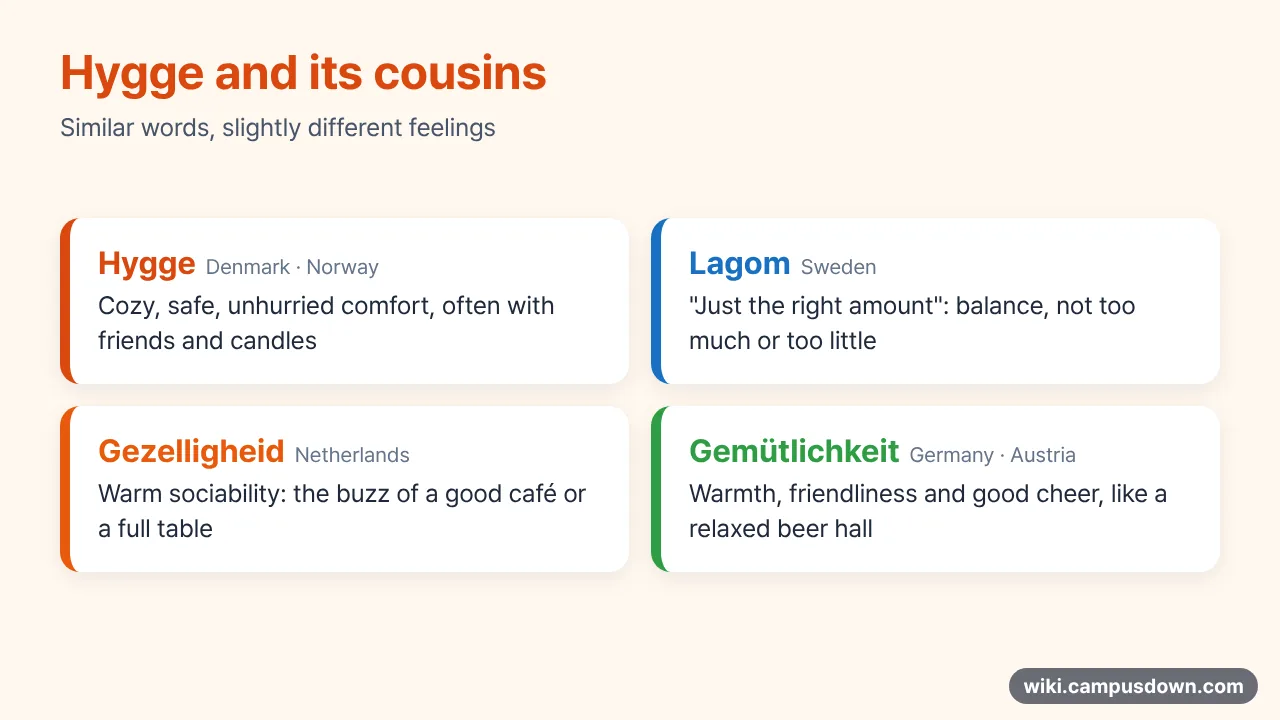
Nearby languages have their own versions. Swedish lagom means "just the right amount." Dutch gezelligheid is the warm buzz of good company. German Gemütlichkeit mixes coziness with cheer. Each one points at the same human need: feeling at ease with others.
How to try it (no shopping required)
- Dim the lights. Danes love candles and lamps over harsh overhead lighting.
- Invite a few people. Hygge works best in small groups.
- Put phones away. Being present is the whole point.
- Keep it simple. Soup, cocoa, board games, a walk in the cold, then warming up.
- Skip the competition. No bragging, no heated debates. Comfort first.
FAQ
- How do you pronounce hygge?
- Roughly "HOO-gah." The Danish vowel is a bit different from English, but that's close.
- Is hygge only for winter?
- No. Winter makes it obvious, but a summer picnic with friends can be just as hygge.
- What's the difference between hygge and lagom?
- Hygge is about coziness and togetherness. Lagom is about balance, having just enough.
Sources reviewed: 2026-11-20
References
- Den Danske Ordbog. hygge. The Danish dictionary entry.
- World Happiness Report 2025. Country rankings and what explains them.
- Happiness Research Institute, Copenhagen. Meik Wiking's research organization.