
CampusDownWiki
Total citations 126,015한국어KO 12,862EnglishEN 77,490日本語JA 9,775中文ZH 25,888
CampusDown ↗
English

White Elephant Gift Exchange

👥 Sociology By CampusDown Wiki Editorial Team Last updated Views 3
A white elephant gift exchange is a party game where guests bring one wrapped gift, then take turns opening a new gift or stealing one already opened. It is also called Yankee Swap or Dirty Santa.
Contents
  1. 1. What a white elephant gift exchange is
  2. 2. Basic rules
  3. 3. Why is it called a "white elephant"?
  4. 4. White elephant vs. Secret Santa
  5. 5. Why people love it
  6. 6. FAQ
  7. 7. References

What's more fun than getting a present? Stealing one, apparently. That's the whole charm of the white elephant gift exchange, the office-party and dorm-party game where the best gift can change hands three times before dessert.
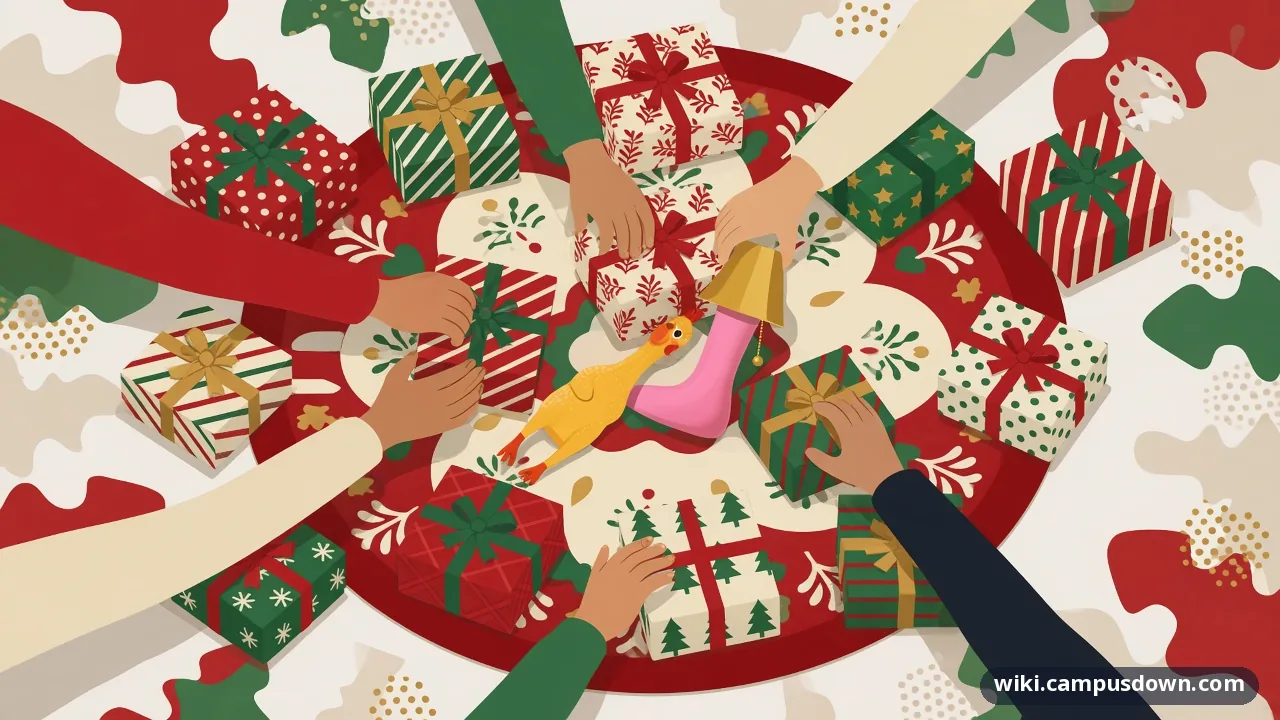
Top-down illustration of many hands reaching for wrapped holiday presents on a table, with a rubber chicken and a boot among the gifts
The rubber chicken will be stolen three times. Nobody knows why.

What a white elephant gift exchange is

Each guest brings one wrapped gift. Players take turns choosing: unwrap a new gift from the pile, or steal a gift someone already opened. The person who got robbed picks again. Nobody knows what's inside until it's opened, so a fancy box might hold socks and a tiny bag might hold the coveted gadget.

You might also hear it called Yankee Swap or Dirty Santa. The core open-or-steal move is the same.

Basic rules

  • Set a price cap so nobody overspends or underspends.
  • Draw numbers to set the order.
  • Player 1 opens a gift. Everyone after chooses: open or steal.
  • If your gift is stolen, you open a new one or steal another (many groups ban stealing straight back).
  • Many groups lock a gift after it's stolen three times.
  • Often player 1 gets a final chance to swap at the end, since they never got to steal.
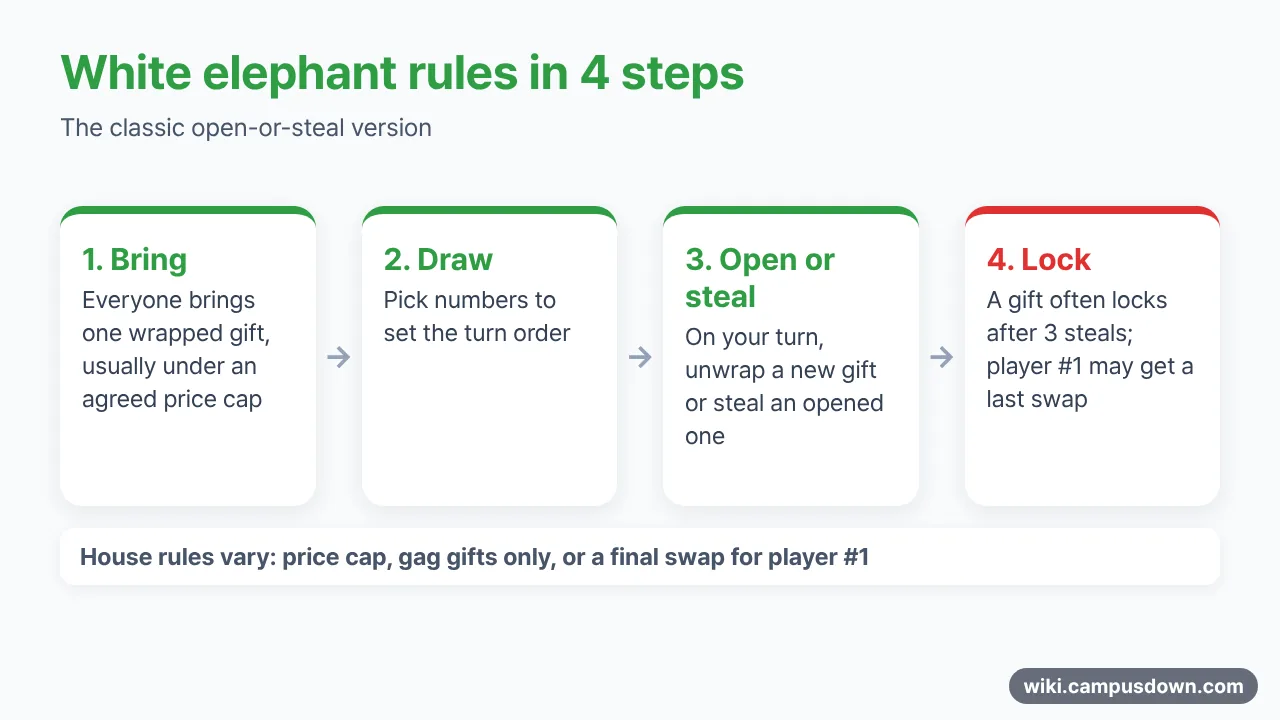
Four-step diagram of white elephant rules: bring a wrapped gift, draw numbers, open or steal, steal limit and final turn
The whole game in four moves.

Why is it called a "white elephant"?

A white elephant means a possession that costs more trouble than it's worth. The phrase comes from a popular story: a king of Siam supposedly gave a sacred white elephant to a courtier he disliked, knowing the animal's upkeep would ruin him.

The figurative phrase shows up in English by the mid-1800s; one early example is an 1851 letter by novelist Geraldine Jewsbury. By the 1890s, U.S. newspapers were promoting holiday "swap parties" where guests traded odd, unwanted items, and the white elephant name followed.

White elephant vs. Secret Santa

  • Secret Santa: you're assigned one person and buy a gift just for them. It's personal and stays secret.
  • White elephant: gifts are for anyone, and the fun is in the stealing. It works better for big groups where people don't all know each other.

Why people love it

Psychologists have a name for valuing something more once it's yours: the endowment effect. White elephant turns that into a game, because the moment a gift is yours, someone else can take it. Gift giving also has long been studied as a way of building social ties, from Marcel Mauss's The Gift onward.

FAQ

How many times can a gift be stolen in white elephant?
It depends on house rules. A common limit is three steals, after which the gift is locked.
What's a good price limit?
Whatever your group agrees on. The point is that everyone spends about the same.
Is Yankee Swap the same as white elephant?
Yes, mostly. The names differ by region and group, but the open-or-steal idea is the same.

Sources reviewed: 2026-11-20

References

  1. HISTORY. Why Is It Called a "White Elephant" Gift? The Siam legend, the 1851 letter and 1890s swap parties.
  2. Wordorigins.org. White elephant. Word history and why the gift story is a Western invention.
  3. The New York Times. (2022, November 23). A Brief History of the White Elephant Party. Alternate names and party history.

Found this helpful? Share it

Send it to a friend who needs it.

X Facebook Threads

Reports and materials that use this theory (Korean)

There are no materials dedicated to this theory yet, but you can search related reports in the CampusDown library (Korean).

Find more reports · Search '화이트 엘리펀트 선물 교환' on CampusDown →
Boxing DayBoxing Day is December 26, a public holiday in the UK and much of the Commonwealth. It has nothing to do with boxing matches. Here's where the name likely comes from, why 2026's holiday moves to Monday Dec 28 in the UK, and how people spend it.👥 SociologyHyggeHygge (say "HOO-gah") is the Danish idea of cozy, relaxed togetherness: candles, warm drinks, good people, no pressure. Meaning, how it compares with lagom and gezelligheid, the link to Danish happiness, and easy ways to try it.👥 SociologyThe Gift (Mauss)What Mauss's theory of the gift is: gifts seem voluntary but create obligations to give, receive and repay that bind social relations. Kula and potlatch, Gouldner's norm of reciprocity, Titmuss on blood donation and modern applications.👥 SociologyReciprocal AltruismWhat reciprocal altruism is: how costly help can evolve among non-relatives when it is returned later, Trivers's conditions, Axelrod's tournaments, animal evidence and debate, Nowak's five rules and human reciprocity.🔬 Natural SciencesEndowment effectRichard Thaler's endowment effect, the famous Kahneman–Knetsch–Thaler mug experiment where sellers asked about twice what buyers would pay, its link to loss aversion, and how free trials and return policies exploit it.🧠 PsychologyKrampusKrampus is the horned, birch-carrying companion of Saint Nicholas in Alpine folklore who shows up on Krampusnacht, December 5. Here's what the tradition actually is, what historians can and can't prove about its origins, and how it went global.🎨 Media, Arts & Culture

You may also like

This article was last updated on November 20, 2026. It is based on widely recognized original works and textbooks; when citing it in a paper, please check the original sources listed in the references.