
CampusDownWiki
Total citations 126,015한국어KO 12,862EnglishEN 77,490日本語JA 9,775中文ZH 25,888
CampusDown ↗
English

Seasonal Affective Disorder (SAD)

🩺 Nursing & Health By CampusDown Wiki Editorial Team Last updated Views 3
Seasonal affective disorder (SAD) is a type of depression that follows a seasonal pattern, usually starting in late fall or early winter and easing in spring and summer.
Contents
  1. 1. What SAD is
  2. 2. Symptoms
  3. 3. Who gets it
  4. 4. Why shorter days matter
  5. 5. Treatment
  6. 6. FAQ
  7. 7. References

Do you feel like a different person from November to March? Sleeping more, getting nothing done, wanting carbs and couch? Plenty of people get the "winter blues." For some, it's a real, treatable condition called seasonal affective disorder, or SAD.
Illustration of a woman at a desk by a dark, snowy winter window, reading under a warm desk lamp
When the sun clocks out at 4:30, your mood can try to leave with it.

What SAD is

The U.S. National Institute of Mental Health (NIMH) describes SAD as a type of depression that comes and goes with the seasons. It usually starts in late fall or early winter and lifts during spring and summer. To count as SAD, the symptoms show up most years, not just one bad winter.

Psychiatrist Norman Rosenthal and colleagues described and named it in a 1984 paper, which also tested light therapy.

Symptoms

SAD includes the usual signs of depression: low mood most of the day, losing interest in things you enjoy, low energy, trouble concentrating, feeling hopeless. On top of that, NIMH lists pattern-specific signs.
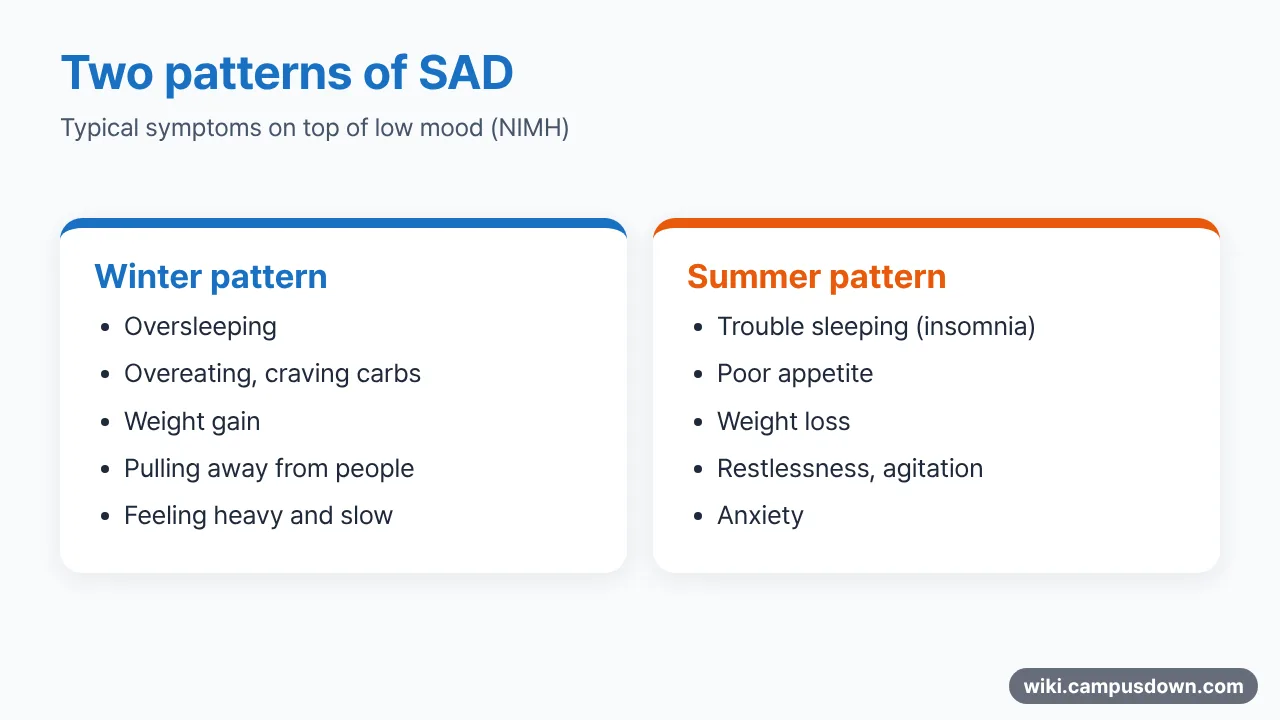
Comparison of winter-pattern and summer-pattern seasonal affective disorder symptoms
Most people with SAD have the winter pattern, but a summer pattern exists too.

Who gets it

NIMH notes that SAD is more common in women than men, often starts in young adulthood, and is more common the farther people live from the equator, where winter days are shortest. Students who move from a sunny hometown to a northern campus sometimes notice it for the first time.

Why shorter days matter

Researchers point to less sunlight disrupting the circadian rhythm, shifts in the brain chemical serotonin, and more melatonin, the hormone that makes you sleepy. Some people with SAD also have low vitamin D. The exact cause isn't fully settled.

Treatment

  • Light therapy: NIMH describes sitting in front of a bright light box (typically 10,000 lux) for about 30 to 45 minutes each morning, from fall to spring.
  • Talk therapy: cognitive behavioral therapy adapted for SAD.
  • Medication: antidepressants prescribed by a doctor.
  • Vitamin D: may help if a blood test shows you're low.

Getting outside in daylight, staying active and keeping a regular sleep schedule help too. Talk to a doctor before starting a light box, especially if you have eye conditions or bipolar disorder.

FAQ

Is SAD the same as the winter blues?
No. The winter blues are mild and don't stop daily life. SAD is depression that interferes with school, work or relationships and returns most years.
Do SAD lamps work?
Light therapy is a standard first-line treatment for winter-pattern SAD. Use it with a clinician's advice.
Can you get SAD in summer?
Yes, though it's less common. The summer pattern brings insomnia, low appetite and restlessness.

Sources reviewed: 2026-11-20

References

  1. National Institute of Mental Health. Seasonal Affective Disorder. Symptoms, risk factors and treatments.
  2. NHS. Seasonal affective disorder (SAD). UK overview and self-help.
  3. Rosenthal, N. E., et al. (1984). Seasonal affective disorder: A description of the syndrome and preliminary findings with light therapy. Archives of General Psychiatry, 41(1), 72–80. The original description.
  4. 988 Suicide & Crisis Lifeline. U.S. crisis support.

Found this helpful? Share it

Send it to a friend who needs it.

X Facebook Threads

Reports and materials that use this theory (Korean)

There are no materials dedicated to this theory yet, but you can search related reports in the CampusDown library (Korean).

Find more reports · Search '계절성 정동장애' on CampusDown →
Winter SolsticeThe winter solstice is the moment Earth's North Pole leans farthest from the Sun. The 2026 December solstice lands Dec 21, 20:50 UTC. Here's why it's the shortest day, why sunsets don't follow the rule, and how people mark it.🔬 Natural SciencesMajor depressive disorderMajor depressive disorder explained: from Hippocrates' melancholia to the DSM, the nine diagnostic symptoms lasting two weeks, the monoamine and stress-vulnerability models, how antidepressants and CBT compare, and where to get help.🧠 PsychologyCircadian RhythmHow the circadian rhythm works: the master clock in the brain's SCN, clock genes behind the 2017 Nobel Prize, melatonin and the two-process model of sleep, and how shift work, jet lag and late-night light disrupt your body clock.🩺 Nursing & HealthMelatoninHow melatonin works with light and your body clock, what studies show for insomnia, jet lag, and delayed sleep phase, why low doses taken at the right time matter most, label-accuracy problems with U.S. supplements, and side effects.🩺 Nursing & HealthVitamin DVitamin D explained: how sunlight and food supply it, how the 25(OH)D blood test is read, what the VITAL and D2d supplement trials found for cancer, heart disease, diabetes and fractures, and the risks of taking too much.🩺 Nursing & HealthHyggeHygge (say "HOO-gah") is the Danish idea of cozy, relaxed togetherness: candles, warm drinks, good people, no pressure. Meaning, how it compares with lagom and gezelligheid, the link to Danish happiness, and easy ways to try it.👥 Sociology

You may also like

This article was last updated on November 20, 2026. It is based on widely recognized original works and textbooks; when citing it in a paper, please check the original sources listed in the references.