
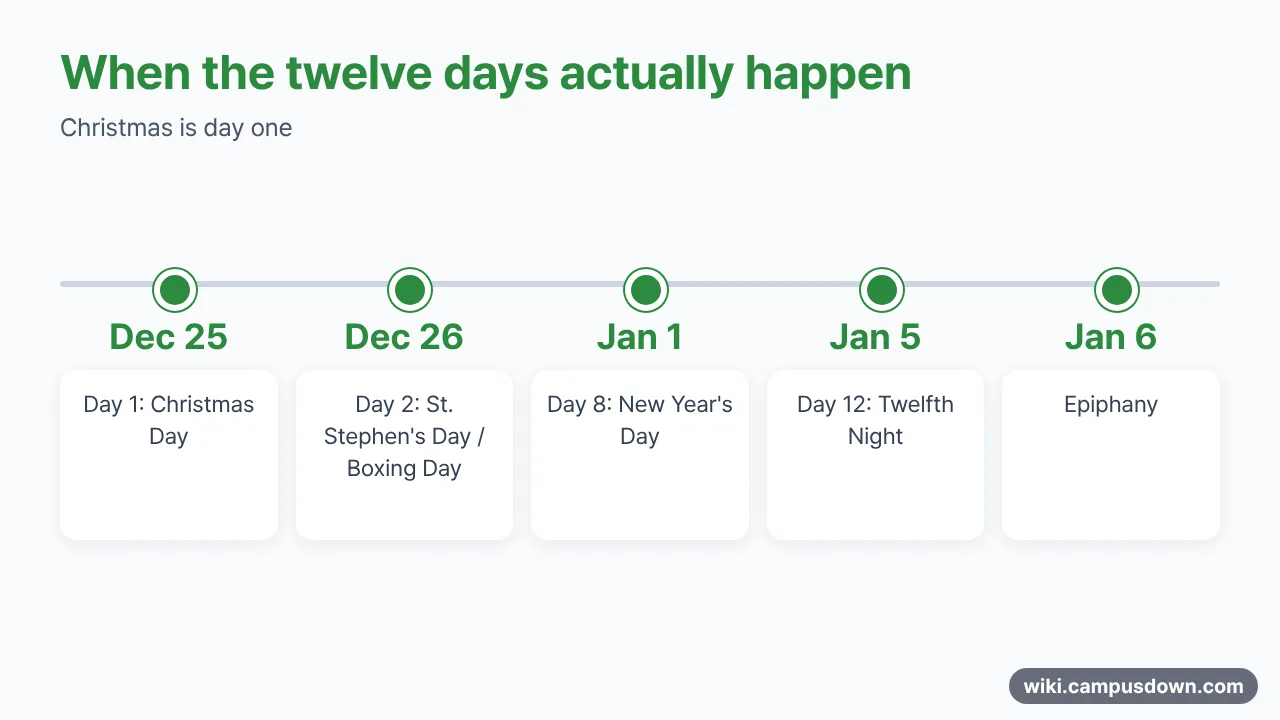
Quick: do the twelve days of Christmas end on Christmas, or start on it? Most people guess wrong. They start on December 25 and run into January.
What the twelve days are
In many Christian traditions, Christmas is not one day but a 12-day season called Christmastide. It begins on Christmas Day and ends on Twelfth Night, January 5. The next day, January 6, is Epiphany.
That's also why some people keep their decorations up until Twelfth Night.

Where the song came from
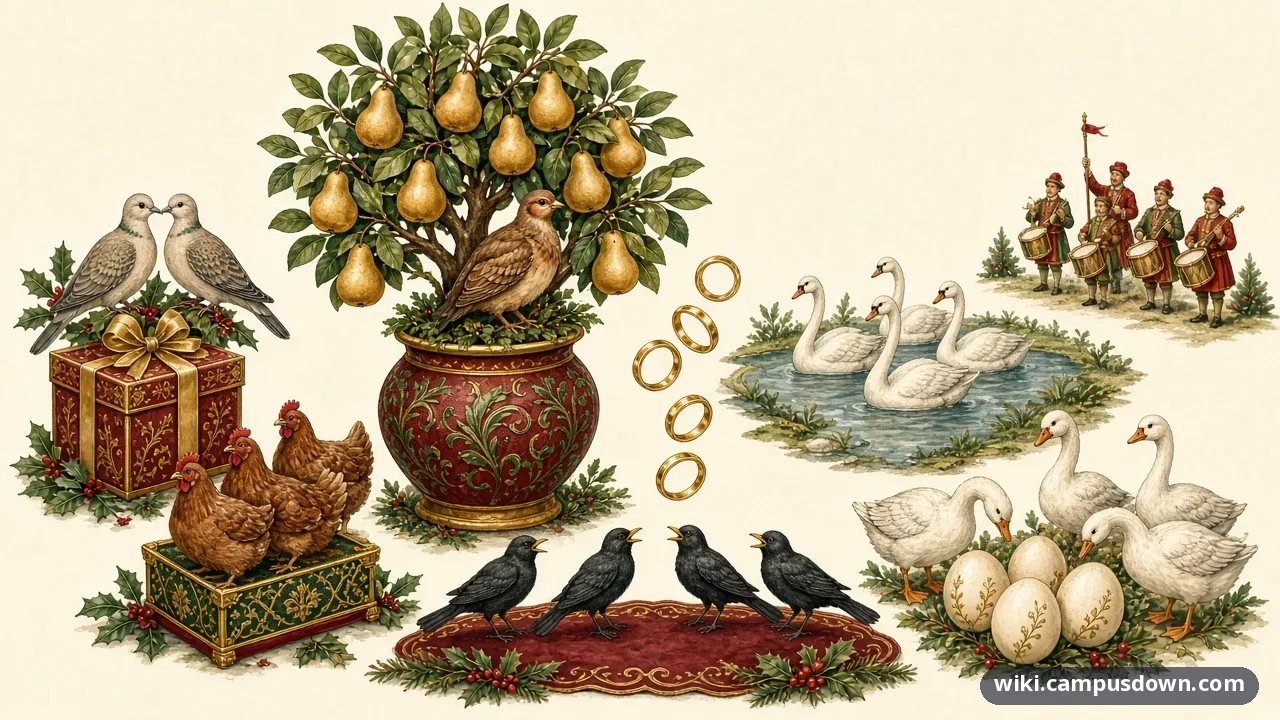
"The Twelve Days of Christmas" is a cumulative song: each verse adds a new gift and repeats all the earlier ones. It appeared in print in a London children's book, Mirth without Mischief, around 1780. The tune most people sing today comes from English composer Frederic Austin's 1909 arrangement, including the long, stretched-out "five gold rings."
Why the gifts add up to 364
Because the song repeats every earlier gift, the totals stack. Day 1 gives 1 gift, day 2 gives 2 + 1, day 3 gives 3 + 2 + 1, and so on. Add all twelve days and the true love hands over 364 gifts, almost one for every day of the year.
The bank PNC even runs a yearly "Christmas Price Index" that prices out every gift in the song, as a lighthearted economics lesson.
FAQ
- When do the 12 days of Christmas start?
- On Christmas Day, December 25.
- When is Twelfth Night?
- January 5, the evening before Epiphany.
- Who wrote the "five gold rings" melody?
- Frederic Austin composed those famous stretched-out bars for his 1909 arrangement.
Sources reviewed: 2026-11-20
References
- Encyclopaedia Britannica. Twelve Days of Christmas. December 25 to January 6.
- Library of Congress, From the Catbird Seat. Is It "Four Calling Birds" or "Four Colly Birds"? Mirth without Mischief, colly birds, Austin 1909.
- Princeton University, Index of Medieval Art. Five Gold Rings. Austin and the "five gold rings" bars.
- Encyclopaedia Britannica. Twelfth Night. January 5 and Epiphany.
- PNC. Christmas Price Index. Pricing the song's gifts.