
Every New Year's Eve, millions of people sing a song at midnight without knowing what the title means. So what is an "auld lang syne"? Short answer: old times. Long answer: a Scottish poet, a bandleader and a surprising trip around the world.

What "auld lang syne" means
The title is Scots. Word for word it's "old long since," and it means something like "days gone by" or "for old times' sake." The song asks a simple question: should old friends be forgotten? The answer is no, so let's share a drink to the good old days.
The best-known line, "we'll tak a cup o' kindness yet," means "we'll still raise a glass in friendship."

Who wrote it
Robert Burns, Scotland's national poet, sent the song to The Scots Musical Museum in 1788. He said he had taken it down from an old man's singing, though he clearly reworked it and added verses. It was published in 1796, the year Burns died. The tune most people sing today became the standard one a few years later.
Why it's a New Year's song
In Scotland, New Year's Eve is called Hogmanay, and singing Auld Lang Syne at midnight is a long tradition. In the US, bandleader Guy Lombardo made it the sound of midnight through his New Year's Eve broadcasts from 1929 onward.
A tune that traveled
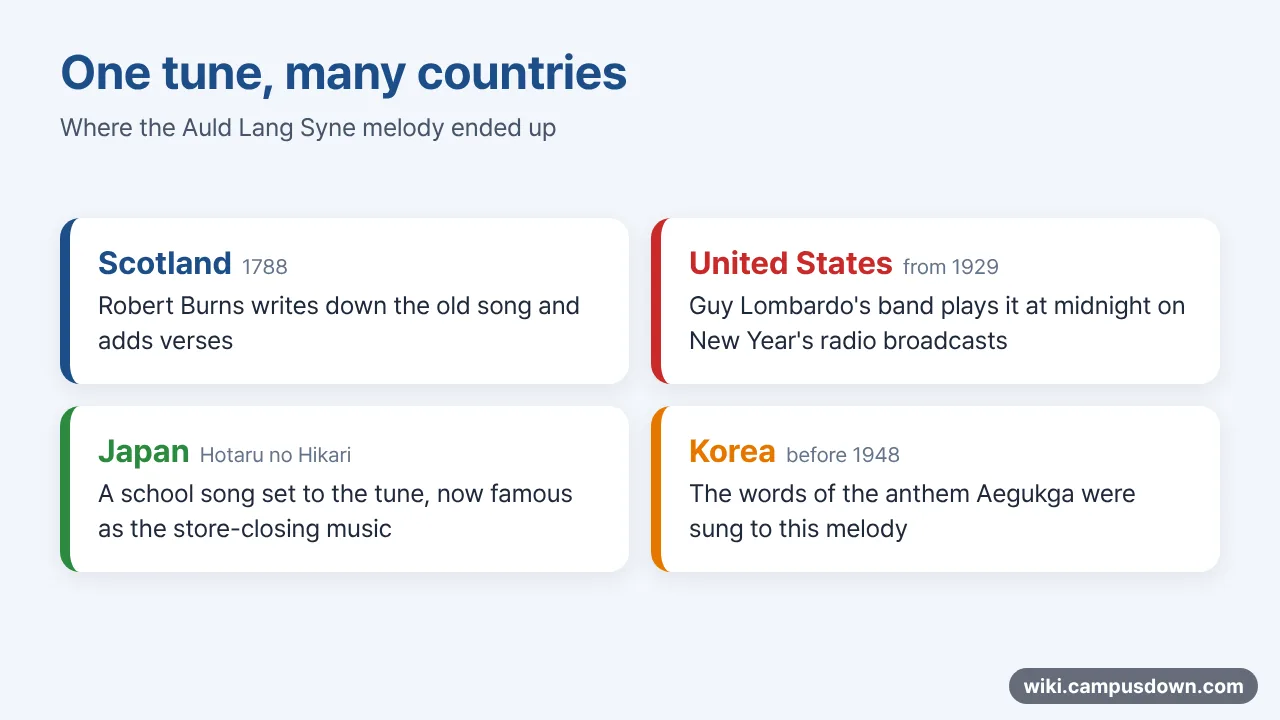
In Japan, the melody became the school song "Hotaru no Hikari" (Glow of the Fireflies), which many stores still play at closing time. In Korea, the words of the national anthem, Aegukga, were sung to this tune until Ahn Eak-tai's melody, composed in 1935, came into official use after the government was founded in 1948.
FAQ
- What language is Auld Lang Syne?
- Scots, a language closely related to English that's spoken in Scotland.
- Is it a sad song?
- It's bittersweet. It looks back at the past, but it's about keeping friendships alive.
- Do I have to know all the words?
- Nope. Most people know the first verse and the chorus.
Sources reviewed: 2026-11-20
References
- Encyclopaedia Britannica. Auld Lang Syne. Burns, the meaning and the tune.
- Ministry of the Interior and Safety (Korea). National symbols: Aegukga. The anthem sung to Auld Lang Syne before Ahn Eak-tai's melody.