
If you are not sure whether God exists, which choice is the smarter bet? In the 1650s the French mathematician Blaise Pascal answered with a famous piece of decision logic now called Pascal's Wager: believe, because what you could win is infinite and what you could lose is small.
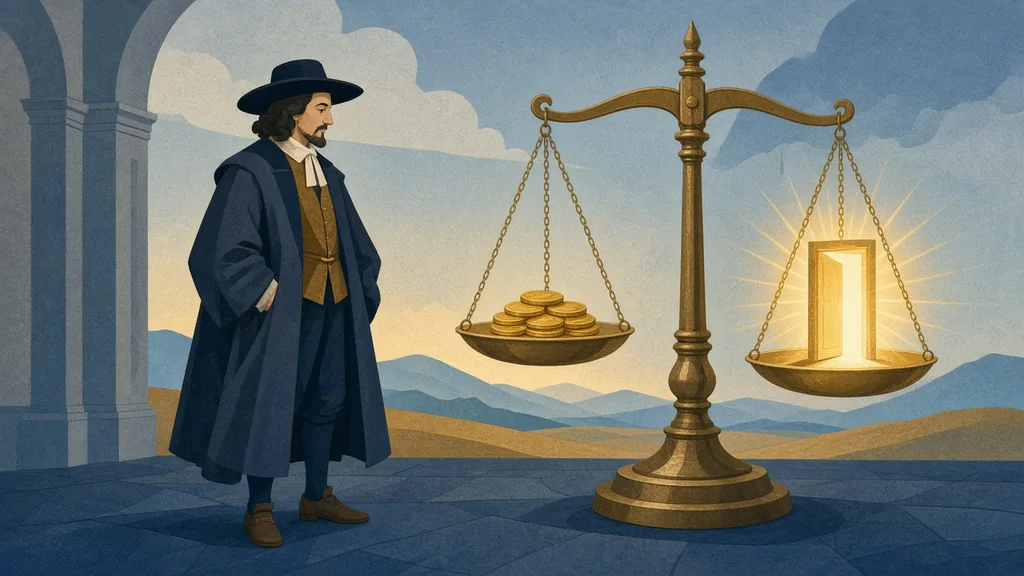
The argument in plain terms
Pascal wrote his notes for a defense of Christianity, published after his death as the Pensées (1670). He assumed that reason alone cannot prove or disprove God, so everyone has to "wager" one way or the other by how they live. Not choosing is itself a choice.
Pascal laid out the options roughly like this:
- Believe, and God exists: infinite gain (eternal life).
- Believe, and God does not exist: small finite loss (some pleasures given up).
- Do not believe, and God exists: infinite loss, or at least loss of the infinite good.
- Do not believe, and God does not exist: small finite gain.
In modern terms this is an expected value argument. As long as the chance that God exists is above zero, an infinite payoff swamps any finite cost, so belief "wins" the calculation. Pascal was also a founder of probability theory, which is why historians often call the wager one of the first uses of decision theory.
Key idea
The wager is not a proof that God exists. It is an argument about what it is rational to do when you cannot know.

Pascal's own reply to "but I can't just believe"
Pascal anticipated that people cannot switch belief on by willpower. His advice was to act as believers do, attend services, follow the practices, and let habits shape conviction over time. Critics see this as the weakest part of the argument, because it treats belief as something you can train rather than something based on evidence.

US cases
- When and where
- 1896, address to the philosophical clubs of Yale and Brown
- What happened
- The American philosopher and psychologist William James opened his famous essay by discussing Pascal's Wager. He rejected the bare betting version as unlikely to move anyone who did not already lean toward belief, but argued that when a choice is "live, forced, and momentous," people may let their passions decide where evidence is silent.
- Why it matters
- It became the classic American response, and a founding text of pragmatism.
- When and where
- 2007, Independence, Oregon
- What happened
- Greg Craven, a science teacher at Central High School, posted "The Most Terrifying Video You'll Ever See" on YouTube. He drew a two-by-two grid (act or not act, climate change real or not) and argued that the worst cell, doing nothing when the threat is real, makes action the safer bet. The video drew millions of views, and critics quickly compared it to Pascal's Wager.
- Why it matters
- It shows the wager's structure being used, and challenged, in a modern US policy debate.
Main objections
- The many-gods objection: if many religions promise infinite rewards and punishments, the wager does not tell you which one to pick.
- Infinity problems: any non-zero chance times infinity is infinite, so the argument cannot rank different options that each offer infinite payoffs. Philosophers call related puzzles "Pascal's mugging."
- Belief and sincerity: a God who rewards belief might not reward belief adopted as a bet.
- Hidden costs: a lifetime of practice is not always a small loss, and the wager assumes we know what God would value.
Related concepts
The wager is a starting point for game theory and decision theory, and is often compared to zero-risk bias in everyday choices. It also connects to existentialism, which takes up the same idea of choosing without certainty.
Study material (Korean): 「존재론적 논증의 역사적 흐름」
Frequently asked questions
- Is Pascal's Wager a proof that God exists?
- No. It argues that believing is the better bet under uncertainty; it does not claim to show that God exists.
- What is the many-gods objection?
- It says that many religions make similar infinite promises, so the wager alone cannot tell you which belief to choose.
- Why do people compare climate arguments to Pascal's Wager?
- Both use a grid of choices and outcomes and stress how bad one outcome could be, though climate risk rests on measured evidence rather than an unknowable chance.