
Why can a three-year-old produce sentences she has never heard before, using rules nobody ever taught her? Universal grammar is one famous answer: part of the human mind is prepared for language before any lesson begins. It is a core topic in American introductory linguistics, psychology and cognitive science courses, and it is also one of the most debated ideas in the field.
The basic idea
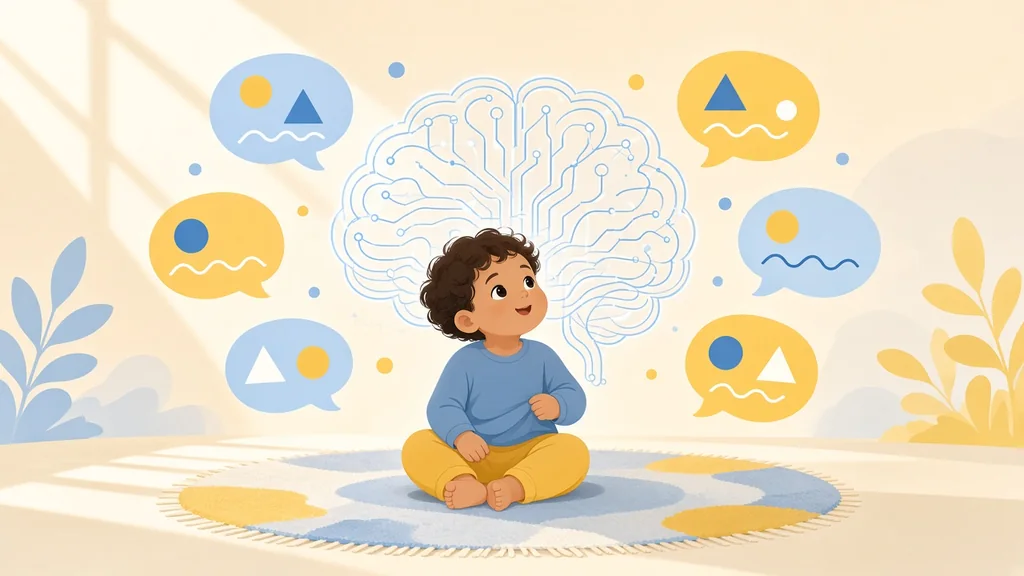
In the 1950s and 1960s Noam Chomsky, a linguist at the Massachusetts Institute of Technology, argued in works such as Syntactic Structures (1957) and Aspects of the Theory of Syntax (1965) that studying language means studying the mental knowledge that lets speakers produce and understand an unlimited number of sentences. He proposed that children are born with a biologically given capacity for language, sometimes called a language acquisition device, and that the common structure shared by all human languages reflects this capacity.
Key idea
Universal grammar is not a grammar book that every language follows. It is a hypothesis that humans are born with a built-in language faculty that limits which grammars a child will consider, which is why children can learn any human language quickly from limited input.

The poverty of the stimulus
The main argument for the idea is called the poverty of the stimulus. Children hear a limited and messy sample of speech, with false starts and few explicit corrections, yet they end up with knowledge of subtle rules. Supporters argue that the input is too thin to explain this result, so some knowledge must be innate. In the 1980s Chomsky and others developed the principles-and-parameters approach, in which languages share universal principles and differ by a small set of switch-like parameters set by experience.
US cases
- When and where
- 1973–1977, New York City
- What happened
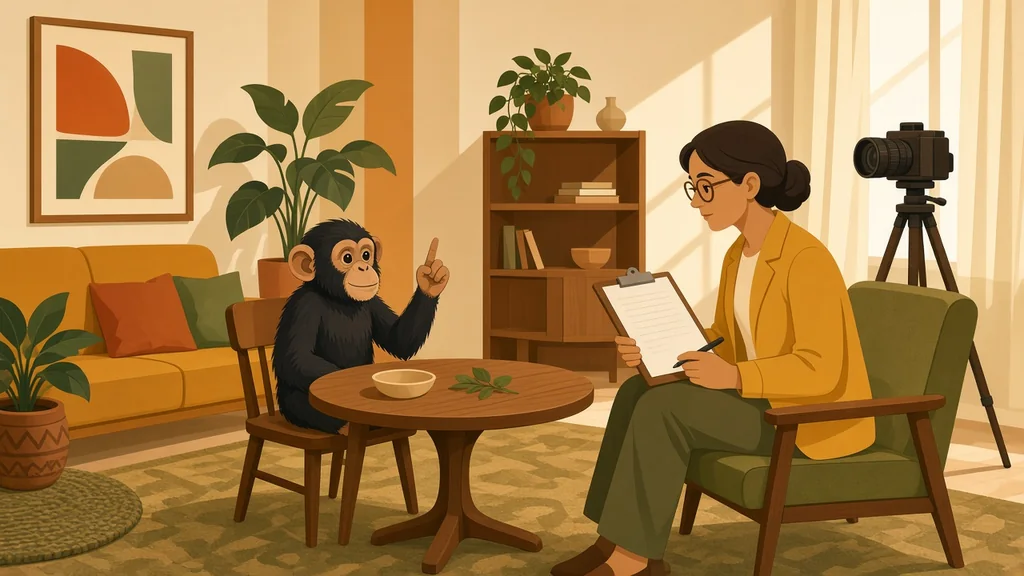
- Herbert Terrace, a psychology professor at Columbia University, launched a project in 1973 to see whether a chimpanzee could acquire American Sign Language. The chimp, born in Oklahoma and named Nim Chimpsky as a pun on Noam Chomsky, was raised in New York City and taught signs by a rotating group of roughly 60 caregivers. After reviewing video records, Terrace and colleagues reported in Science in 1979 that Nim's signing looked like imitation and prompting for rewards rather than the creative sentence-building of a child.
- Why it matters
- The result was widely read as support for the claim that human language is special, though critics of the project pointed to the frequent turnover of caregivers and the stress placed on the animal. Terrace's own paper was titled "Can an Ape Create a Sentence?"
- When and where
- November 22, 2002, Science
- What happened
- Marc Hauser, Noam Chomsky and Tecumseh Fitch published "The Faculty of Language: What Is It, Who Has It, and How Did It Evolve?" in the American journal Science. They distinguished a broad faculty of language, shared in part with other animals, from a narrow faculty that might consist mainly of recursion, the ability to embed structures inside structures.
- Why it matters
- The paper narrowed the claim about what exactly is uniquely human and opened a wave of experiments on animals, infants and different languages that continues today.
Criticisms
Many researchers reject the strong form of the theory. Usage-based and constructionist linguists, such as the American psychologist Michael Tomasello, argue that children build grammar from general learning abilities and social interaction rather than from an innate grammar. Studies of the Amazonian language Pirahã by the linguist Daniel Everett (2005) claimed that it lacks recursion, which would challenge the idea that recursion is universal. Others point out that the theory has changed form many times, making it hard to test, and that language diversity appears larger than early versions of the theory predicted.
Related concepts
Universal grammar is usually contrasted with learning-based accounts such as behaviorism, and it is one side of the debate summarized in theories of language development. The idea that language must be learned within a window of time links it to the critical period hypothesis. Questions about what makes language different from animal communication are covered in properties of language, and the use of language to perform actions is described in speech act theory.
Study material (Korean): 「영유아 언어발달 이론과 영유아 언어지도 방향」
Frequently asked questions
- What is universal grammar in simple terms?
- It is the idea, associated with Noam Chomsky, that humans are born with a built-in language faculty that shapes which kinds of grammar children can learn.
- Did Project Nim prove that animals cannot learn language?
- No. Terrace concluded that Nim's signing was mostly imitation, but the study had design problems, and the question of what animals can learn remains debated.
- Is universal grammar accepted by all linguists?
- No. It remains influential, but usage-based approaches and findings from languages such as Pirahã lead many researchers to question its strong form.
References
- Wikipedia: Universal grammar
- Terrace, H. S., Petitto, L. A., Sanders, R. J., & Bever, T. G. (1979). Can an Ape Create a Sentence? Science
- Hauser, M. D., Chomsky, N., & Fitch, W. T. (2002). The Faculty of Language: What Is It, Who Has It, and How Did It Evolve? Science
- Everett, D. L. (2005). Cultural Constraints on Grammar and Cognition in Pirahã. Current Anthropology
- Wikipedia: Nim Chimpsky