
CampusDownWiki
Total citations 125,995한국어KO 12,859EnglishEN 77,485日本語JA 9,775中文ZH 25,876
CampusDown ↗
English

AI Slop

🎨 Media, Arts & Culture By CampusDown Wiki Editorial Team Last updated Views 3
AI slop is low-quality digital content churned out in bulk with artificial intelligence: filler articles, uncanny images, fake videos. Merriam-Webster named "slop" its Word of the Year 2025.
Contents
  1. 1. What AI slop means
  2. 2. Where the word came from
  3. 3. Common kinds of AI slop
  4. 4. How to spot it
  5. 5. Why search engines push back
  6. 6. FAQ
  7. 7. References

Scrolled past a "heartwarming" photo where the kid had six fingers? Read a recipe blog that somehow said nothing in 2,000 words? That's AI slop, and in 2025 there was so much of it that dictionaries had to make room.

Illustration of a robot arm on a factory conveyor belt dumping piles of identical images into a giant slop trough
Made fast, made cheap, made in bulk. Nobody asked for it.

What AI slop means

Merriam-Webster made slop its 2025 Word of the Year and defines it as "digital content of low quality that is produced usually in quantity by means of artificial intelligence." Australia's Macquarie Dictionary picked the two-word version, AI slop, for its own 2025 Word of the Year.

Think of the old meaning of slop: cheap leftovers fed to pigs. Now picture that, but for your feed.

Where the word came from

People in online tech circles were using "slop" for unwanted AI output by 2024. In May 2024 programmer Simon Willison quoted a post comparing it to spam: just as "spam" became the word for unwanted email, "slop" was becoming the word for unwanted AI content. His own line: "Not all AI-generated content is slop. But if it's mindlessly generated and thrust upon someone who didn't ask for it, slop is the perfect term for it."
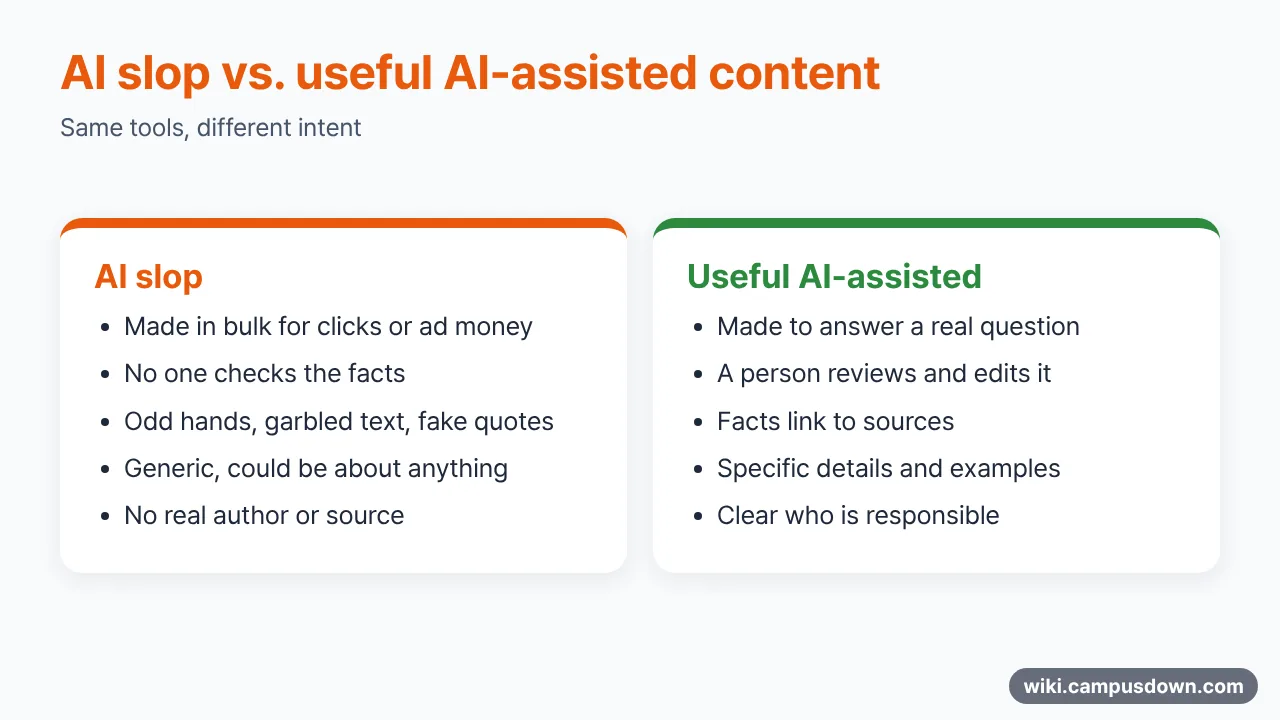
Checklist comparing useful AI-assisted content with AI slop
AI isn't the problem. Nobody checking is.

Common kinds of AI slop

  • Images built for likes: impossible animals, weird hands, fake "lost history" photos.
  • Articles stuffed with keywords that repeat themselves and cite nothing.
  • Videos with robotic narration over stock clips, uploaded by the hundreds.
  • Books and product listings rushed out to ride a trending topic.

How to spot it

  • Zoom in: hands, text on signs and backgrounds often break.
  • Look for a named author and real sources.
  • Check whether the account posts dozens of near-identical items a day.
  • Ask whether the page actually answers your question, or just circles it.

Why search engines push back

Google's spam policies name "scaled content abuse": producing many pages mainly to manipulate rankings rather than help people, whether made by AI, humans, or both. In other words, the method doesn't matter much. Mass-produced and unhelpful is the problem. That's also why good SEO today leans on real expertise.

FAQ

Is all AI-generated content slop?
No. Slop means low-quality, bulk and unreviewed. AI-assisted work that a person checks and stands behind isn't slop.
What was Merriam-Webster's Word of the Year 2025?
"Slop," defined as low-quality digital content usually mass-produced with AI.
Why is AI slop a problem?
It buries useful information, can spread false claims and wastes time.

Sources reviewed: 2026-11-20

References

  1. Merriam-Webster. Word of the Year 2025: Slop. Definition and announcement.
  2. Willison, S. (2024, May 8). Slop is the new name for unwanted AI-generated content. An early post that helped popularize the term.
  3. Google Search Central. Spam policies for Google web search. See "scaled content abuse."

Found this helpful? Share it

Send it to a friend who needs it.

X Facebook Threads

Reports and materials that use this theory (Korean)

There are no materials dedicated to this theory yet, but you can search related reports in the CampusDown library (Korean).

Find more reports · Search 'AI 슬롭' on CampusDown →
Rage BaitRage bait is online content designed to make you angry so you'll engage. Oxford named it Word of the Year 2025. Here's the definition, the research on why outrage spreads, the engagement loop behind it and a quick spotting checklist.🎨 Media, Arts & CultureParasocial RelationshipParasocial means feeling a connection with a famous person, fictional character or AI that doesn't know you. Cambridge Dictionary made it Word of the Year 2025. Definition, origin (Horton & Wohl, 1956), healthy vs. unhealthy signs and FAQ.🧠 PsychologySearch engine optimization (SEO)SEO from the 1990s keyword-stuffing era and Google's 1998 PageRank to the Panda and Penguin updates, Core Web Vitals, E-E-A-T, and helpful content: the key on-page, technical, and link factors, plus how AI-driven search is changing optimization.💼 BusinessMisinformation and Confirmation BiasWhy false information spreads and why people accept it. Covers mis-, dis- and mal-information, confirmation bias from Wason's task onward, filter bubbles and echo chambers, the continued influence effect, and remedies such as fact-checking and prebunking.🎨 Media, Arts & CultureFilter bubbleWhat a filter bubble is (Eli Pariser, 2011), how personalization algorithms create one, how it differs from an echo chamber, its link to confirmation bias, what research says about its real effects, and practical ways to break out.🎨 Media, Arts & CultureConfirmation BiasConfirmation bias explained: seeking, interpreting and remembering information that fits what you already believe, Wason's 2-4-6 task, Lord, Ross and Lepper's biased assimilation study, filter bubbles, and ways to counter it.🧠 Psychology

You may also like

This article was last updated on November 20, 2026. It is based on widely recognized original works and textbooks; when citing it in a paper, please check the original sources listed in the references.