
Ever typed a furious reply, hit send, and then realized that was exactly what the post wanted? Congrats, you've been rage baited. It happens to all of us, and in 2025 it happened often enough that Oxford University Press made it the Word of the Year.

What rage bait means
Oxford defines rage bait as "online content deliberately designed to elicit anger or outrage by being frustrating, provocative, or offensive, typically posted in order to increase traffic to or engagement with a particular web page or social media content." The keyword is deliberately. A post that makes you mad by accident isn't bait. A post engineered to make you mad is.
Oxford says usage of the term tripled over the 12 months before its December 2025 announcement, beating out the shortlist finalists "aura farming" and "biohack."

Why anger works so well online
Researchers have measured this. In a 2017 study of hundreds of thousands of tweets on hot-button issues, William Brady and colleagues found that each additional moral-emotional word in a post raised its retweet rate by about 20%. In a 2021 study of posts from news outlets and U.S. politicians, Steve Rathje, Jay Van Bavel and Sander van der Linden found that each word about the political out-group raised the odds of a share by about 67%.
Our brains also give bad news extra weight, a habit psychologists call negativity bias, and strong feelings spread from person to person through emotional contagion.
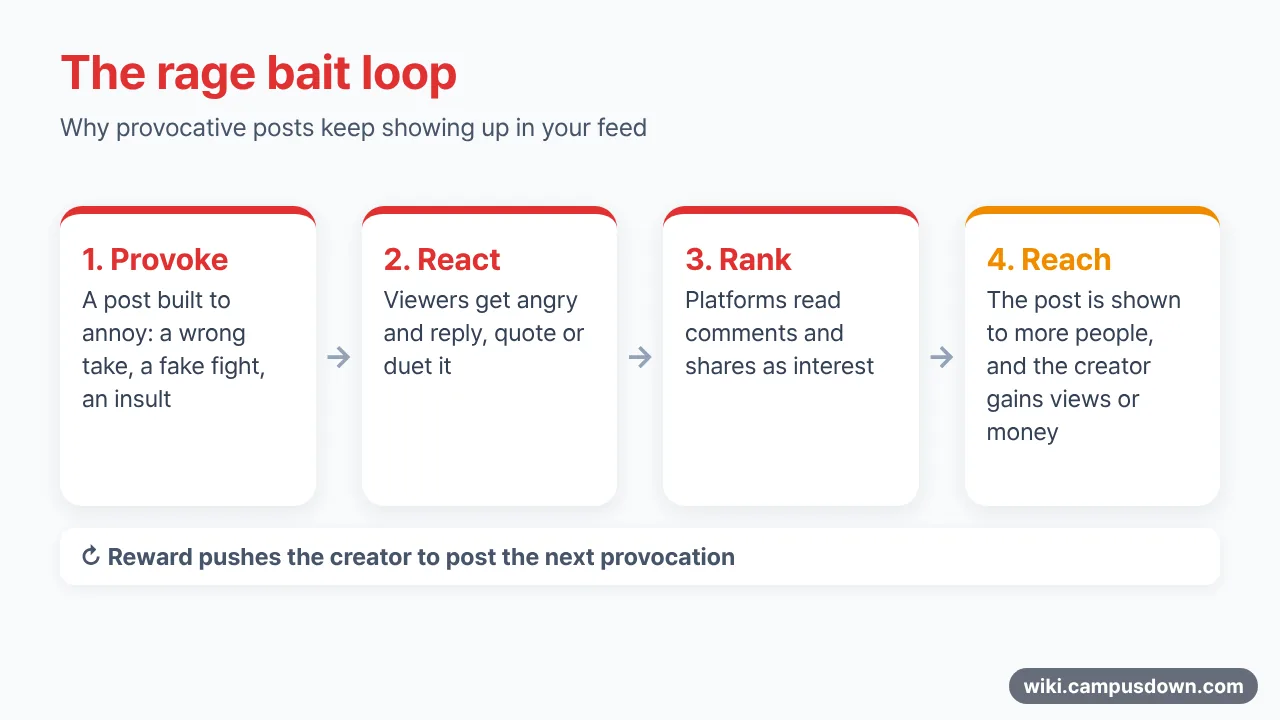
The rage bait loop
Most feeds rank posts partly by engagement: comments, shares, watch time. Angry reactions generate lots of all three. So the system learns "people care about this" and shows it to more people. The creator gets reach, followers, or ad money, and has every reason to do it again.
Rage bait vs. clickbait vs. trolling
- Clickbait teases curiosity to get a click. Rage bait provokes anger to get a reaction.
- Trolling is often about the fun of upsetting someone. Rage bait is usually about the numbers.
- Engagement bait is the umbrella: "comment YES if you agree" is the polite cousin.
How to spot it (and not feed it)
- Is the claim weirdly extreme, with no source?
- Does the post seem to want the argument more than the answer?
- Is the account new, anonymous, or posting this kind of thing nonstop?
- Does replying change anything, or just boost it?
If it's bait, the strongest move is boring: scroll past, mute, or use "not interested." Quote-posting to dunk on it still spreads it, sometimes deeper into an echo chamber.
FAQ
- Is rage bait the same as misinformation?
- Not always. Rage bait can be true but framed to enrage. It overlaps with misinformation when the provocation is false.
- Who chose rage bait as Word of the Year?
- Oxford University Press, for 2025. Other dictionaries picked different words that year, such as Cambridge's "parasocial" and Merriam-Webster's "slop."
- Does ignoring rage bait actually help?
- On engagement-ranked feeds, fewer reactions generally mean less reach, so not engaging removes the reward.
Sources reviewed: 2026-11-20
References
- Oxford University Press. (2025, December 1). The Oxford Word of the Year 2025 is rage bait. Official definition, shortlist and the tripled usage figure.
- Brady, W. J., Wills, J. A., Jost, J. T., Tucker, J. A., & Van Bavel, J. J. (2017). Emotion shapes the diffusion of moralized content in social networks. PNAS, 114(28), 7313–7318. Moral-emotional words and retweet rates.
- Rathje, S., Van Bavel, J. J., & van der Linden, S. (2021). Out-group animosity drives engagement on social media. PNAS, 118(26), e2024292118. Posts about the political out-group and the odds of being shared.