
CampusDownWiki
Total citations 126,015한국어KO 12,862EnglishEN 77,490日本語JA 9,775中文ZH 25,888
CampusDown ↗
English

Parasocial Relationship

🧠 Psychology By CampusDown Wiki Editorial Team Last updated Views 3
A parasocial relationship is a one-sided bond people feel with a celebrity, creator, fictional character or AI that doesn't know them. Cambridge Dictionary named "parasocial" its Word of the Year 2025.
Contents
  1. 1. What parasocial means
  2. 2. Where the term came from
  3. 3. Is it bad to have one?
  4. 4. Signs it's getting unhealthy
  5. 5. FAQ
  6. 6. References

Have you ever felt a little sad when a YouTuber you watch every week took a break, even though they've never heard of you? That feeling has a name, and in 2025 it became a dictionary star. Cambridge Dictionary picked parasocial as its Word of the Year.
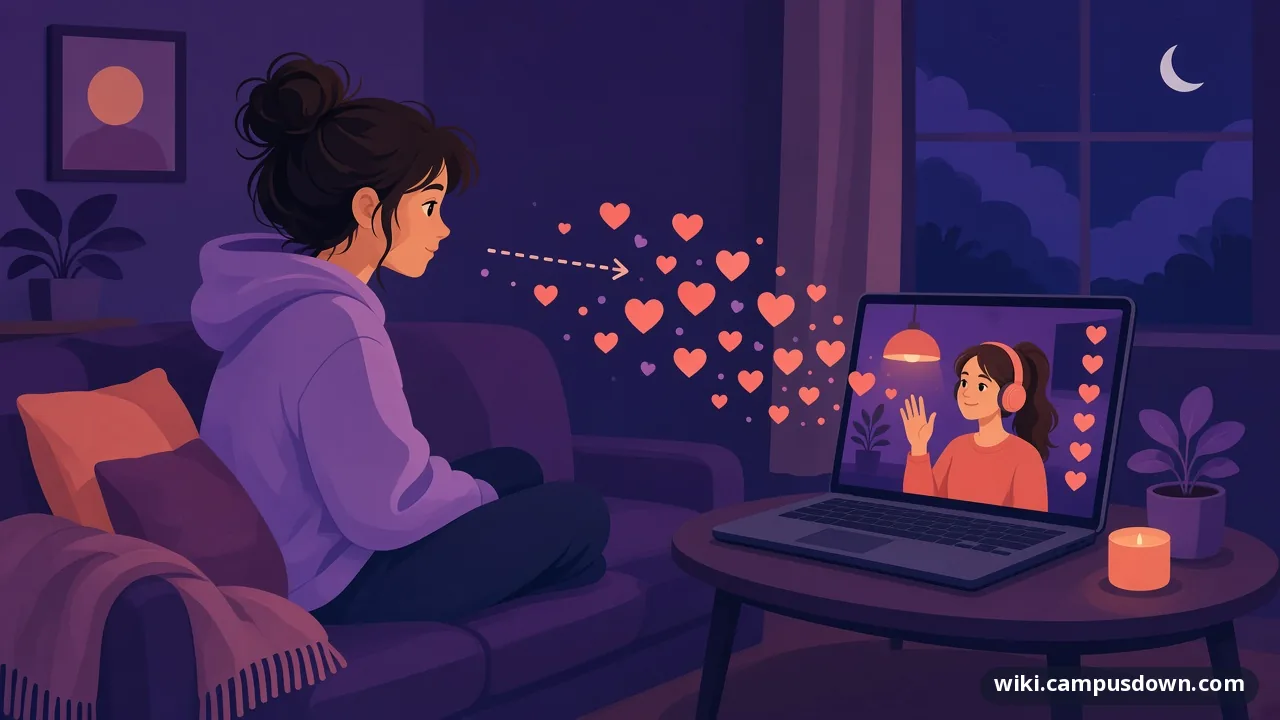
Illustration of a viewer on a couch sending a stream of hearts toward a streamer waving on a laptop screen
You know their coffee order. They don't know your name.

What parasocial means

Cambridge defines parasocial as "involving or relating to a connection that someone feels between themselves and a famous person they do not know, a character in a book, film, TV series, etc., or an artificial intelligence." The relationship is real on one side and missing on the other.

The AI part is new. Chatbots that remember your name and answer warmly can feel like a friend, which is one reason the word took off in 2025.

Where the term came from

Sociologists Donald Horton and R. Richard Wohl coined "para-social interaction" in a 1956 paper in the journal Psychiatry. They were looking at TV and radio hosts who spoke straight to the camera as if chatting with each viewer. Their phrase for it was "intimacy at a distance."
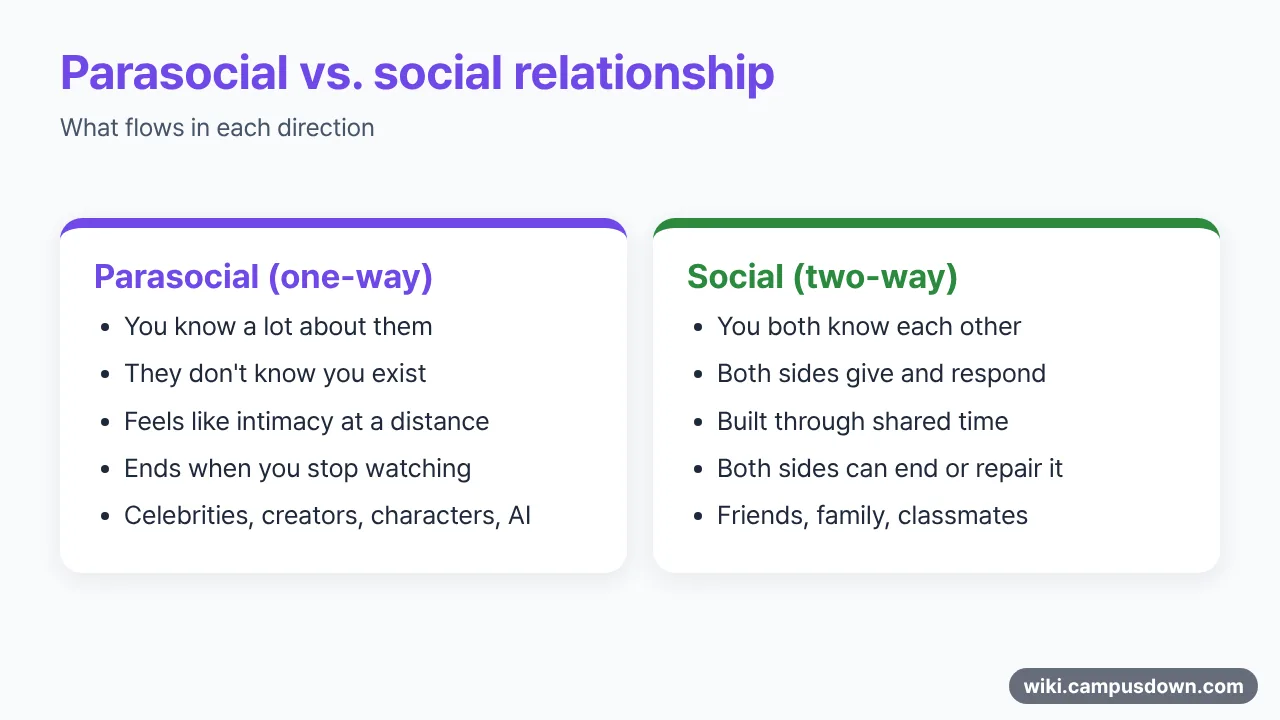
Comparison chart of a parasocial relationship versus a two-way social relationship
Same warm feelings, very different wiring.

Is it bad to have one?

Mostly, no. Feeling close to a favorite author, athlete or podcaster is normal and can be comforting, motivating, even a way to find community with other fans. It links to uses and gratifications research: people pick media that meets real needs.

Researchers studying celebrity worship, such as McCutcheon and colleagues in 2002, describe a range. It starts with enjoying a star for entertainment and talking about them with friends. At the far end, it becomes intense personal feelings that can crowd out real life.

Signs it's getting unhealthy

  • You spend money or time on it that you can't afford.
  • You feel betrayed or furious when the person acts like a stranger, because they are one.
  • Real relationships start to feel like too much work by comparison.
  • You'd trust their advice over people who actually know you.

FAQ

What is an example of a parasocial relationship?
Feeling like a streamer is your friend because you watch daily, or grieving when a fictional character dies.
Can you have a parasocial relationship with AI?
Yes. Cambridge's definition names artificial intelligence directly.
Who coined parasocial?
Donald Horton and R. Richard Wohl, in 1956.

Sources reviewed: 2026-11-20

References

  1. Cambridge Dictionary. (2025, November 18). Cambridge Dictionary Word of the Year 2025. Announcement and definition.
  2. Horton, D., & Wohl, R. R. (1956). Mass communication and para-social interaction: Observations on intimacy at a distance. Psychiatry, 19(3), 215–229. The paper that introduced the term.
  3. McCutcheon, L. E., Lange, R., & Houran, J. (2002). Conceptualization and measurement of celebrity worship. British Journal of Psychology, 93(1), 67–87. A scale for levels of celebrity attachment.

Found this helpful? Share it

Send it to a friend who needs it.

X Facebook Threads

Reports and materials that use this theory (Korean)

There are no materials dedicated to this theory yet, but you can search related reports in the CampusDown library (Korean).

Find more reports · Search '파라소셜 관계' on CampusDown →
Rage BaitRage bait is online content designed to make you angry so you'll engage. Oxford named it Word of the Year 2025. Here's the definition, the research on why outrage spreads, the engagement loop behind it and a quick spotting checklist.🎨 Media, Arts & CultureAI SlopAI slop is low-quality content mass-produced with AI. Merriam-Webster chose "slop" as its 2025 Word of the Year and Macquarie picked "AI slop". Definition, where the term came from, examples, how to spot it and why search engines push back.🎨 Media, Arts & CultureSocial Comparison TheorySocial comparison theory explained: Leon Festinger's (1954) idea that without objective standards people evaluate their abilities and opinions by comparing themselves with others. Covers the similarity hypothesis, upward and downward comparison, schadenfreude and social media.🧠 PsychologyBowlby's Attachment TheoryJohn Bowlby's attachment theory explained: its evolutionary basis, the four phases of attachment, internal working models, Mary Ainsworth's Strange Situation and the attachment patterns, plus later research.🧠 PsychologyUses and Gratifications TheoryUses and gratifications theory explained: Katz, Blumler and Gurevitch, the shift to what people do with media, the active audience, cognitive, affective, personal, social and tension-release needs, gratifications sought vs. obtained, and social media research.🎨 Media, Arts & CultureMere exposure effectWhat the mere exposure effect is, Zajonc’s 1968 experiments, the perceptual fluency explanation, examples in advertising, relationships and music, the inverted-U pattern in meta-analyses and when the effect fades.🧠 Psychology

You may also like

This article was last updated on November 20, 2026. It is based on widely recognized original works and textbooks; when citing it in a paper, please check the original sources listed in the references.