
Why can't someone build a machine that keeps running forever without fuel? The answer is one of the most tested ideas in all of science: the law of conservation of energy. Energy can change form, but in an isolated system the total amount never goes up or down.

Definition
The law states that the total energy of an isolated system stays constant. Energy moves between forms, such as kinetic energy of motion, potential energy of height or stretched springs, chemical energy in fuel and food, heat, light and electricity, but none is created from nothing and none disappears. In thermodynamics this is the first law: the change in a system's internal energy equals the heat added minus the work it does. Einstein's relativity added that mass itself is a form of energy, so mass and energy are conserved together.
Key idea
Energy is never used up, it is converted. When people say a device "wastes" energy, they mean it turns energy into forms, mostly heat, that are hard to put back to work.

History
In the 1840s several scientists reached the idea independently. Julius Robert von Mayer argued that heat and work are equivalent, James Prescott Joule measured how much mechanical work produces a given amount of heat, and Hermann von Helmholtz stated a general principle of the conservation of force in 1847. Earlier, Émilie du Châtelet had helped show that the energy of motion depends on the square of speed.
US cases
- When and where
- Ongoing policy; Joseph Newman's application filed 1979
- What happened
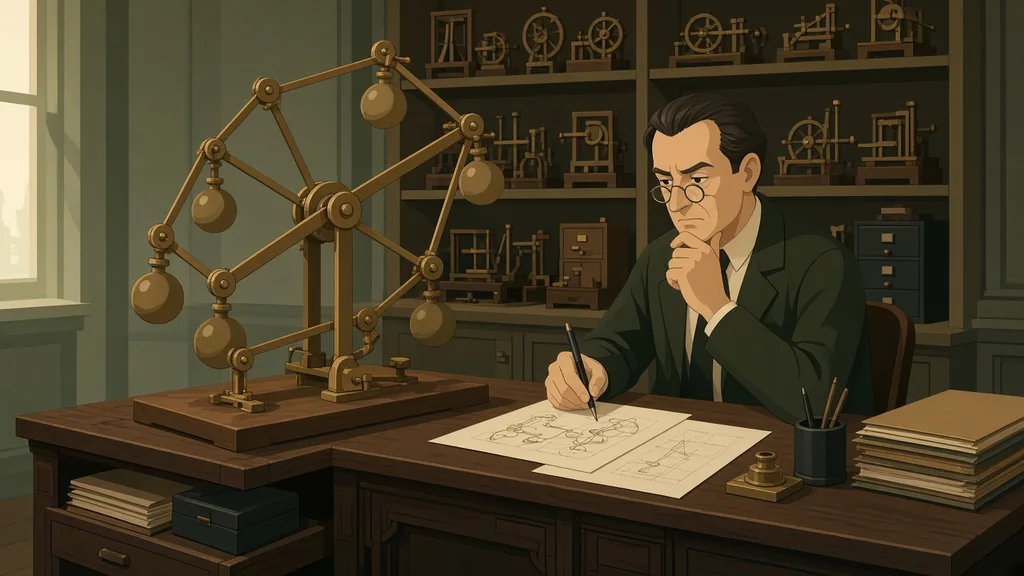
- The US Patent and Trademark Office normally does not ask inventors for a working model, but its examining manual makes an exception for perpetual motion. Joseph Newman's "energy machine" was rejected as a perpetual motion device, and a federal court ordered the machine sent to the National Bureau of Standards for testing.
- Why it matters
- The rule shows how firmly US law relies on conservation of energy: a claim of free energy is presumed impossible until a working device proves otherwise.
- When and where
- December 5, 2022, Lawrence Livermore National Laboratory, California
- What happened
- A laser pulse of 2.05 megajoules produced 3.15 megajoules of fusion energy, the first scientific breakeven in a controlled fusion experiment. Producing that laser pulse took about 300 megajoules from the grid.
- Why it matters
- The result did not create energy from nothing. It released energy stored in atomic nuclei, and the full accounting shows why fusion power plants are still far from net gain at the facility level.
Common misunderstandings
- "Energy is used up": it is converted to less useful forms such as low temperature heat.
- Efficiency over 100 percent: devices like heat pumps move heat rather than create it, so their high ratings do not break the law.
- Open systems: a system that receives energy from outside, such as a solar panel, can gain energy without violating conservation.
Related concepts
Conservation of energy is the first of the laws of thermodynamics. The second law, explained in the law of entropy, says usable energy tends to degrade, which leads to ideas like the heat death of the universe. Energy conservation works alongside Newton's laws of motion and appears in the photoelectric effect, where light's energy is handed to electrons.
Study material (Korean): 「발전단계와 엔트로피, 에너지 관련 핵심 내용 요약 정리」
Frequently asked questions
- What is the law of conservation of energy in simple terms?
- Energy cannot be made or destroyed. It only changes from one form to another, so the total stays the same in an isolated system.
- Why are perpetual motion machines impossible?
- A machine that produced work forever without an energy input would create energy from nothing, which the law forbids.
- Did the 2022 fusion experiment break conservation of energy?
- No. The fusion energy came from nuclei, and the facility used far more energy to power its lasers than the experiment produced.