
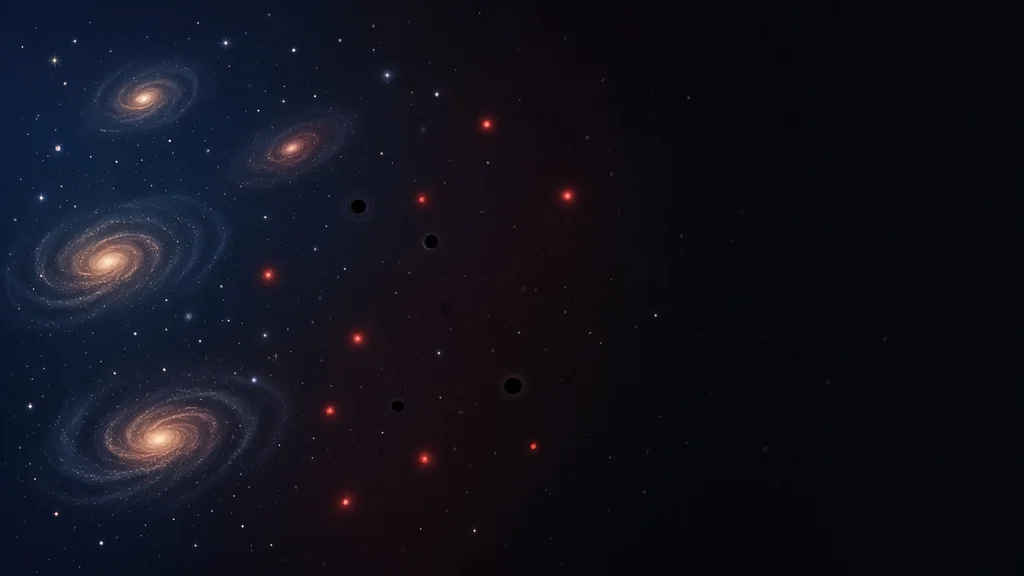
Will the universe end in fire or in ice? Most cosmologists today lean toward ice. In the scenario called the heat death of the universe, or the Big Freeze, the cosmos does not explode or collapse; it simply runs down until every place is equally cold and nothing can happen anymore.
The physics in plain terms
The idea comes from the second law of thermodynamics: in a closed system, entropy, a measure of disorder, tends to increase. Useful work, from a steam engine to a living cell, needs a difference in energy, such as hot next to cold. As entropy rises, those differences even out.
In the 1850s the British physicist William Thomson, later Lord Kelvin, extended this to the whole universe. If the universe is a closed system, he reasoned, it will eventually reach a uniform temperature, a state with no usable energy left. Hermann von Helmholtz and Rudolf Clausius developed the idea further.

How the far future might unfold
Modern cosmology adds expansion to the picture. If the universe keeps expanding forever, a rough sequence of eras is often described:
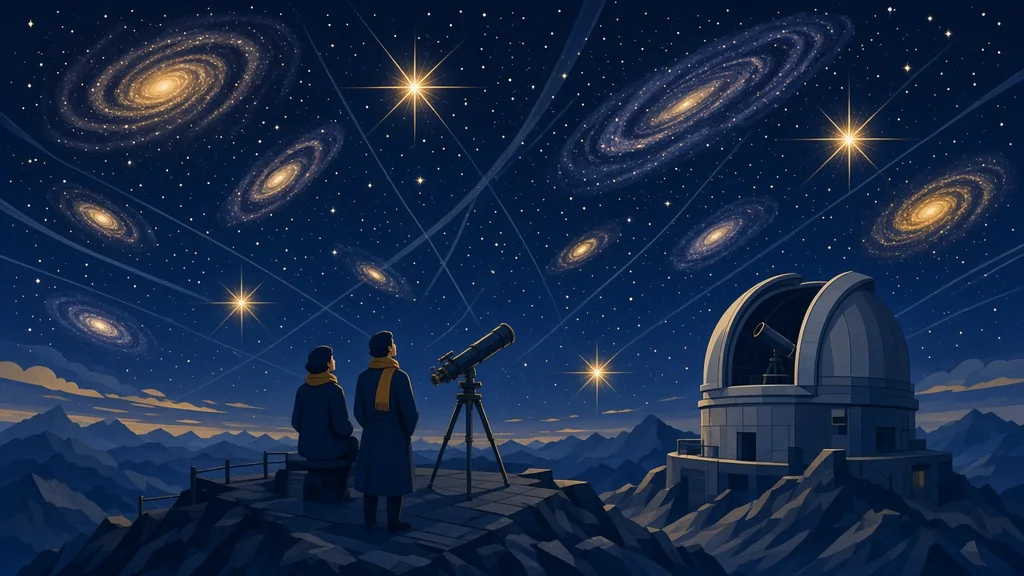
- Stars burn out: new star formation slows as gas runs out, and the longest-lived red dwarf stars eventually die.
- Black holes dominate: remaining matter ends up in black holes or scattered remnants.
- Black holes evaporate: according to Stephen Hawking's work, black holes slowly lose energy as radiation over unimaginably long times.
- Maximum entropy: what remains is a thin, cold, nearly uniform sea of particles and radiation.
Key idea
Heat death is not about high temperature. "Heat" refers to heat energy becoming evenly spread, so no temperature differences remain to do work.
US cases
- When and where
- 1998, Lawrence Berkeley National Laboratory and the High-Z Supernova Search Team
- What happened
- Two teams measuring distant exploding stars, one led by Saul Perlmutter at Berkeley Lab and one including Adam Riess, then at UC Berkeley and later at Johns Hopkins, along with Brian Schmidt, found that the expansion of the universe is speeding up. The three shared the 2011 Nobel Prize in Physics.
- Why it matters
- An accelerating expansion, attributed to dark energy, makes an eternal, cooling universe, the Big Freeze, the leading scenario.
- When and where
- 1956, Science Fiction Quarterly
- What happened
- The American writer Isaac Asimov published a short story in which people keep asking an ever more powerful computer whether entropy can be reversed. Asimov later called it one of his favorite stories.
- Why it matters
- It is the best-known American work of fiction about heat death and still introduces many readers to the idea.
Open questions and criticisms
- Is the universe a closed system? Applying thermodynamics to the entire universe, including gravity and expanding space, raises unresolved technical questions.
- Dark energy may change: if dark energy grows or weakens over time, the future could instead be a "Big Rip" or even a "Big Crunch."
- Fluctuations: over infinite time, random fluctuations could in principle create new structure, which leads to puzzles such as the Boltzmann brain.
- Time scales: the timelines involved are so vast that the scenario cannot be tested directly.
Related concepts
Heat death follows from the laws of thermodynamics combined with an expanding universe described by Hubble's law and the Big Bang theory.
Study material (Korean): 「리프킨 엔트로피 독후감, 엔트로피 법칙과 세계관」
Frequently asked questions
- When will the heat death of the universe happen?
- Not for an almost unimaginable length of time, far longer than the current age of the universe; there is no practical date.
- Is heat death the same as the Big Freeze?
- Yes, the terms are usually used for the same scenario of a cold, uniform, expanding universe.
- Could the universe end another way?
- Yes. If dark energy behaves differently than expected, alternatives include the Big Rip and the Big Crunch.