
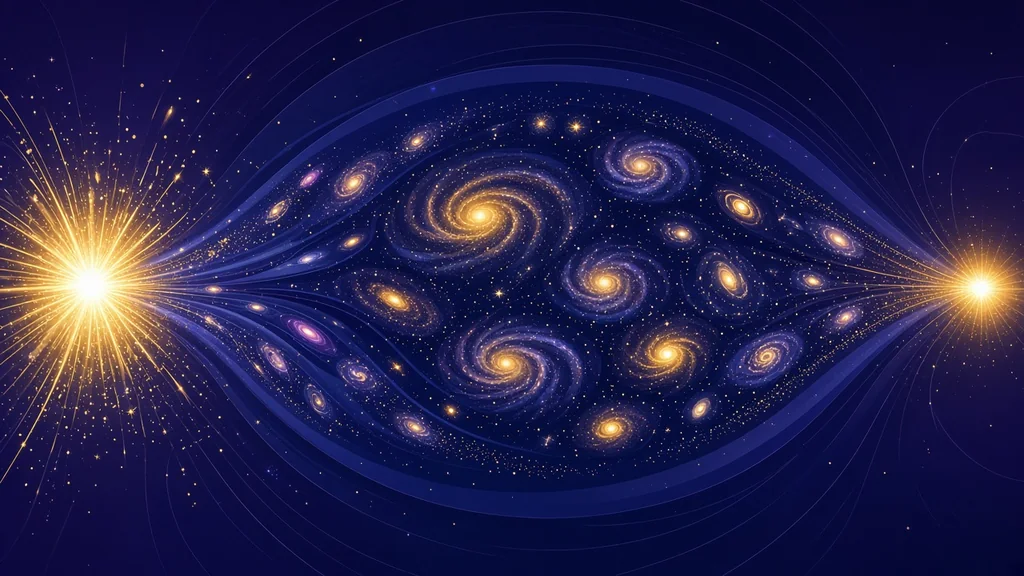
Will the universe expand forever, or could it one day fall back in on itself? The Big Crunch is the scenario in which cosmic expansion stops, reverses and pulls all matter and energy back into an extremely hot, dense state, a kind of Big Bang in reverse.
Definition
After the Big Bang, the universe has been expanding. Whether that continues depends on how much matter and energy it contains and on the nature of dark energy. In 1922 Russian physicist Alexander Friedmann derived equations from general relativity showing that the universe's fate depends on its density. If the density is high enough and gravity wins, expansion slows, stops and turns into contraction. Galaxies would draw closer, temperatures would soar, and the universe would end in a collapse.
Key idea
The Big Crunch is one of several possible endings. The others include endless expansion into a cold "Big Freeze," also called heat death, and a "Big Rip" in which expansion tears matter apart.

What changed in 1998
For much of the 20th century, many cosmologists thought the main question was whether gravity would eventually stop expansion. Then in 1998 two teams measuring distant exploding stars, type Ia supernovae, found that expansion is accelerating. Something, now called dark energy, is pushing the universe apart. If dark energy stays constant, a Big Crunch will not happen.
US cases
- When and where
- 1998, Lawrence Berkeley National Laboratory, California, and the High-Z Supernova Search Team
- What happened
- Saul Perlmutter's Supernova Cosmology Project at Berkeley Lab and the High-Z team, including Adam Riess and Brian Schmidt, independently found that distant supernovae were dimmer than expected, meaning expansion is speeding up.
- Why it matters
- The three shared the 2011 Nobel Prize in Physics, and the discovery made a Big Crunch appear unlikely.
- When and where
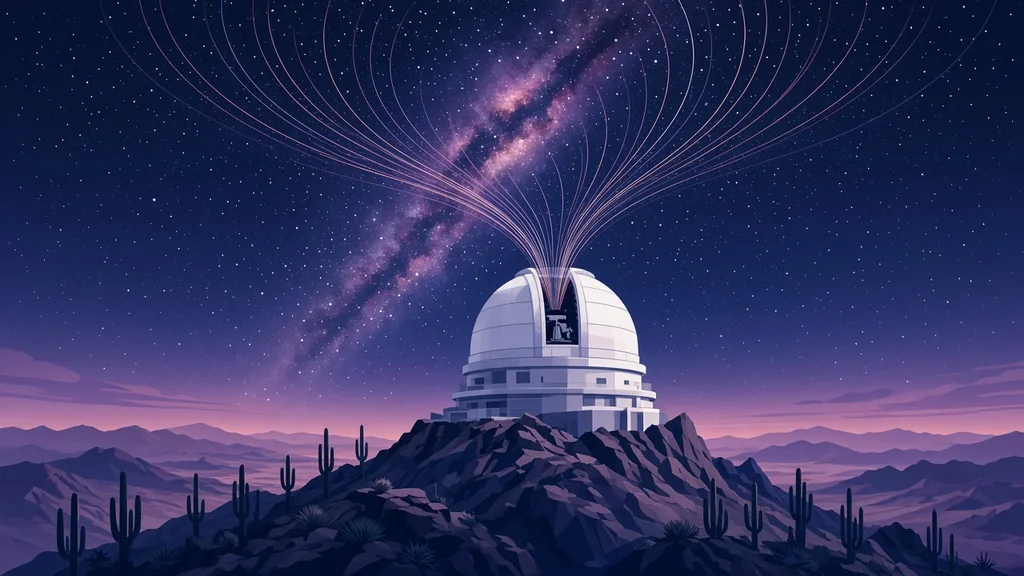
- April 2024 and March 2025, Kitt Peak National Observatory, Arizona
- What happened
- The Dark Energy Spectroscopic Instrument, mounted on the Mayall Telescope near Tucson and managed by Berkeley Lab, mapped millions of galaxies. Its results gave evidence consistent with dark energy evolving over time rather than staying constant, and analysis of three years of data strengthened that hint.
- Why it matters
- If dark energy weakens, the long-term future is open again, and some physicists have revisited collapse scenarios. The evidence is not yet conclusive.
Criticisms and open questions
- Against current data: with constant dark energy, the measurements favor endless expansion.
- Unknown physics: no one knows what dark energy is, so predictions billions of years ahead are uncertain.
- The singularity problem: general relativity breaks down at infinite density, so the end state requires a theory of quantum gravity.
Related concepts
The Big Crunch is usually contrasted with the heat death of the universe. It rests on Einstein's theory of relativity, and its final state resembles the inside of a black hole. Ideas such as the Big Bounce and the multiverse ask what could come after, and puzzles like the Boltzmann brain arise when cosmologists think about very long futures.
Frequently asked questions
- What is the Big Crunch in simple terms?
- It is the idea that the universe's expansion could stop and reverse, causing everything to collapse back into a tiny, hot, dense state.
- Is the Big Crunch likely?
- Current evidence of accelerating expansion makes it unlikely if dark energy stays constant, but recent results suggesting dark energy may change have reopened the question.
- What is the Big Bounce?
- A related idea in which a collapsing universe rebounds into a new Big Bang, possibly repeating in cycles.