
You see a video of a celebrity saying something outrageous. It looks real, it sounds real... but it never happened. Welcome to the deepfake era.
What a deepfake is
A deepfake is a video, photo or audio recording that seems real but has been manipulated with artificial intelligence. The name mixes "deep learning," a type of AI, with "fake." The technology can swap faces, change expressions, create faces that don't exist and copy someone's voice.

How deepfakes are made
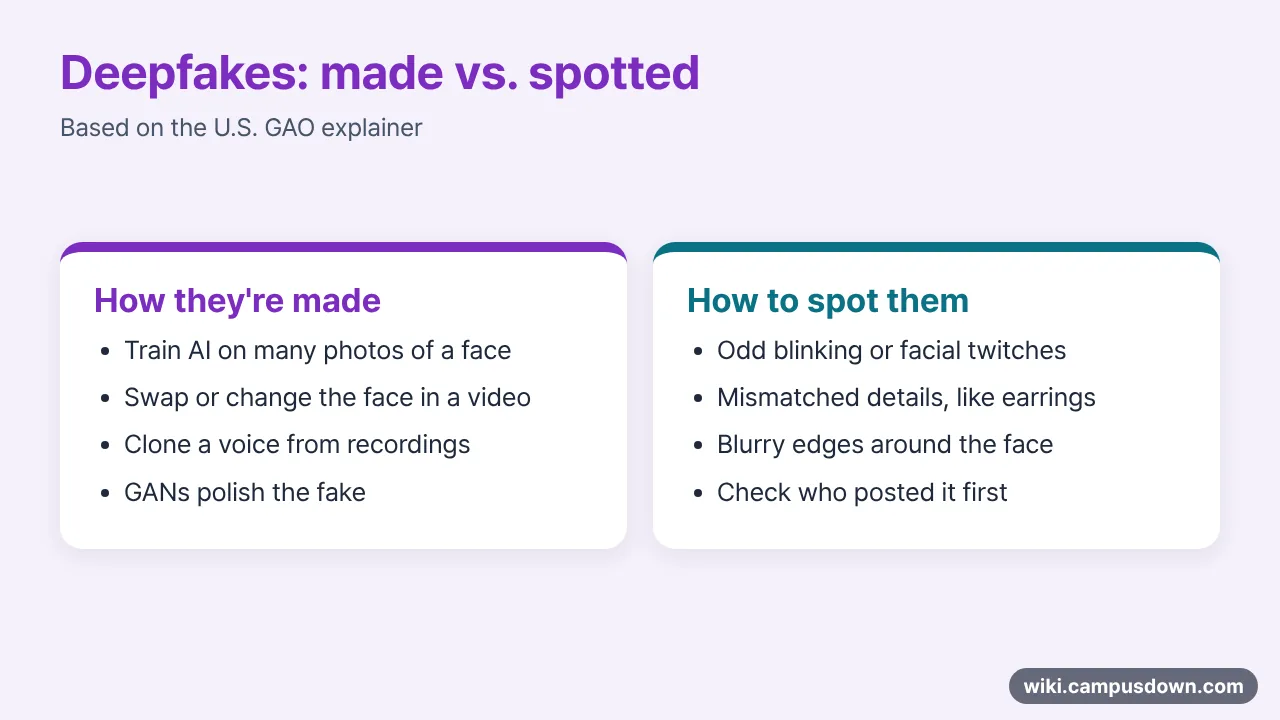
Most deepfakes use neural networks trained on hundreds or thousands of images of a face. The U.S. Government Accountability Office (GAO) explains two common methods: autoencoders, and GANs, where one network makes a fake and another tries to catch it, over and over, until the fake looks convincing.
Why people worry
GAO notes that deepfakes have mostly been used for nonconsensual pornography that disproportionately targets women, and could also be used to sway elections or spread disinformation. Another risk: once fakes are common, people may dismiss real evidence as "just a deepfake."
The law is catching up
In May 2025 the US enacted the TAKE IT DOWN Act, which makes it a federal crime to knowingly publish nonconsensual intimate images, including AI-made ones, and requires platforms to remove them after a valid request.
Not all bad
The same tools can dub movies into other languages, let shoppers try on clothes virtually, or recreate a voice for someone who lost theirs.
FAQ
- Where does the word deepfake come from?
- It combines "deep learning" and "fake."
- How can I tell if a video is a deepfake?
- Look for odd blinking, blurry face edges and mismatched details, and check where the video first came from.
- Are deepfakes illegal?
- Making one isn't always illegal, but sharing nonconsensual intimate deepfakes is a federal crime in the US under the TAKE IT DOWN Act.
Sources reviewed: 2026-11-20
References
- U.S. GAO. Science & Tech Spotlight: Deepfakes (GAO-20-379SP, 2020). Definition, autoencoders and GANs, detection.
- The White House. President Signed S. 146 into Law (TAKE IT DOWN Act, May 2025). Federal law on nonconsensual intimate images.