
Can a tiny spinning top teach you probability and a history lesson at the same time? During Hanukkah, it does.

What a dreidel is
A dreidel is a four-sided spinning top played with on Hanukkah. The word is Yiddish; in Hebrew it's called a sevivon. Each side has a Hebrew letter: nun, gimel, hei and shin.
The letters stand for Nes gadol haya sham, "A great miracle happened there." In Israel, the shin is replaced by a pe, for po, "here."

How to play
Players usually use chocolate coins called gelt, nuts or candy. Everyone puts one in the pot, then takes turns spinning:
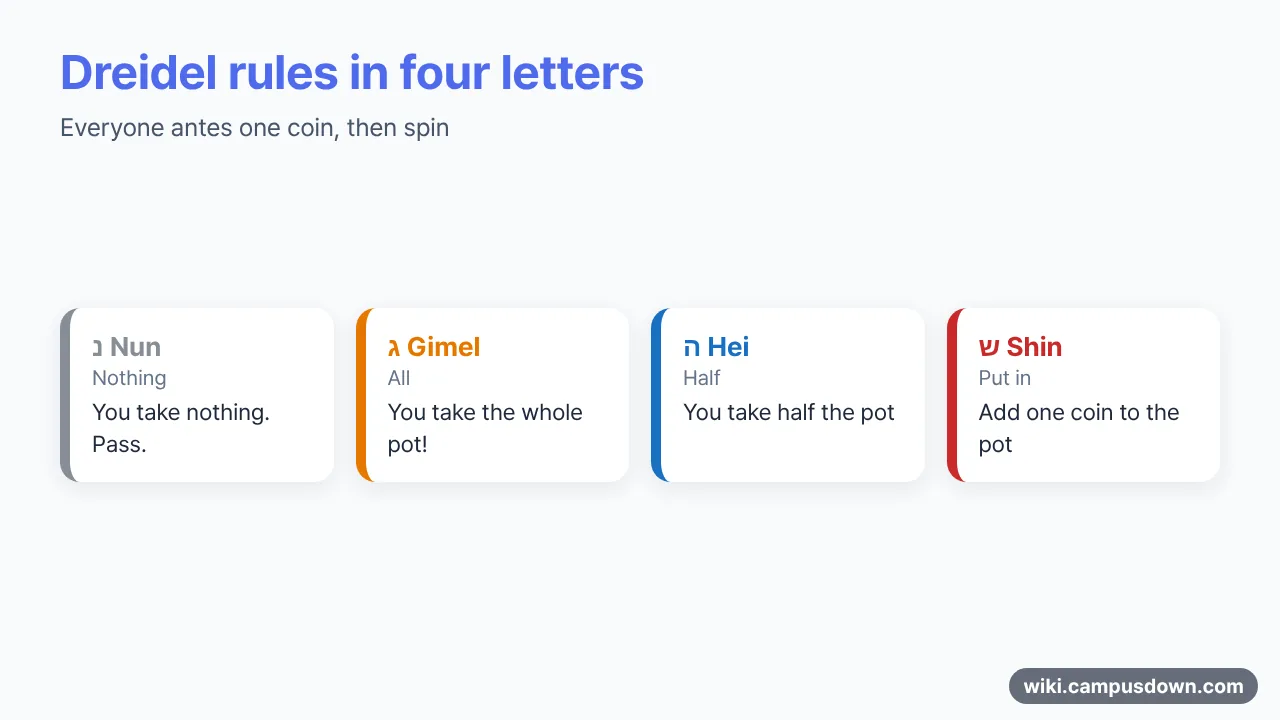
When the pot is empty or down to one piece, everyone adds one again. Run out of tokens and you're out. The last player with tokens wins.
The math part
On a fair dreidel, each letter has about a 1 in 4 chance. Gimel is the jackpot, but shin and nun come up just as often, which is why games can drag on. That's a quick lesson in why "I'm due for a gimel" isn't how chance works: every spin is independent.
FAQ
- What do the letters on a dreidel mean?
- Nun, gimel, hei, shin: the first letters of "A great miracle happened there."
- Why do Israeli dreidels have a different letter?
- They use pe for "here," because the Hanukkah story happened in the Land of Israel.
- What is gelt?
- Money; for dreidel, usually foil-wrapped chocolate coins.
Sources reviewed: 2026-11-20
References
- My Jewish Learning. What Do the Letters on the Dreidel Stand For? Nun, gimel, hei, shin and pe.
- My Jewish Learning. What Is a Dreidel? Rules, Yiddish origin and the legend.