
Suppose a driver causes a minor crash, and an injured passenger turns out to have a fragile heart and dies. Is the driver responsible for the death, or only for what an average person would have suffered? Tort law in the United States answers with the eggshell skull rule: the wrongdoer takes the victim as found.
What the rule says
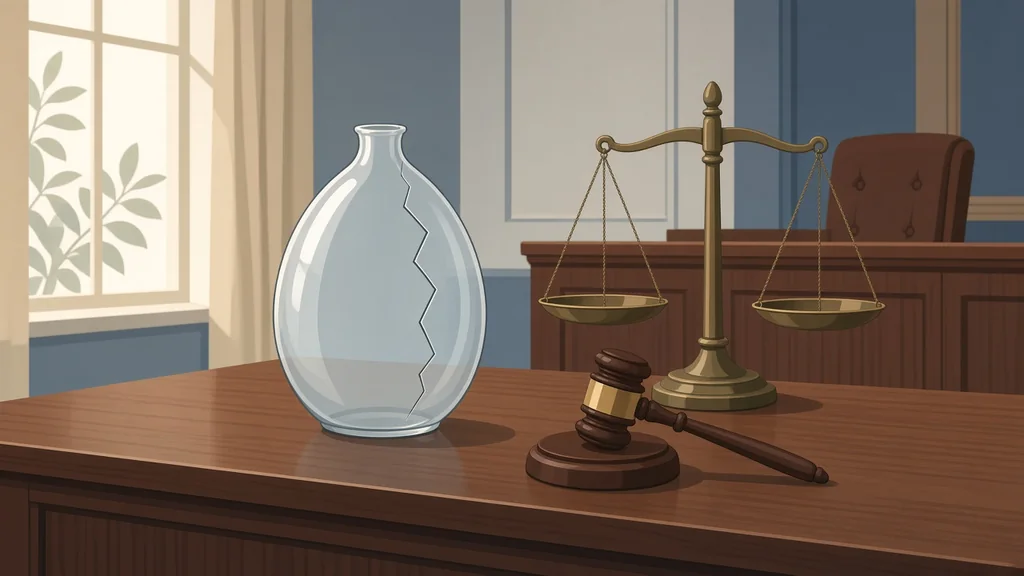
The rule appears in nearly every first-year torts course in American law schools. It applies after a court has found that the defendant's wrongful act was a cause of the injury. At that point, the defendant is liable for the full harm, even if the victim's pre-existing condition, such as a thin skull, a weak heart or an old injury, made the harm much greater than anyone could have expected.
Key idea
The rule concerns the extent of damages, not whether the defendant caused harm at all. The plaintiff must still prove that the defendant's wrongful act was a cause of the injury; once that is shown, the defendant cannot reduce liability by pointing out that the victim was unusually fragile.

US cases
- When and where
- February 20, 1889, Waukesha, Wisconsin; decided 1891
- What happened
- In a Waukesha classroom, 11-year-old George Putney lightly kicked 14-year-old Andrew Vosburg in the shin. Vosburg had cut his knee with an axe in 1887, and the kick, though light, was followed by severe pain and permanent damage to the leg. Vosburg sued for assault and battery and won $2,800 in the first trial. After the Wisconsin Supreme Court ordered a new trial in 1890, a second jury awarded $2,500, and the court's 1891 opinion is still widely cited.
- Why it matters
- The case is taught in American law schools as an illustration that a defendant must take the plaintiff as found, though its main holding concerns the intent needed for a battery. Vosburg wore a leg brace for the rest of his life.
- When and where
- February 15, 1989 accident; Iowa Supreme Court decided February 23, 1994
- What happened
- On an icy road in Missouri, a semi-tractor and trailer rear-ended a van carrying Loras Benn, who had a history of heart disease and diabetes. He suffered a bruised chest and a fractured ankle and died of a heart attack six days later. The jury awarded $17,000 for his injuries but nothing for his death, after the trial court refused to give an eggshell plaintiff instruction. The Iowa Supreme Court agreed with the court of appeals that this refusal was reversible error and sent the case back for a new trial.
- Why it matters
- The decision shows that the rule matters even when the injury looks minor: a jury must be told it may hold the defendant responsible for aggravating an existing condition.
Limits and criticisms
The rule does not cover every consequence. Courts still require that the defendant's act actually caused the harm, and the plaintiff has a duty to take reasonable steps to limit the damage. Some commentators argue that the rule can feel unfair to defendants who could not have foreseen the result, and that it conflicts with the foreseeability limits found in negligence law. Supporters answer that the injured person is more innocent than the person who caused the harm, so the loss should fall on the defendant. In criminal cases, the same rule is applied when deciding how responsible a defendant is for a victim's death.

Related concepts
The rule is part of the broader body of tort law, where wrongful acts lead to compensation. A different way of proving fault is res ipsa loquitur, in which the accident itself suggests negligence. Rules that encourage or limit liability for helping others are covered in the Good Samaritan law, and the self-defense limits of the castle doctrine show another line drawn around responsibility. Government officials are protected from some damages claims by qualified immunity.
Study material (Korean): 「자동차손해배상보장사업(정부보장사업) 정리: 뺑소니·무보험차 피해자 보상과 자배법 제30조 해석」
Frequently asked questions
- What does eggshell skull mean in law?
- It means that a person who wrongfully injures someone is responsible for the full harm, even if the victim was unusually vulnerable.
- Is the eggshell skull rule the same as the thin skull rule?
- Yes. Both names, and the term eggshell plaintiff rule, refer to the same doctrine.
- Does the rule mean the defendant is liable for anything that happens?
- No. The plaintiff must still prove that the defendant's wrongful act caused the harm, and courts apply other limits on remote consequences.