
If police break the rules to find a key piece of evidence, should the jury ever see it? The fruit of the poisonous tree doctrine says usually not: when the source of evidence is illegal, the evidence that grows out of it is tainted too.
Definition
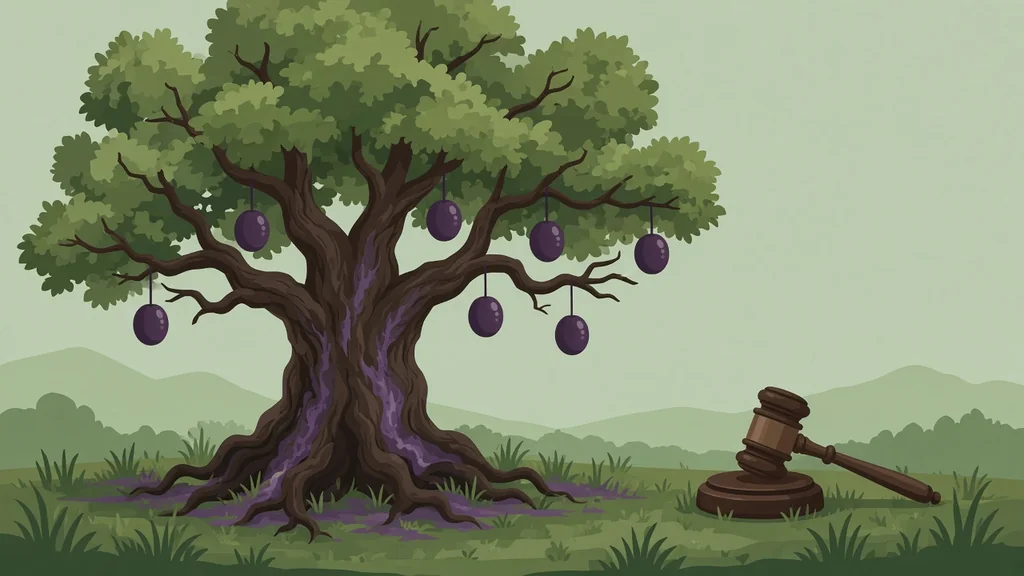
Fruit of the poisonous tree is a metaphor used in US law for evidence obtained from an illegal search, seizure, arrest or interrogation. The illegal act is the "tree"; anything police learn because of it, such as a second piece of evidence or a witness they would not otherwise have found, is the "fruit." The doctrine extends the exclusionary rule, which bars evidence gathered in violation of the Fourth Amendment's protection against unreasonable searches and seizures.
The idea first appeared in Silverthorne Lumber Co. v. United States (1920). Federal agents had illegally seized the company's tax books and made copies, and Justice Oliver Wendell Holmes Jr. wrote that evidence obtained even indirectly from an illegal search could not be used. The phrase itself was first used by Justice Felix Frankfurter in Nardone v. United States (1939).
Key idea
The rule is not about whether the evidence is true. It exists to remove the incentive for police to violate constitutional rights.

Exceptions
- Independent source: the evidence was also found through a separate, lawful route.
- Inevitable discovery: police would have found it lawfully anyway.
- Attenuation: the link between the illegal conduct and the evidence is too remote.
US cases
- When and where
- Search May 23, 1957, Cleveland, Ohio; Supreme Court decision June 19, 1961
- What happened
- Cleveland police came to Dollree Mapp's home looking for a suspect. She refused to let them in without a search warrant; they later forced their way in, and she was convicted on what they found, although prosecutors could not produce a valid warrant.
- Why it matters
- In a 6–3 decision written by Justice Tom C. Clark, the Supreme Court overturned her conviction and held that the exclusionary rule applies to state governments, not only federal agents. That brought the doctrine into everyday state criminal cases across the country.
- When and where
- Crime December 24, 1968, Des Moines, Iowa; Supreme Court decision 1984
- What happened
- Robert Williams kidnapped and murdered ten-year-old Pamela Powers. While hundreds of police officers and volunteers searched, a detective driving him to Des Moines urged him to reveal where the body was before an expected snowfall, despite a promise not to question him without his lawyer. In Brewer v. Williams (1977) the Supreme Court ruled his right to counsel had been violated.
- Why it matters
- At a second trial his statements were excluded, but the body was admitted because the search would inevitably have found it. Williams was convicted again on July 15, 1977, and in 1984 the Supreme Court upheld the conviction, recognizing the inevitable discovery exception.
Criticisms
- Guilty people go free: critics argue that excluding reliable evidence punishes the public rather than the officer who broke the rules.
- Weak deterrence: some judges and scholars question whether exclusion actually changes police behavior, and favor civil suits or discipline instead.
- Exceptions swallow the rule: defenders of the doctrine warn that broad exceptions such as inevitable discovery let illegal evidence back in.
Related concepts
Excluded evidence cannot help the prosecution carry its burden of proof or establish guilt beyond a reasonable doubt. Statements about intent obtained illegally can also affect proof of mens rea. For another area where US criminal law turns on rights and reasonable belief, see stand-your-ground laws.

Study material (Korean): 「형사소송법 312조·314조 사례: 사망한 공범의 사법경찰관 작성 피의자신문조서 증거능력」
Frequently asked questions
- What does fruit of the poisonous tree mean in simple terms?
- If police get evidence illegally, they generally cannot use it, or anything they found because of it, against the defendant in court.
- Which amendment is the fruit of the poisonous tree linked to?
- Mainly the Fourth Amendment, which protects against unreasonable searches and seizures; it also applies to violations of the right to counsel and other rights.
- What are the exceptions to fruit of the poisonous tree?
- The main ones are independent source, inevitable discovery and attenuation.