
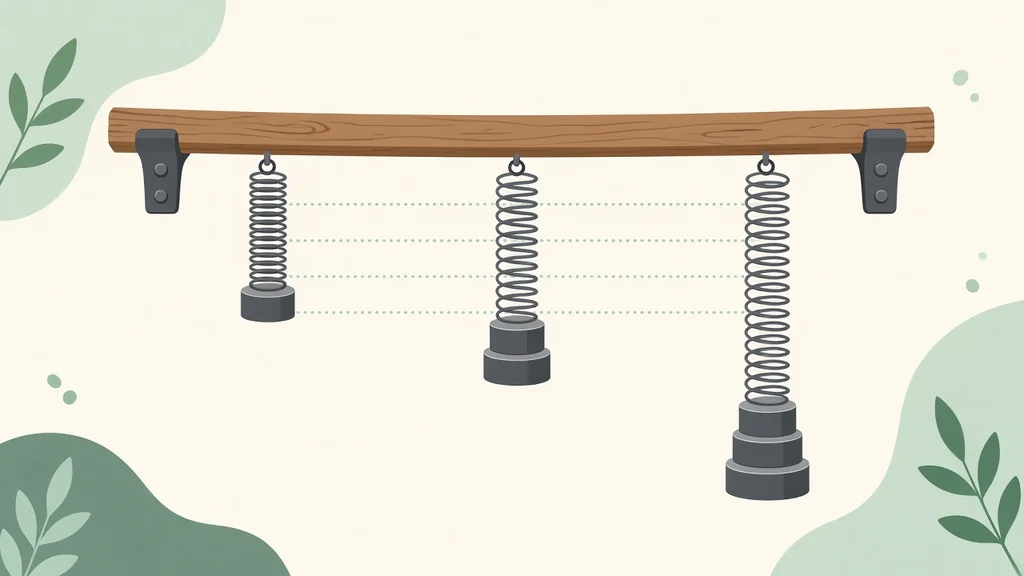
Why does a spring stretch twice as far when you hang twice the weight on it? That simple, reliable pattern is Hooke's law, one of the first quantitative laws of physics. It explains bathroom scales, car suspensions, mechanical watches and a toy found in American homes since 1945.
The law
Hooke's law states that the force F needed to stretch or compress a spring is proportional to the distance x it moves from its resting length: F = kx. The constant k, called the spring constant, measures stiffness. A stiff spring has a large k; a soft one has a small k. The spring pushes or pulls back with an equal and opposite restoring force, often written F = −kx, in line with Newton's laws of motion.
Key idea
The law holds only within the elastic limit. Stretch a spring too far and it deforms permanently, and the straight-line relationship breaks down.

History
The English scientist Robert Hooke first published the law in 1676 as a scrambled Latin anagram, "ceiiinosssttuv," a common way at the time to claim a discovery without revealing it. In 1678 he gave the solution: "Ut tensio, sic vis," meaning "As the extension, so the force." He said he had known the law since 1660.

Why it matters
Hooke's law is the basis of spring scales, pressure gauges and the balance wheel in mechanical watches. Because the restoring force grows in proportion to displacement, a mass on a spring moves in simple harmonic motion, a pattern that appears throughout physics. Engineers apply the same idea to beams, bridges and buildings, treating many materials as springs as long as the loads stay small.
US cases
- When and where
- 1943–1945, Philadelphia, Pennsylvania
- What happened
- Naval engineer Richard James was working with tension springs in 1943 when he saw one fall and keep moving. He and his wife Betty turned it into the Slinky. On November 27, 1945, he demonstrated it on an inclined plane in the toy section of Gimbels department store in Philadelphia, and the first 400 units sold in 90 minutes.
- Why it matters
- The way a Slinky walks downstairs and falls is governed by Hooke's law and gravity, which is why it became a popular physics classroom demonstration.
- When and where
- 1989 and 2020, Salt Lake City, Utah
- What happened
- During a renovation completed in 1989, the historic sandstone building was placed on a base isolation system of steel and rubber bearings, which behave like stiff springs that let the ground move under the building. When a magnitude 5.7 earthquake shook the Wasatch Front in March 2020, the needed repairs were minimal.
- Why it matters
- Base isolation applies spring mechanics on the scale of a whole building to protect structures in earthquake-prone US cities.
Criticisms and limits
- Elastic limit: beyond a certain load, materials deform permanently and the law no longer applies.
- Approximation: rubber, biological tissue and many plastics do not follow a straight line even at moderate loads.
- Ignores time effects: some materials creep or lose energy over time, which a simple F = kx model does not capture.
Related concepts
Like Coulomb's law, Hooke's law is a simple proportional rule found by measurement. Boyle's law and the ideal gas law describe a gas behaving as a kind of spring when compressed. Economists borrowed the word "elasticity" for a different idea, the price elasticity of demand.
Frequently asked questions
- What is Hooke's law in simple terms?
- The more you stretch or compress a spring, the harder it pulls or pushes back, in direct proportion, as long as you do not overstretch it.
- What does k mean in F = kx?
- k is the spring constant, a measure of stiffness. A higher k means you need more force to stretch the spring the same distance.
- When does Hooke's law not work?
- It fails past the elastic limit, where the material deforms permanently, and for materials like rubber that do not respond in a straight line.