
Why do people kiss under a plant that lives by stealing from trees? Mistletoe has one of the strangest glow-ups in holiday history.
What mistletoe is
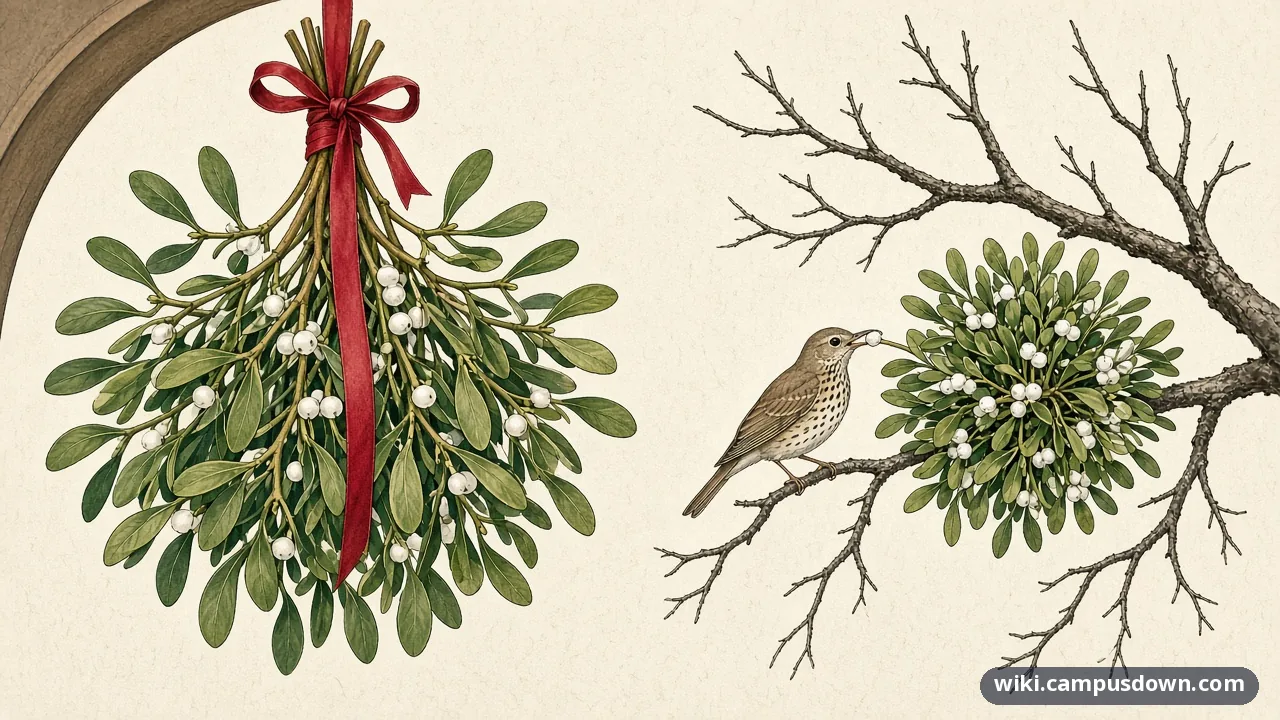
Mistletoe is a hemiparasite. It has green leaves and makes some of its own food through photosynthesis, but it also steals water and nutrients from the tree it grows on. In nature it lives only on branches, never in the ground.

How it spreads
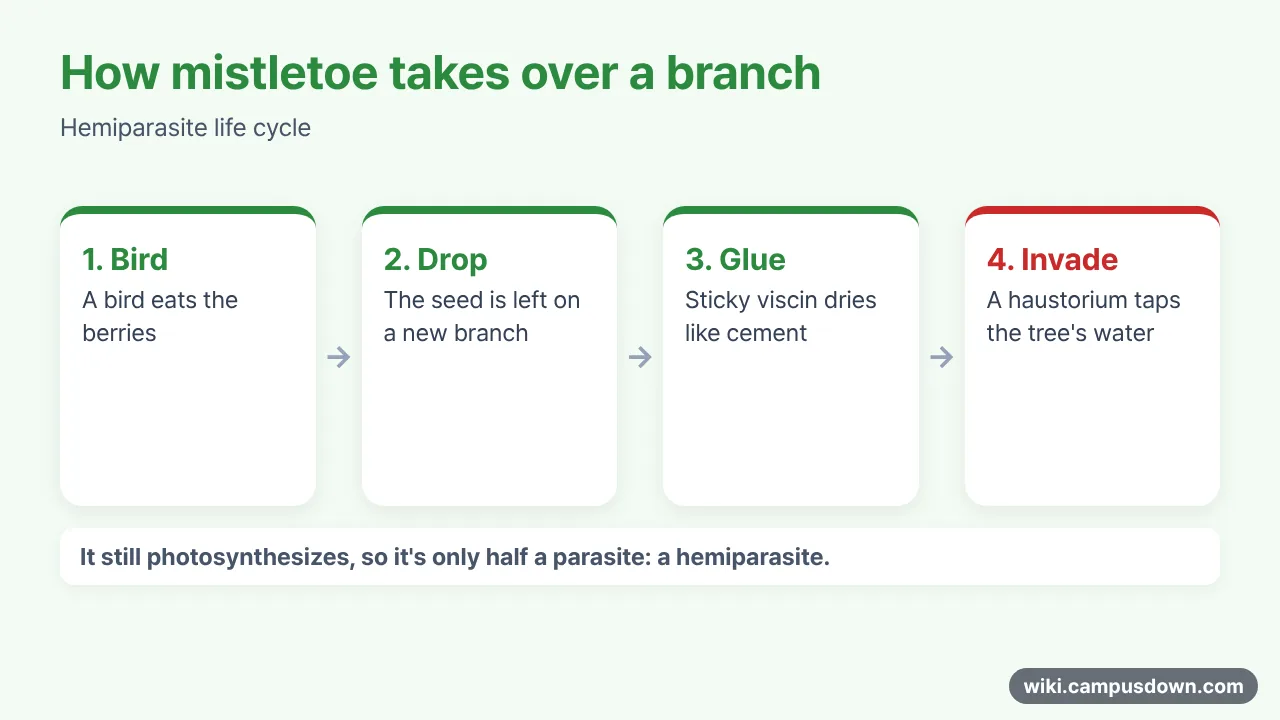
Most mistletoe seeds are spread by birds. They eat the berries and leave the seeds on another branch. A sticky substance called viscin dries like cement and holds the seed in place. Then the plant grows a special organ, a haustorium, that pushes into the branch.
Myths and medicine
In Norse myth, the god Balder is killed by an arrow made of mistletoe. Ancient Greeks and Romans used its leaves as medicine, and first-century Celtic druids reportedly treated it as a symbol of fertility. Part of the appeal: it stays green on bare winter trees.
Where the kissing came from
The first known reference to kissing under mistletoe is in a 1784 English poem. Around 1820, American writer Washington Irving described a rule: each berry stood for one kiss, and when the berries were all picked, the kissing stopped.
Is mistletoe poisonous?
Its berries are poisonous, so keep real mistletoe away from kids and pets. Most store-bought decorations today are artificial.
FAQ
- Is mistletoe a parasite?
- Yes, a hemiparasite. It photosynthesizes but takes water and nutrients from its host tree.
- Why do we kiss under mistletoe?
- The custom shows up in England by 1784 and spread in the 19th century; its exact origin isn't documented.
- What color are mistletoe berries?
- White on European mistletoe. Red berries usually mean it's fake.
Sources reviewed: 2026-11-20
References
- Smithsonian Magazine. How Mistletoe Became a Christmas Kissing Tradition. Balder, druids, the 1784 poem and Irving.
- The Conversation. Mistletoe might be festive, but it's actually a tree-plundering parasite. Hemiparasite biology, birds, viscin, haustorium.