
Why did the Cold War never turn into nuclear war? One unsettling answer is that both superpowers built so many weapons that starting a war would have meant certain suicide. That logic has a fitting acronym: MAD, for mutually assured destruction.

The doctrine
MAD rests on a simple chain of reasoning:
- both sides have enough nuclear weapons to destroy the other;
- each side can survive a surprise attack with enough weapons left to strike back, known as second-strike capability;
- therefore any first strike guarantees the attacker's own destruction;
- so a rational leader will never launch one.
To make retaliation certain, the United States spread its weapons across a nuclear triad of land-based missiles, bombers and submarines. By the time of the 1962 Cuban Missile Crisis, both the US and the Soviet Union could launch nuclear missiles from submerged submarines.
Key idea
In game-theory terms, MAD is a Nash equilibrium: once both sides are armed, neither has an incentive to attack first or to disarm.

Origin of the term
The phrase was coined in 1962 by Donald Brennan, a strategist at Herman Kahn's Hudson Institute in New York. He built the acronym deliberately to spell "mad," arguing that a policy resting on the threat of mutual annihilation was irrational. The strategy itself was declared in the early 1960s, mainly by US Secretary of Defense Robert McNamara.
US cases
- When and where
- October 1962, Washington, D.C., and the Caribbean
- What happened
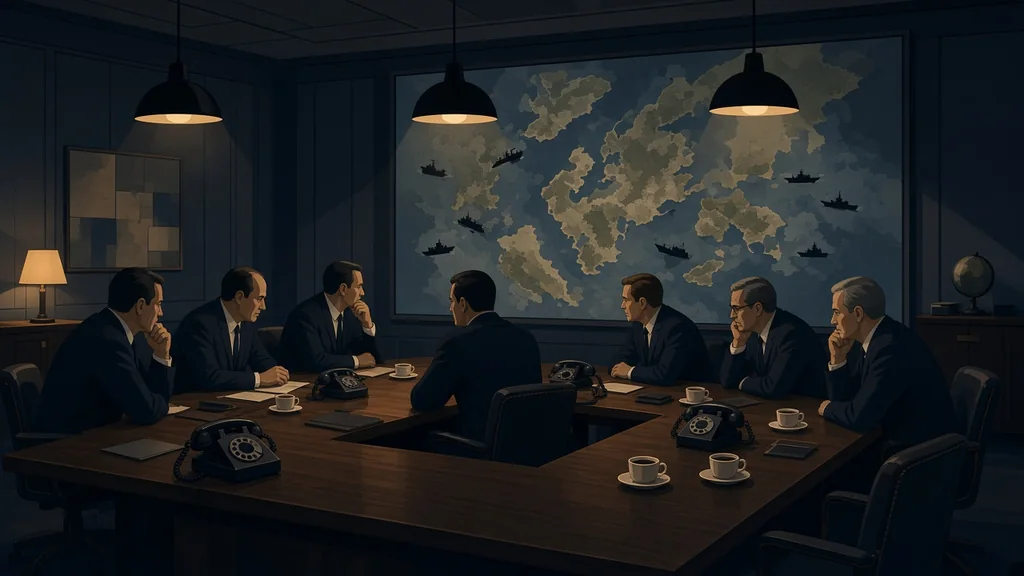
- After the discovery of Soviet missiles in Cuba, the United States and the Soviet Union came closer to nuclear war than at any other time. US bombers were dispersed to several airfields, and sixty-five B-52s were kept airborne at all times.
- Why it matters
- The crisis ended in a negotiated withdrawal, and both sides later set up a direct communications link, a sign that deterrence alone felt too risky.
- When and where
- March 23, 1983, Washington, D.C.
- What happened
- In a televised address, President Ronald Reagan called on scientists to give the US "the means of rendering these nuclear weapons impotent and obsolete," launching the Strategic Defense Initiative, a proposed missile defense system nicknamed "Star Wars."
- Why it matters
- Critics argued that an effective shield would undermine MAD by removing the threat of retaliation, which could make the balance less stable.
Criticisms
- Depends on rationality: MAD assumes leaders are rational and in full control; accidents, false alarms or reckless actors could break it.
- Moral objection: it holds entire civilian populations hostage to threats.
- Arms race: maintaining a credible threat encouraged ever larger arsenals, a pattern described by the security dilemma.
- Proliferation: deterrence between two powers may not work the same way with many nuclear states.
Related concepts
MAD is the most extreme form of deterrence theory and a classic application of game theory. The arms race around it is often modeled as a prisoner's dilemma.
Study material (Korean): 「전쟁론으로 본 전쟁의 본질과 탈냉전 이후 전쟁의 6가지 특징」
Frequently asked questions
- What does mutually assured destruction mean?
- If either side launches a full nuclear attack, the other can still retaliate, so both would be destroyed; this prospect deters both from attacking.
- Who came up with MAD?
- The term was coined in 1962 by Donald Brennan of the Hudson Institute; the strategy was associated mainly with Defense Secretary Robert McNamara.
- Does MAD still apply today?
- Major nuclear powers still rely on second-strike forces for deterrence, though missile defense and more nuclear states complicate the picture.