
Why does the front of a car look grumpy, and why do power outlets seem shocked to see you? That everyday experience has a name: pareidolia, the tendency to see a meaningful image, usually a face, in a random or vague pattern.

What pareidolia is
Pareidolia comes from Greek words meaning "beside" and "image." It describes perceiving a definite form where there is only noise: a face in clouds, an animal in a rock, a figure in a burnt piece of toast. The term appears in 19th-century German psychiatry, where Karl Ludwig Kahlbaum used it in 1866 for illusions of this kind.
Pareidolia is a specific, visual or auditory case of the broader tendency called apophenia, which covers seeing meaningful connections in unrelated data of any kind.

Why the brain does it
Faces matter enormously for a social species, so the visual system is tuned to detect them fast. A rough "two eyes over a mouth" layout is enough to trigger face processing. Brain imaging shows that face-like objects can activate the fusiform face area, a region in the temporal lobe that responds strongly to real faces.
The trade-off is cheap. Mistaking a socket for a face costs nothing; missing a real face, such as a predator or a person watching you, could cost a lot. Expectations also shape what we see, an example of top-down processing.
Key idea
Pareidolia is not a sign of illness. It is a normal side effect of a visual system that prefers false alarms to missed faces.
US cases
- When and where
- 1976, NASA Viking 1 orbiter
- What happened
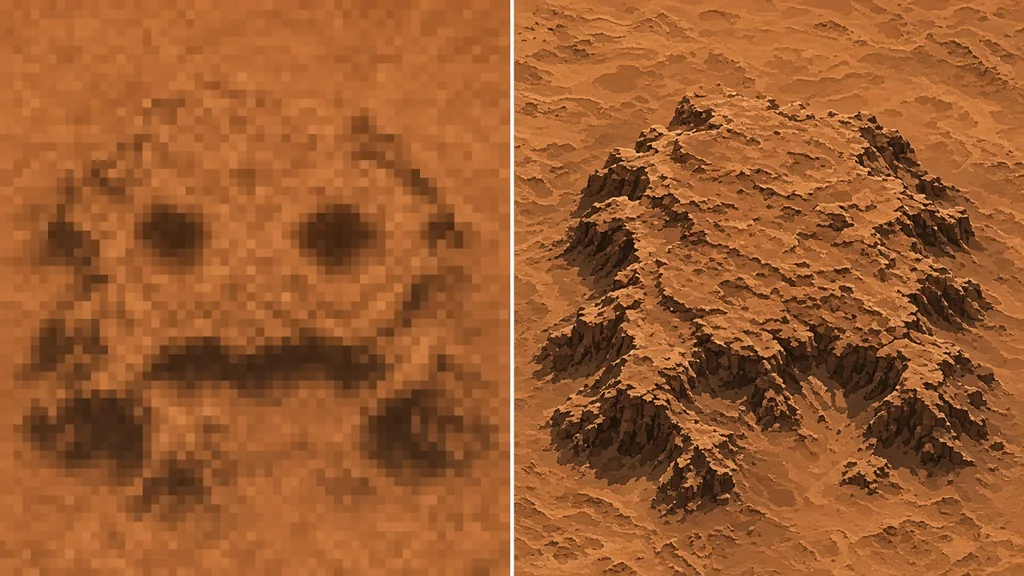
- A low-resolution image of the Cydonia region showed a mesa whose shadows looked like a human face. It became a fixture of tabloids and books about ancient Martians. NASA's Mars Global Surveyor took much sharper images in 1998 and 2001, showing an ordinary eroded hill.
- Why it matters
- A textbook example of how poor resolution plus shadows invite pareidolia, and how better data clears it up.
- When and where
- 2004, Florida and eBay
- What happened
- Diana Duyser of Florida said a 10-year-old grilled cheese sandwich showed the face of the Virgin Mary. She sold it on eBay for $28,000 to the online casino GoldenPalace.com.
- Why it matters
- It shows how strongly people respond to perceived faces, even enough to pay for them.
Limits and debates
Not every pattern people report is pareidolia; sometimes there really is a signal. The concept also does not explain why some people report patterns more often than others. Research links stronger pareidolia to factors such as belief in the paranormal and certain conditions like Lewy body dementia, but those links are correlations, not proof of cause.
Related concepts
Pareidolia sits alongside Gestalt principles of perception, the illusory correlation, and confirmation bias, which can turn a chance shape into "evidence" for a belief.
Frequently asked questions
- Is pareidolia normal?
- Yes. Nearly everyone sees faces in objects sometimes, and it reflects how the brain detects faces.
- What is the difference between pareidolia and apophenia?
- Pareidolia is mostly about seeing images or hearing sounds in noise; apophenia is the broader habit of finding meaningful links in random information.
- Can animals experience pareidolia?
- Studies suggest some primates, such as rhesus monkeys, also look longer at face-like objects, which hints that the tendency is old in evolution.