
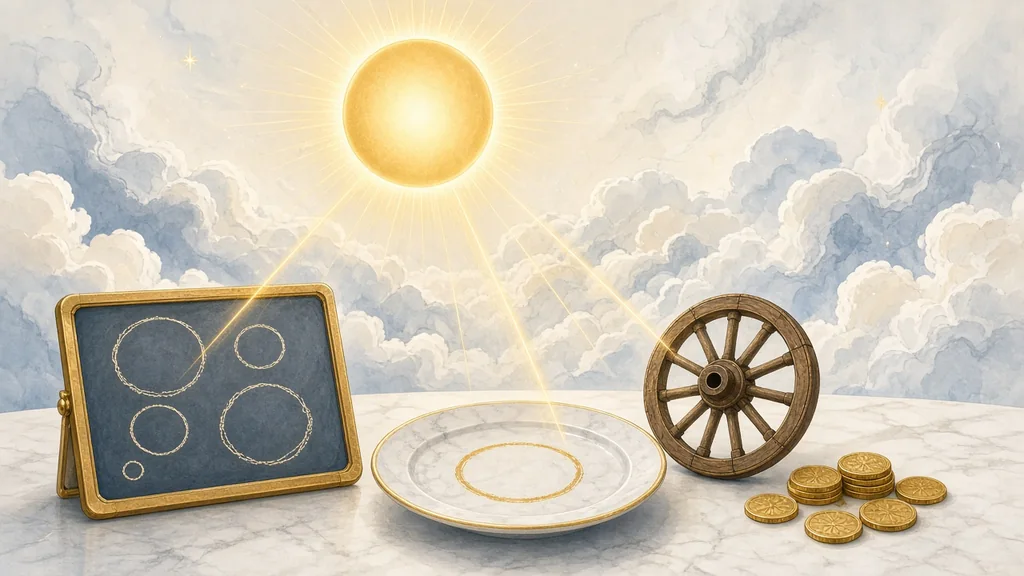
Is there such a thing as a perfect circle? You have never seen one: every circle you draw is a little lopsided. Yet you know exactly what a circle is. Plato's theory of Forms starts from this puzzle and concludes that the perfect circle exists, just not in the physical world.
The theory
Plato, writing in Athens in the 4th century BC, argued that reality has two levels:
- The world of the senses: physical things that change, decay and are never perfect.
- The world of Forms: eternal, unchanging ideals such as Justice, Beauty, Equality and the Circle.
Physical things "participate in" or imitate their Forms. A just action is just because it shares in the Form of Justice; a beautiful face is beautiful because it reflects Beauty itself. Above all the others stands the Form of the Good, which Plato compared to the sun that makes everything visible.
Key idea
For Plato, true knowledge is knowledge of the Forms. Information from the senses gives only opinion, because the things it shows keep changing.

The cave allegory
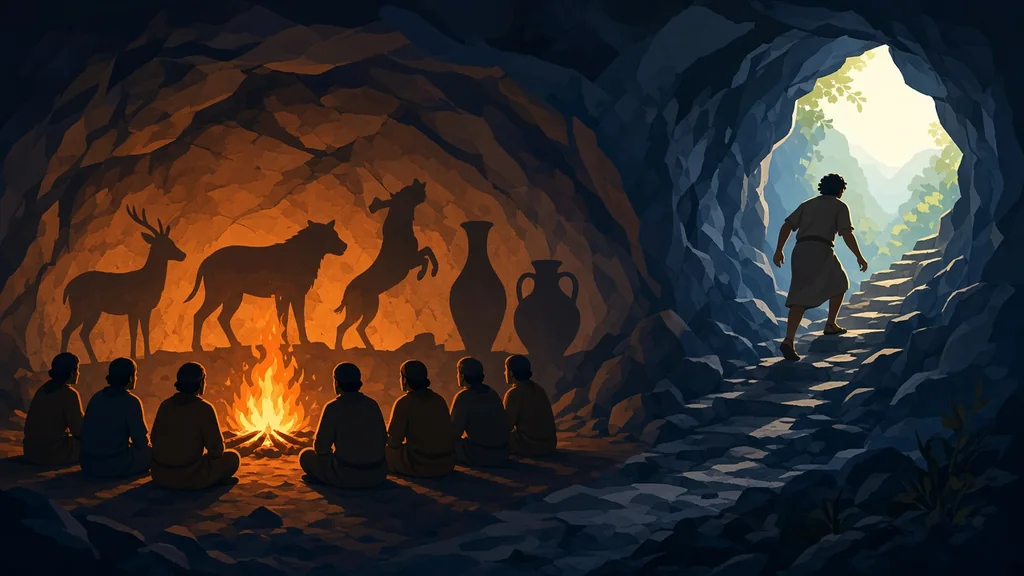
In the Republic, Plato illustrates the theory with the allegory of the cave. Prisoners chained in a cave see only shadows on a wall and take them for reality. One prisoner escapes, sees the real objects and finally the sun, and returns to tell the others, who refuse to believe him. The shadows stand for the world of the senses, the sun for the Good.
US cases
- When and where
- 1999 film and 2002 book, United States
- What happened
- The Wachowskis' film The Matrix, in which humans live inside a simulated world without knowing it, has been widely compared to Plato's cave. American philosopher William Irwin edited "The Matrix and Philosophy" (2002), which examines that link.
- Why it matters
- The film turned an ancient metaphysical idea into a pop-culture reference point, and it also feeds modern debate over the simulation hypothesis.
- When and where
- 1964, Supreme Court of the United States
- What happened
- In Jacobellis v. Ohio, the manager of a Cleveland Heights theater had been charged for showing Louis Malle's film The Lovers. Justice Potter Stewart wrote that he could not precisely define hard-core pornography, "But I know it when I see it."
- Why it matters
- The line is often quoted to show how hard it is to pin down abstract concepts in words, the same problem Plato tried to solve by positing Forms that we grasp through reason.
Criticisms
- The third man argument: Plato himself, in the Parmenides, raised a problem: if large things share in a Form of Largeness, then the group of large things plus the Form needs another Form, and so on without end.
- Aristotle's objection: his student Aristotle argued that forms exist only in particular things, not in a separate realm.
- Nominalism: later philosophers argued that general terms are just names, with no extra reality behind them.
- Testability: the Forms cannot be observed, so critics see the theory as unverifiable.
Related concepts
Plato's search for unchanging standards influenced later moral theories, from virtue ethics to deontology and Kant's moral philosophy.
Study material (Korean): 「서양철학 과제 – 플라톤과 아리스토텔레스의 인식론」
Frequently asked questions
- What is Plato's theory of Forms in simple terms?
- It is the view that behind every imperfect thing we see there is a perfect, unchanging idea, and that those ideas are more real than physical objects.
- What is an example of a Form?
- The perfect Circle: no drawn circle is perfect, but all of them copy the idea of a circle, which we understand through reason.
- How does the cave allegory relate to the Forms?
- The shadows in the cave stand for the changing world of the senses, and the sunlight outside stands for the Forms and the Good.