
Is light a wave or a stream of particles? For centuries physicists argued about it. Quantum mechanics gave a surprising answer: light, and matter too, behaves like both. This idea, called wave–particle duality, is one of the foundations of modern physics, and two of its key experiments were done in American labs in the 1920s.
Definition
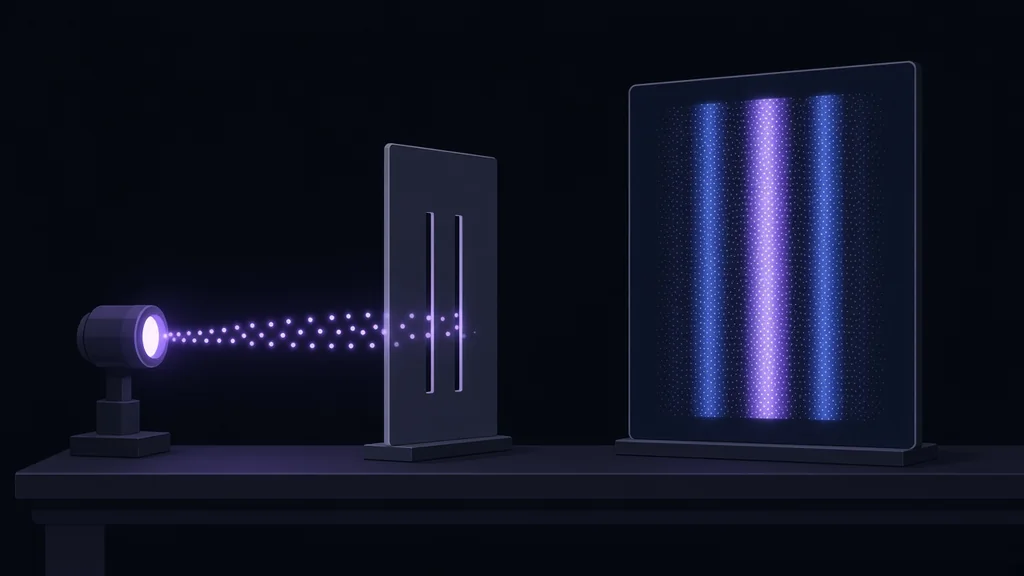
Wave–particle duality means that entities like photons and electrons show wave behavior, such as interference and diffraction, and particle behavior, such as arriving in single lumps of energy and momentum. Which behavior appears depends on the experiment. In the famous double-slit experiment, particles sent one at a time through two slits land as individual dots, yet the dots slowly build up a striped interference pattern that only waves should make.
Key idea
Duality does not mean an electron is sometimes a little ball and sometimes a ripple. It means neither classical picture alone describes it, and quantum mechanics uses a single framework that predicts both kinds of results.

History
Thomas Young's interference experiments in 1801 supported the wave theory of light. In 1905 Albert Einstein explained the photoelectric effect by treating light as discrete quanta, later called photons. In 1924 Louis de Broglie proposed in his doctoral thesis that matter also has a wavelength, inversely related to its momentum. Experiments soon tested both sides of the idea.
US cases
- When and where
- 1923, Washington University in St. Louis, Missouri
- What happened
- Arthur Holly Compton scattered X-rays off light elements and found that their wavelength shifted exactly as if each X-ray photon collided like a particle carrying momentum.
- Why it matters
- The result persuaded many skeptics that light has a particle side, and Compton received the 1927 Nobel Prize in Physics.
- When and where
- 1927, Western Electric's research lab, later Bell Labs, New York
- What happened
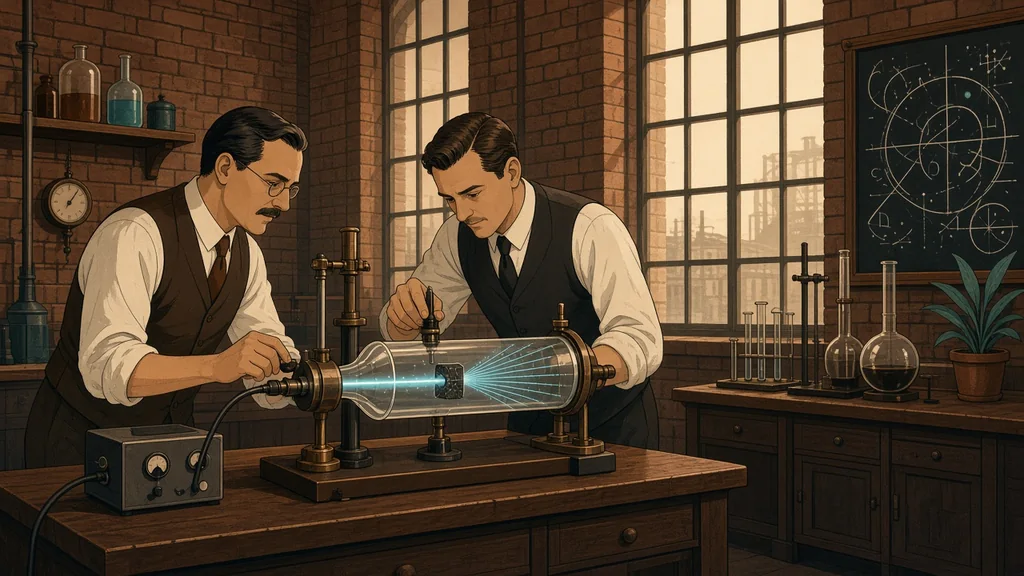
- Clinton Davisson and Lester Germer fired slow electrons at a nickel crystal and saw a diffraction pattern, the signature of waves. Their original aim was to study the nickel surface, not to test de Broglie.
- Why it matters
- It confirmed that matter has wave properties, and Davisson shared the 1937 Nobel Prize in Physics with George Paget Thomson, who found the same effect independently.
Misconceptions
- "Watching changes reality": what matters is physical interaction with a detector, not a human observer's mind.
- "It is one or the other": experiments show different aspects, but a single quantum description covers both.
- "Only tiny things": duality applies to all matter, but large objects have wavelengths far too small to notice.
Related concepts
Wave–particle duality is central to quantum mechanics and to the idea of photons, first used to explain the photoelectric effect. It is closely tied to the uncertainty principle, which limits how precisely position and momentum can be known together, and to puzzles about measurement dramatized in Schrödinger's cat.
Study material (Korean): 「색채와 빛이, 파장 관련 핵심 내용 요약 정리」
Frequently asked questions
- What is wave–particle duality in simple terms?
- It is the idea that light and matter can act like waves in some experiments and like particles in others.
- Do electrons really behave like waves?
- Yes. The Davisson–Germer experiment in 1927 showed electrons forming a diffraction pattern, and electron microscopes rely on their wave behavior.
- Why don't we see wave behavior in everyday objects?
- Their wavelengths are extremely tiny because their momentum is large, so interference effects are far too small to detect.