
How did chemistry become biology? Abiogenesis is the scientific name for that question: the natural process by which life arose from non-living matter. It is one of the biggest open problems in science, and one of the most searched.
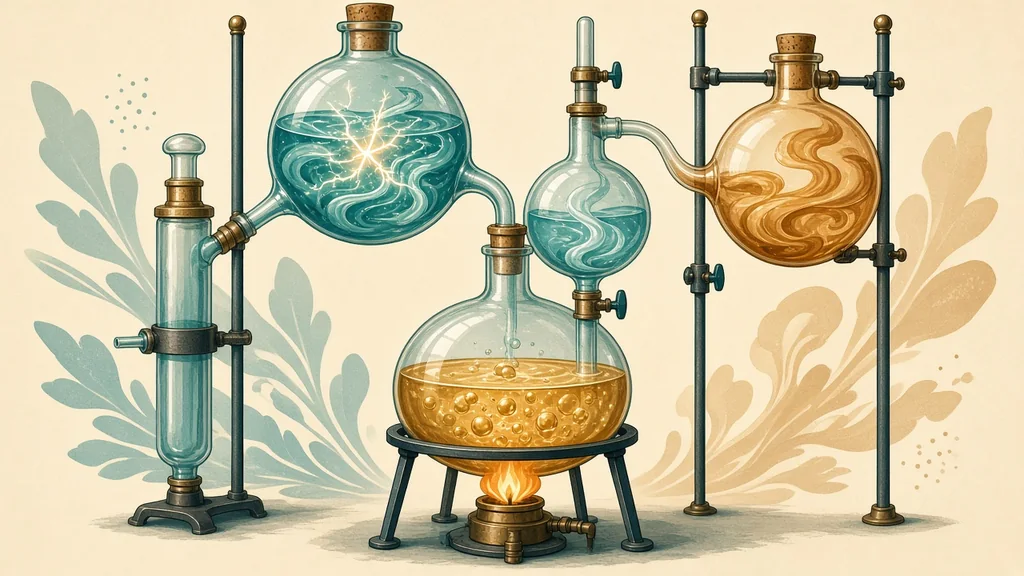
What abiogenesis means
Abiogenesis is different from evolution. Evolution explains how life changes once it exists; abiogenesis asks how the first self-copying, metabolizing systems appeared. The oldest widely accepted evidence of life on Earth is more than 3.5 billion years old, so the process happened early in the planet's history.
It is also different from the old idea of "spontaneous generation," the belief that maggots or mice arise from rotting matter. Louis Pasteur's experiments in the 1860s disproved that.

The primordial soup and Miller–Urey
In the 1920s, Alexander Oparin in the Soviet Union and J. B. S. Haldane in Britain independently proposed that simple molecules in early oceans, energized by sunlight or lightning, could build up into more complex ones: a "primordial soup."
- When and where
- 1952–1953, University of Chicago
- What happened
- Graduate student Stanley Miller, working with Nobel laureate Harold Urey, sealed water, methane, ammonia, and hydrogen in glass flasks and ran electric sparks through them. Within days, the mixture contained amino acids, the building blocks of proteins. The result was published in Science in 1953.
- Why it matters
- It was the first lab demonstration that life's building blocks can form from simple chemistry. A 2008 reanalysis of Miller's saved samples found even more amino acids than he originally reported.
Scientists now think the early atmosphere was less rich in methane and ammonia than Miller assumed, but similar experiments under other conditions still produce organic molecules.
Leading hypotheses today
- RNA world. RNA can store information like DNA and speed up reactions like proteins. The idea, named by Walter Gilbert in 1986, is that early life ran on RNA before DNA and proteins took over.
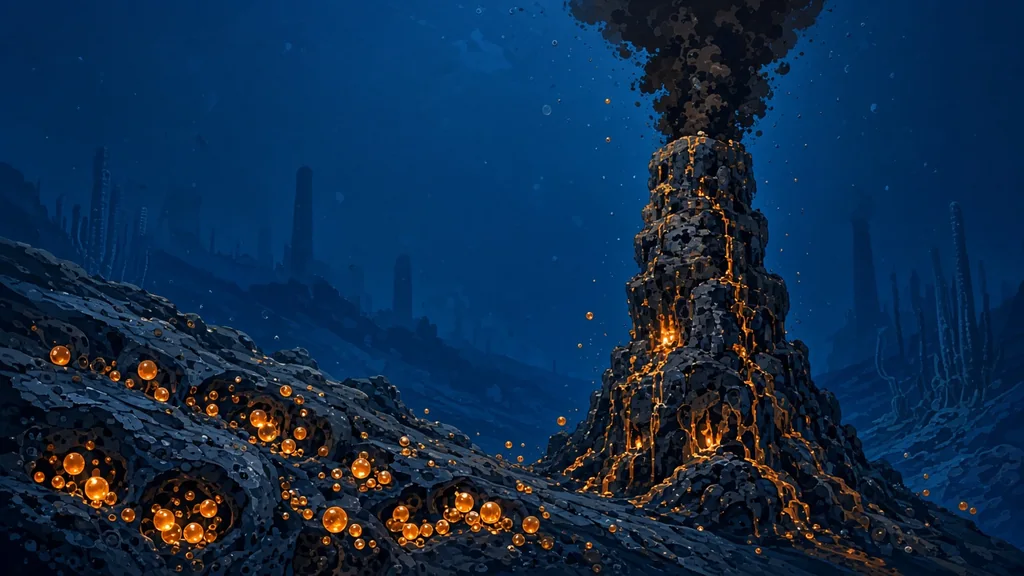
- Hydrothermal vents. Alkaline vents on the seafloor provide energy gradients, minerals, and tiny compartments that could host early chemistry.
- Warm little ponds. Wet-dry cycles on land, which Darwin speculated about in an 1871 letter, could concentrate molecules.
Key idea
Scientists do not yet know exactly how life began. What they have is several testable pathways, each backed by partial lab evidence.
A recent US finding
- When and where
- January 2025, NASA
- What happened
- Scientists analyzing rock and dust that the OSIRIS-REx mission brought back from asteroid Bennu reported 14 of the 20 amino acids used by life on Earth and all five nucleobases found in DNA and RNA.
- Why it matters
- It shows that life's ingredients form in space and could have been delivered to early Earth, though it does not show that life itself came from space.
Open problems and criticisms
No experiment has yet produced a self-replicating cell from scratch. Critics of specific models note problems such as how RNA could form and survive in water. Some ideas, like panspermia, move the question elsewhere without solving it.
Related concepts
Once replicators exist, natural selection and evolution take over. The flow of information in modern cells is described by the central dogma of molecular biology.
Frequently asked questions
- Is abiogenesis proven?
- No. It is an active research field. Many steps have been demonstrated in the lab, but not the full path to a living cell.
- What is the difference between abiogenesis and evolution?
- Abiogenesis is about how life started; evolution is about how life changes after it exists.
- Did the Bennu samples prove life came from space?
- No. They show that building blocks can form in space, not that living things arrived from space.