
If the universe is so big, why haven't we heard from anyone? One unsettling answer is that everyone out there is hiding on purpose. The dark forest hypothesis says civilizations keep quiet because revealing yourself is the fastest way to get destroyed.
Where the idea comes from
The hypothesis is named after *The Dark Forest* (2008), the second novel in Chinese author Liu Cixin's trilogy that begins with *The Three-Body Problem*. In the book, a character lays out a "cosmic sociology" built on two axioms: survival is a civilization's primary need, and civilizations grow while the matter in the universe stays fixed.
Similar worries existed before. Astronomers and science-fiction writers had long debated whether contacting aliens could be dangerous. Liu's version gave the idea a vivid metaphor that stuck.

The logic
The novel adds two more ideas.
- Chain of suspicion. You cannot know whether another civilization is friendly, and it cannot know about you. Even if both are friendly, neither can be sure the other believes that.
- Technological explosion. A civilization that looks primitive today could leap ahead quickly, so waiting is risky.
Put together, the safest strategy is to stay hidden and, if you detect someone, strike first. The universe becomes a dark forest full of silent, armed hunters.
Key idea
The hypothesis turns the Fermi paradox around: the silence would not mean nobody is there, but that everyone has learned to hide.
US cases and debates
- When and where
- November 1974, Arecibo Observatory, Puerto Rico
- What happened
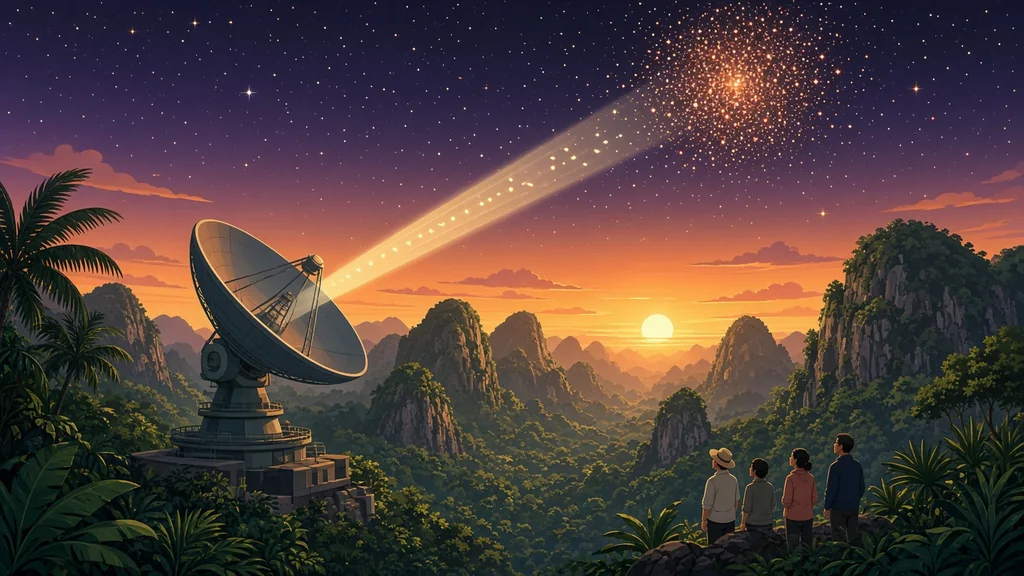
- Frank Drake, with help from Carl Sagan and others, beamed a short binary message from the giant Arecibo radio telescope toward the star cluster M13, about 25,000 light-years away.
- Why it matters
- It remains the best-known deliberate signal sent from Earth, and later debates over "messaging extraterrestrial intelligence" (METI) often cite dark-forest-style risks.
- When and where
- March 2024, Netflix (US)
- What happened
- The English-language adaptation created by David Benioff, D. B. Weiss, and Alexander Woo brought Liu's story to a mass American audience.
- Why it matters
- Search interest in the hypothesis jumped as viewers looked up the ideas behind the plot, which is one reason it now ranks among the most-read astrobiology topics.
Criticisms
- Detection is hard. Many scientists note that our own leakage of radio and TV signals fades quickly with distance, so hiding may not even be necessary.
- Assumes aggression. The model treats interstellar politics like a one-shot prisoner's dilemma. Repeated interaction or the huge cost of attacking across light-years could favor caution rather than first strikes.
- No evidence. Like other Fermi paradox answers, it is a scenario, not a tested theory.
Related concepts
Compare it with the Great Filter, which says something stops civilizations before they spread, the Drake equation, the Kardashev scale, and deterrence theory from Cold War strategy.
Frequently asked questions
- Is the dark forest hypothesis a scientific theory?
- No. It is a speculative answer to the Fermi paradox that comes from fiction and cannot currently be tested.
- Did Liu Cixin invent the idea?
- He popularized and named it. Concerns about dangerous contact with aliens existed earlier among astronomers and science-fiction writers.
- Has Earth already revealed itself?
- Earth has sent a few deliberate signals and leaks weak radio emissions, but most of that leakage would be very hard to detect at interstellar distances.