
How advanced could a civilization get, and how would we even measure it? In 1964 the Soviet astrophysicist Nikolai Kardashev proposed a blunt answer: count the energy it uses. The result, the Kardashev scale, is now a staple of astronomy talks, science fiction, and late-night internet rabbit holes.
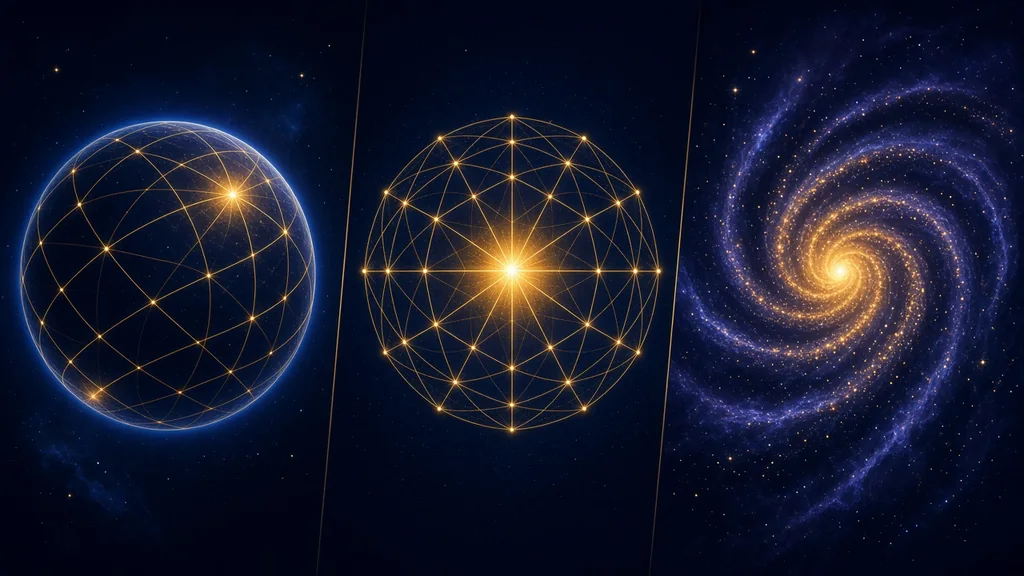
The three types
Kardashev's original paper, "Transmission of Information by Extraterrestrial Civilizations," described three levels.
- Type I uses energy on the scale of its home planet, roughly all the sunlight that reaches it.
- Type II uses energy on the scale of its star, for example by surrounding it with collectors.
- Type III uses energy on the scale of its entire galaxy.
Each step is a jump of about ten billion times. Kardashev was thinking about which civilizations might be powerful enough to send signals we could detect.

Sagan's formula and where we stand
Carl Sagan later suggested a continuous version so civilizations could sit between types. His formula is K = (log10 P − 6) / 10, where P is power in watts. On this version, Type I is about 10^16 watts, Type II about 10^26 watts, and Type III about 10^36 watts.

In the 1970s Sagan estimated humanity at about 0.7. Using today's world energy use, estimates come out a little above that, around 0.72 to 0.73. We are not yet Type I.
Key idea
The Kardashev scale is not a measure of wisdom or culture. It only ranks raw energy use, which makes it useful for thinking about what might be visible across space.
The Dyson sphere connection
A Type II civilization is often pictured building a Dyson sphere, an idea from physicist Freeman Dyson's 1960 paper in Science. Dyson pointed out that a structure capturing a star's light would re-emit waste heat as infrared, which telescopes could look for. That turned the scale into something astronomers could test.
US searches for super-civilizations
- When and where
- 2015, Pennsylvania State University
- What happened
- Roger Griffith, Jason Wright, and colleagues searched data from NASA's WISE infrared telescope for galaxies glowing with too much mid-infrared heat, a possible sign of a Type III civilization. Among roughly 100,000 galaxies they found no clear candidates.
- Why it matters
- It put a real observational limit on how common galaxy-spanning civilizations could be.
- When and where
- 2015–2018, Kepler mission data
- What happened
- The star KIC 8462852 showed strange, deep dips in brightness. Some astronomers, including Jason Wright, noted that an alien megastructure was one hypothesis among several. Follow-up observations, partly crowdfunded, showed the dimming changed with color, which pointed to dust rather than a solid structure.
- Why it matters
- It is the best-known case where the Kardashev and Dyson ideas met a real star, and natural causes won.
Criticisms
The scale assumes advanced civilizations keep using more energy, which may not hold if efficiency improves or growth stops. It also says nothing about whether such civilizations exist. That question belongs to the Fermi paradox, the Drake equation, and ideas like the Great Filter and the dark forest hypothesis.
Related concepts
Energy use at stellar scales also runs into the limits described by the second law of thermodynamics, since every useful process produces waste heat.
Frequently asked questions
- What type of civilization is Earth?
- Not yet Type I. Using Sagan's formula, humanity is around 0.7 on the scale.
- Has anyone found a Type II or Type III civilization?
- No. Searches for unusual infrared heat and odd stars have so far found natural explanations.
- Who invented the Kardashev scale?
- Soviet astrophysicist Nikolai Kardashev proposed it in 1964; Carl Sagan later added the decimal version.