
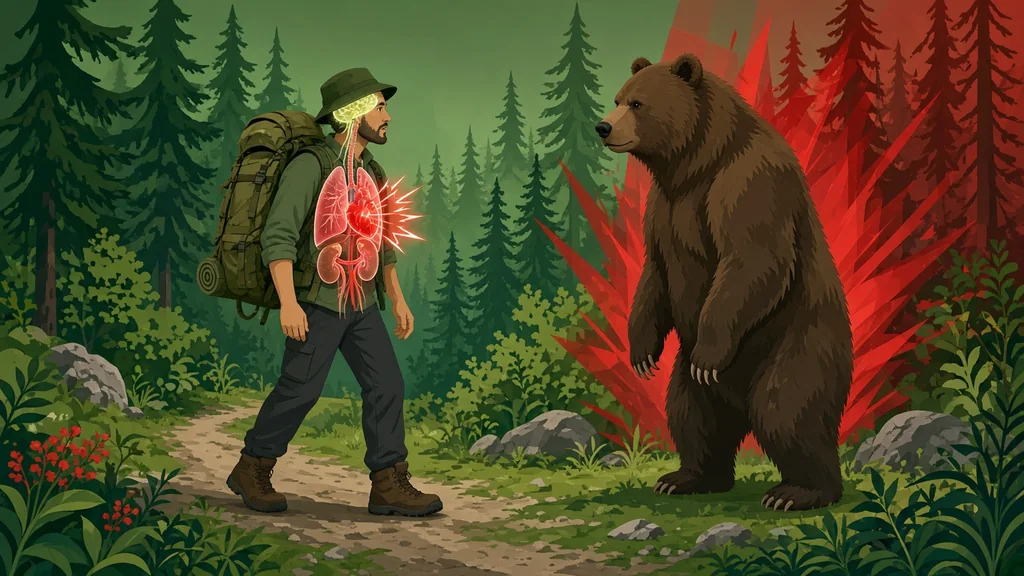
Why does your heart pound before a big presentation even though no one is in danger? Your body is running an ancient survival program designed for physical threats. That program is the fight-or-flight response, and it fires whether the threat is a bear on a trail or an email from your boss.
How it works
When the brain perceives danger, the amygdala sends a distress signal to the hypothalamus, which acts like a command center. The hypothalamus activates the sympathetic nervous system and signals the adrenal glands to release adrenaline (epinephrine). Within seconds:
- the heart beats faster and blood pressure rises;
- breathing speeds up and airways open;
- stored sugar and fat are released for quick energy;
- blood flow shifts toward large muscles;
- digestion slows and pupils widen.
If the threat continues, a second pathway raises cortisol to keep the body on alert.
Key idea
The response is automatic and fast, and it starts before the conscious mind has finished evaluating the threat. That is why people often react before they can explain why.

Origin of the idea
Walter Bradford Cannon, chair of the Department of Physiology at Harvard Medical School, first described the response in 1914 and wrote of "the necessities of fighting or flight" in his 1915 book Bodily Changes in Pain, Hunger, Fear and Rage. Researchers later added freezing as a third common reaction.
US cases
- When and where
- 1982, Lawrenceville, Georgia
- What happened
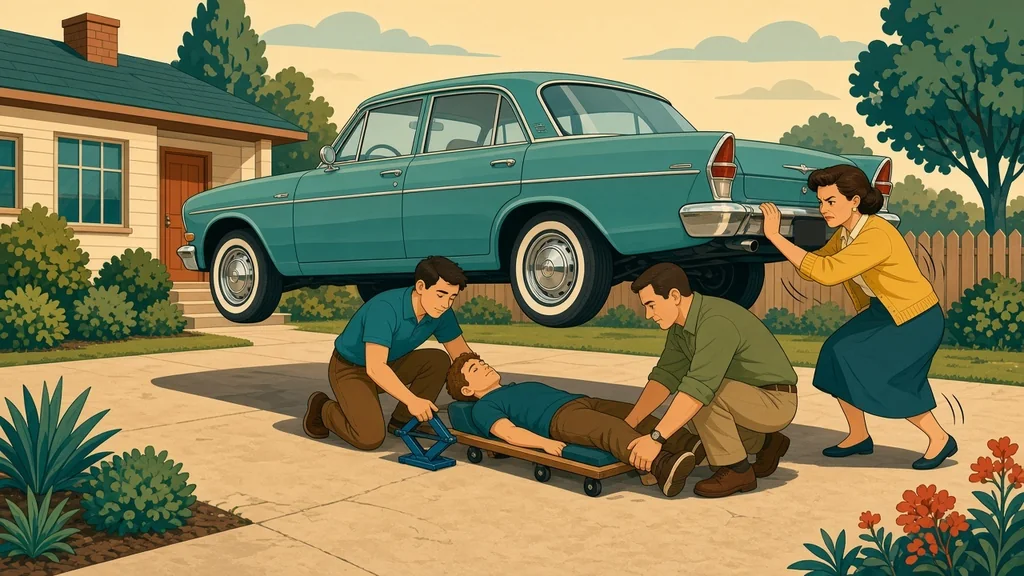
- Tony Cavallo was working under a 1964 Chevrolet Impala when it fell off its jacks and trapped him. His mother, Angela Cavallo, lifted the car high enough and long enough for two neighbors to replace the jacks and pull him out.
- Why it matters
- The story is a widely cited example of "hysterical strength," which is commonly attributed to the adrenaline surge of the fight-or-flight response, though such feats are hard to study scientifically.
- When and where
- 2000, University of California, Los Angeles
- What happened
- Psychologist Shelley E. Taylor and her team published a Psychological Review article arguing that females often respond to stress not only with fight or flight but by protecting offspring and seeking social support, a pattern they called "tend-and-befriend" and linked to oxytocin.
- Why it matters
- The research challenged the idea that fight-or-flight is the single universal stress response.
Criticisms
- Too narrow: many people freeze, appease or seek others rather than fight or flee.
- Based largely on males: early stress research mostly studied male animals and men, which the tend-and-befriend work highlighted.
- Modern mismatch: the response evolved for brief physical dangers, but modern stressors such as debt or deadlines can keep it switched on for long periods, with health costs.
Related concepts
Hans Selye's general adaptation syndrome describes what happens when stress lasts, and Selye's and Lazarus's stress theories add the role of appraisal. Polyvagal theory proposes additional states such as shutdown. When the alarm system stays stuck after trauma, it can contribute to PTSD. Therapies such as dialectical behavior therapy teach skills to calm intense physical arousal.
Study material (Korean): 「스트레스의 개념과 스트레스 대처방안과 스트레스의 유형 및 증상」
Frequently asked questions
- What happens in the body during fight or flight?
- Adrenaline is released, the heart and breathing speed up, energy is released into the blood and muscles get more blood flow, while digestion slows.
- Is anxiety the fight-or-flight response?
- Anxiety often involves the same physical changes, triggered by perceived rather than immediate physical threats.
- How can you calm the fight-or-flight response?
- Slow breathing, physical activity and relaxation techniques can activate the body's calming systems and lower arousal.