
Your doctor mentions a small once-a-day tablet for a slow urine stream, and your cousin takes the same one for thinning hair. Is it really the same medicine, and what should you ask before the first dose?
This guide uses the MedlinePlus finasteride page (AHFS patient information, last revised June 15, 2026). It is general information, not a prescription; your doctor and pharmacist set your plan. If you want to learn more about urinary symptoms that bring men to the doctor, take a closer look at blood in the urine.
What finasteride is used for
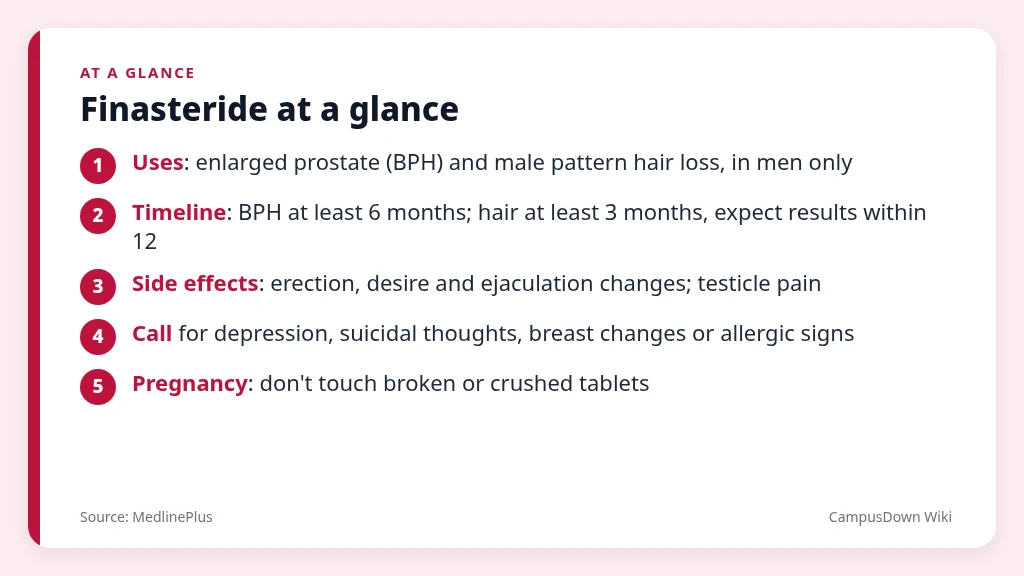
MedlinePlus says finasteride treats benign prostatic hypertrophy (BPH, an enlarged prostate) and male pattern hair loss (gradual thinning, a receding hairline or balding on top). It is a 5-alpha reductase inhibitor: for BPH it blocks the body's production of a male hormone that causes the prostate to enlarge, and for hair loss it blocks a male hormone in the scalp that stops hair growth. The page lists the brands Propecia, Proscar and Entadfi (a combination with tadalafil). MedlinePlus says finasteride is only for use in men.

How it is taken
It is a tablet taken once a day, with or without food, at about the same time each day. Take it exactly as directed. If you miss a dose, skip it and continue as scheduled; never double up.
How long it takes
- BPH: MedlinePlus says finasteride may control your condition but is not a one-time fix, and it may take at least 6 months before symptoms improve. Keep taking it even if you feel well, and don't stop without talking to your doctor.
- Hair loss: at least 3 months before improvement, and improvement is expected during the first 12 months. If you notice no improvement after 12 months, further treatment probably will not help; talk to your doctor. It only slows hair loss while you take it, and you will probably lose any hair that grew back within about 12 months after stopping.
Safety and who should be careful
- Pregnancy handling: MedlinePlus says women who are or may become pregnant should not touch broken or crushed finasteride tablets, because touching them may harm the fetus. If it happens, wash the area right away with soap and water and call a doctor.
- Tell your doctor about liver disease or prostate cancer before you start.
- Fertility and sex: it may decrease fertility in men, and decreased sexual desire, ejaculation problems and inability to have or keep an erection may occur during and after treatment. Talk with your doctor about these risks.
- Lab tests: tell your doctor and the lab you take finasteride before any lab test.
Side effects
Tell your doctor if severe or lasting: erection problems, lower sexual desire, ejaculation problems (including less semen) and testicle pain.
Get help now if
Call your doctor right away for new or worsening depression, or thoughts about harming or killing yourself. In the US you can call or text 988 anytime. Also call for breast changes (enlargement, lumps, pain or nipple discharge) or allergic signs such as rash, hives, swelling of the lips or face, or trouble breathing or swallowing, and call 911 for trouble breathing.
Cancer notes
MedlinePlus says taking finasteride may increase the risk of high-grade prostate cancer or breast cancer. Talk to your doctor about these risks. Keep appointments for checks and lab tests.
Overdose and storage
Store at room temperature away from heat and moisture (not the bathroom), keep it away from children, and use a take-back program for leftovers. In an overdose, call poison control at 1-800-222-1222, or 911 if someone has collapsed or can't be awakened. Don't share your medication. See the brown bag medication review and polypharmacy and the Beers Criteria.
Questions for your doctor or pharmacist
- Is finasteride the right choice for my BPH or hair loss, and what else could I try?
- How will we know it's working, and when will we decide to continue or stop?
- How do I handle and store tablets around someone who is pregnant?
- What should I do if I notice mood changes or sexual side effects?
- Do I need prostate checks while I'm on it?
Example scenario: the crushed tablet
- Who
- Roderick, 61, a retired surveyor in Boise, Idaho, took finasteride for an enlarged prostate.
- What happened
- One morning a tablet crumbled in his hand while his daughter, who was pregnant, helped him sort the pill box.
- How it felt
- He worried he had put her at risk.
- What they did
- He remembered the pharmacist's warning, washed the area, had his daughter wash with soap and water and called her doctor and his pharmacist. They also moved his tablets into a separate container. Roderick kept his appointments and discussed his urine flow and any side effects at each visit.
- How it turned out
- Roderick said the pharmacist's handout saved him from panicking.
This is an illustrative example, not a real patient or a review.
Roderick's story is an illustrative example. Pregnant women and people who could become pregnant should not touch broken or crushed tablets.
Most-asked questions about finasteride
What are finasteride side effects in men?
Erection problems, lower sexual desire, ejaculation changes and testicle pain; call right away for breast changes, depression or allergic signs.
Why people ask: "finasteride side effects men" is #2 for "finasteride side effects" (US autocomplete, November 2026).
What are finasteride side effects in women?
MedlinePlus says finasteride is only for use in men, and pregnant women or those who could become pregnant should not touch broken or crushed tablets.
Why people ask: "finasteride side effects women" is #3 for "finasteride side effects" (US autocomplete, November 2026).
Are finasteride side effects permanent?
MedlinePlus says sexual problems may occur during and after treatment; it doesn't say how long they last, so talk to your doctor.
Why people ask: "finasteride side effects permanent" is #5 for "finasteride side effects" (US autocomplete, November 2026).
Can finasteride cause hair loss?
It is used to treat male pattern hair loss, not cause it; hair that grew back is likely lost within about 12 months of stopping.
Why people ask: "finasteride side effects hair loss" is #6 for "finasteride side effects" (US autocomplete, November 2026).
Does finasteride affect the prostate?
It treats BPH by blocking a hormone that enlarges the prostate, and it may increase the risk of high-grade prostate cancer, so keep your checkups.
Why people ask: "finasteride side effects prostate" is #7 for "finasteride side effects" (US autocomplete, November 2026).
What percentage of men get finasteride side effects?
MedlinePlus doesn't give percentages; ask your doctor or pharmacist about the numbers in the prescribing information.
Why people ask: "finasteride side effects percentage" is #8 for "finasteride side effects" (US autocomplete, November 2026).
What are finasteride side effects in females?
It isn't for females; pregnant women should avoid touching broken tablets, which could harm a fetus.
Why people ask: "finasteride side effects in females" is #9 for "finasteride side effects" (US autocomplete, November 2026).
Does finasteride cause cancer?
MedlinePlus says it may increase the risk of high-grade prostate cancer or breast cancer; talk to your doctor about the risks.
Why people ask: "finasteride side effects cancer" is #10 for "finasteride side effects" (US autocomplete, November 2026).
What are finasteride uses in males?
Treating BPH and male pattern hair loss.
Why people ask: "finasteride uses in males" is #2 for "finasteride uses" (US autocomplete, November 2026).
Is finasteride used for women?
No; MedlinePlus says finasteride is only for use in men.
Why people ask: "finasteride uses for women" is #3 for "finasteride uses" (US autocomplete, November 2026).
What are finasteride uses and side effects?
BPH and male pattern hair loss; sexual side effects, testicle pain, breast changes and mood warnings.
Why people ask: "finasteride uses and side effects" is #4 for "finasteride uses" (US autocomplete, November 2026).
Is finasteride used for hair?
Yes, for male pattern hair loss; expect at least 3 months before improvement and results within 12 months.
Why people ask: "finasteride uses for hair" is #5 for "finasteride uses" (US autocomplete, November 2026).
What are finasteride uses for men?
Enlarged prostate and male pattern hair loss.
Why people ask: "finasteride uses for men" is #6 for "finasteride uses" (US autocomplete, November 2026).
What are finasteride uses in urology?
Treating an enlarged prostate (BPH); it blocks a hormone that causes the prostate to grow and may take at least 6 months to improve symptoms.
Why people ask: "finasteride uses in urology" is #7 for "finasteride uses" (US autocomplete, November 2026).
Related on CampusDown
You can learn more about the medicines hub and check it for yourself in the brown bag medication review. For urinary symptoms in detail, see blood in the urine, and for mood warnings see depression in older adults.
Frequently asked questions
- What is finasteride for?
- BPH and male pattern hair loss, in men only.
- How long until it works?
- At least 6 months for BPH, at least 3 months for hair with results expected in 12.
- Who shouldn't handle broken tablets?
- Pregnant women and women who could become pregnant.
- What side effects need a call?
- Depression or suicidal thoughts, breast changes, allergic signs, and persistent sexual or testicle problems.
- What happens if I stop?
- Hair loss resumes and regrown hair is likely lost within about a year; talk to your doctor before stopping.
Finasteride can help with BPH and male pattern hair loss, but it takes months, it has sexual and mood risks, and it must be handled carefully around pregnancy. Take it daily as directed, keep your checkups and call your doctor for depression, breast changes or allergic signs.
Browse more guides like this in the Medicines hub.
This article is for general education and does not replace advice from your own doctor, nurse or pharmacist.